


Daylight Savings 2026 Australia: Key Dates, States, and What to Expect. Daylight saving time returns in 2026 for much of Australia, bringing the familiar routine of moving clocks forward in spring and back in autumn. Knowing the exact dates, which states are affected, and how the change impacts work, travel and daily life will help you plan ahead and avoid confusion.
What Is Daylight Saving Time in Australia?
Daylight saving time (DST) is when clocks are moved forward by one hour to make better use of daylight during the warmer months, giving lighter evenings at the cost of darker mornings. In Australia, only some states and territories participate in daylight saving, while others stay on standard time all year.
New South Wales, Victoria, the Australian Capital Territory, South Australia and Tasmania observe daylight saving, shifting from standard time to daylight time in spring and back again in autumn. Queensland, Western Australia and the Northern Territory do not change their clocks, which is why time differences between states can change twice a year.
If you want a simple visual overview of how DST works across the country, the interactive overview at timeanddate.com’s Australia daylight saving page is a useful reference.
Daylight Savings 2026 Start and End Dates
Australia’s daylight saving period spans the warmer months, crossing from one calendar year into the next. For the 2025–2026 season, which is the one that finishes in 2026, and the 2026–2027 season that begins in October 2026, the key dates are:
- End of the 2025–2026 daylight saving period:
- Clocks go back one hour at 3:00 am daylight time to 2:00 am standard time on Sunday 5 April 2026 in NSW, ACT, Victoria, South Australia and Tasmania.
- Start of the 2026–2027 daylight saving period:
- Clocks go forward one hour at 2:00 am standard time to 3:00 am daylight time on Sunday 4 October 2026 in the same daylight‑saving states and territories.
In other words, you “gain” an hour’s sleep in April when clocks move back, and you “lose” an hour in October when clocks move forward. The daylight saving season runs for about six months, from early October to early April each year.
Official state information, such as the NSW Government’s Daylight saving in NSW: When it starts and ends page, confirms these dates and times for 2025 and 2026.
Which States and Territories Observe Daylight Saving in 2026?
Australia is split between daylight saving and non‑daylight saving jurisdictions. In 2026, the following regions observe daylight saving:
- New South Wales (NSW) – including Sydney and most of the state.
- Australian Capital Territory (ACT) – Canberra follows the same DST period as NSW.
- Victoria (VIC) – Melbourne and regional Victoria use daylight saving.
- South Australia (SA) – Adelaide and SA towns move to Australian Central Daylight Time.
- Tasmania (TAS) – the entire state observes daylight saving.
- Lord Howe Island – observes a 30‑minute daylight saving adjustment, not a full hour.
- Norfolk Island – has its own DST schedule aligned with the same start and end dates.
The following states do not observe daylight saving:
- Queensland (QLD) – stays on Australian Eastern Standard Time (AEST) all year.
- Western Australia (WA) – remains on Australian Western Standard Time (AWST).
- Northern Territory (NT) – remains on Australian Central Standard Time (ACST).
Because of these differences, the time gap between states changes when clocks shift. For example, during daylight saving, Sydney and Melbourne are usually one hour ahead of Brisbane, and Adelaide is typically half an hour behind Sydney but half an hour ahead of Brisbane.
Daylight Savings 2026 by State: Quick Reference
Understanding how Daylight Savings 2026 looks in each region helps you plan calls, travel, and business across state lines.
New South Wales (NSW) and Australian Capital Territory (ACT)
- End DST 2025–26: Clocks go back 1 hour at 3:00 am AEDT to 2:00 am AEST on Sunday 5 April 2026.
- Start DST 2026–27: Clocks go forward 1 hour at 2:00 am AEST to 3:00 am AEDT on Sunday 4 October 2026.
- Official details: NSW daylight saving guide and ACT’s page on public holidays, school terms and daylight saving.
Victoria (VIC)
- Uses the same dates and times as NSW/ACT.
- End DST 2025–26: 5 April 2026; Start DST 2026–27: 4 October 2026.
- Business Victoria’s daylight saving page emphasises planning around the clock changes for rostering and trading hours.
Tasmania (TAS)
- Follows the same DST schedule as NSW and Victoria.
- The Tasmanian Government’s Daylight saving in Tasmania page confirms the first Sunday in October and first Sunday in April dates for future years.
South Australia (SA)
- Also uses the same DST period, but runs on Australian Central Daylight Time (ACDT), which is 30 minutes behind NSW/VIC during daylight saving.
Queensland (QLD), Western Australia (WA) and Northern Territory (NT)
- No daylight saving: clocks do not change on 5 April or 4 October 2026.
- This means that during the DST period, the time difference between these states and daylight‑saving states is larger than during winter.
For quick confirmation of local clock changes, city‑specific pages like Clock changes in Sydney 2026 and timeanddate’s Queensland overview are helpful.
How the 2026 Clock Changes Affect Your Daily Routine

Daylight Savings 2026 can subtly reshape daily life, especially in the first week after the clocks change. When clocks go forward in October, evenings become lighter, making it easier to enjoy after‑work activities but initially making mornings darker. When clocks go back in April, mornings feel lighter but evenings darken earlier.
Common routine impacts include:
- Sleep patterns: Losing an hour in October can leave you feeling slightly jet‑lagged if you don’t adjust your sleep schedule beforehand.
- Children’s routines: Bedtime and wake‑up times may feel out of sync for a few days, especially for younger kids.
- Pets: Feeding and walking times may feel “off” to pets used to fixed times.
- Exercise and socialising: Lighter evenings during DST encourage outdoor exercise, barbecues and after‑work social time.
Guides like ABC News’ “When does daylight saving time start in Australia? Here’s your pocket guide” include practical tips for easing into the switch, such as gradually shifting bedtime by 10–15 minutes in the days before the change.
Daylight Saving and Work, Business, and Travel in 2026
For businesses and travellers, daylight saving has concrete implications that go beyond adjusting your alarm clock.
Work and meetings
- Organisations with staff or clients across multiple states must account for changing time differences, especially when some offices are in QLD, WA or NT (no DST) and others in NSW, VIC or SA (DST).
- Scheduling software usually updates automatically, but it’s still wise to confirm meeting times with interstate partners around the changeover dates.
Trading hours and rostering
- Retailers and hospitality venues in shopping strips or entertainment precincts often see increased evening foot traffic after clocks go forward, while early‑morning businesses may experience a slight dip as people adjust.
- Business Victoria highlights that employers should double‑check award and enterprise agreement provisions when rostering around the hour that “repeats” as clocks go back in April, to ensure staff are paid correctly.
Travel and transport
- Airlines, long‑distance coaches and rail services schedule around daylight saving changes, often with slight adjustments in departure and arrival times on changeover days.
- If you’re flying interstate around 5 April 2026 or 4 October 2026, always check your itinerary close to the date—most carriers list times in local time for departure and arrival cities.
For businesses, daylight saving is just one of several timing shifts they need to stay on top of in 2026, alongside network outages, airline schedules and changing customer behaviour. If you’re looking at operational risk more broadly, this breakdown of Telstra Outages Hit Australia | What Happened and Who’s Affected shows how unexpected connectivity issues can disrupt trading days, while Qantas Frequent Flyer Status Credits: What’s Changing and Why It’s Trending explores how airlines are reshaping loyalty and travel patterns that often cross multiple time zones and daylight saving boundaries.
Public Holidays, School Terms, and Daylight Savings 2026 Overlap
Daylight Savings 2026 intersects with school terms and public holidays in ways worth noting for families and businesses.
- In NSW and the ACT, the end of daylight saving on 5 April 2026 falls close to Easter and school holiday periods for many students, which can affect travel plans and sleep schedules.
- The start of daylight saving on 4 October 2026 occurs during the spring school holidays in many states, so families returning from trips may arrive home right as the clock change occurs.
- Public holiday calendars, like the NSW Public Holidays 2026 & 2027 guide from the Australian Retailers Association, help businesses align staffing and trading hours with both holidays and DST shift.
The ACT Government’s combined page on public holidays, school terms and daylight saving is a good template for seeing how these elements line up in a single view.
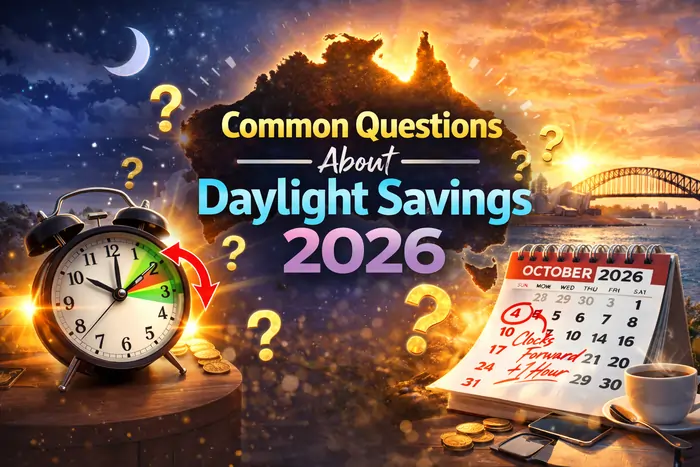
Common Questions About Daylight Savings 2026
Do we “lose” or “gain” an hour in 2026, and when?
- You gain an hour’s sleep when daylight saving ends on Sunday 5 April 2026, as clocks go back one hour.
- You lose an hour’s sleep when daylight saving starts on Sunday 4 October 2026, as clocks go forward.
A simple way to remember it:
- Spring (October) – clocks spring forward (lose an hour)
- Autumn (April) – clocks fall back (gain an hour)
What happens to digital devices and smart clocks?
Most smartphones, computers and connected devices update automatically as long as they are set to the correct time zone and have automatic time updates turned on. Manual clocks, wall clocks, microwaves and ovens usually need to be adjusted by hand.
What about daylight saving in Queensland or Western Australia?
Queensland, Western Australia and the Northern Territory do not have daylight saving in 2026, so clocks stay the same and only the time difference relative to other states changes.
Facebook posts and community guides summarising “daylight saving dates for 2025 and 2026” often reiterate these basics to help people avoid missed appointments during the switch.
Safety and Seasonal Reminders Tied to Daylight Savings 2026
Many Australian safety campaigns use the daylight saving clock change as a handy reminder for other household checks.
Common recommendations include:
- Test and replace smoke alarm batteries when you change the clocks in April and October, or upgrade to long‑life alarms if required.
- Review home emergency plans before summer, particularly for bushfire‑prone areas, as daylight saving begins and warmer, drier weather approaches.
- Check outdoor lighting and security timers, so they line up with the new sunset times and keep entrances well lit.
State government pages, such as Tasmania’s daylight saving guidance, often link daylight saving to broader seasonal safety and preparedness campaigns.
Will Daylight Saving Change Again After 2026?
Daylight Savings 2026 has been debated in Australia for decades, with Queensland and Western Australia in particular holding referendums in the past and trialling daylight saving without adopting it permanently. As of 2026, there are no confirmed changes to which states and territories use daylight saving or to the standard start and end pattern (first Sunday in October to first Sunday in April).
Any major shift—such as Queensland adopting daylight saving or a federal attempt to standardise DST—would require legislation and, in some cases, could be put to public vote. That’s why official sources like state government websites and timeanddate’s Australia daylight saving calendar recommend double‑checking start and end dates each year, rather than relying on assumptions.
Final Thoughts on Daylight Savings 2026 in Australia
Daylight Savings 2026 in Australia follows the now‑familiar pattern: clocks go back one hour on Sunday 5 April 2026, then forward one hour on Sunday 4 October 2026 in NSW, ACT, Victoria, South Australia, Tasmania and a handful of external territories. Queensland, Western Australia and the Northern Territory again sit out, staying on standard time year‑round.
For most people, being ready simply means marking the dates in your calendar, letting your body clock adjust, and double‑checking interstate meeting or travel times around the changeovers. For businesses, schools and families, it’s a chance to review schedules, safety checks and holiday plans so that the shift in sunlight works for you rather than catching you off guard.
Bookmarking official resources like NSW’s daylight saving guide, Business Victoria’s daylight saving page and the national overview at timeanddate.com will make it easy to confirm details as the April and October 2026 dates approach.