

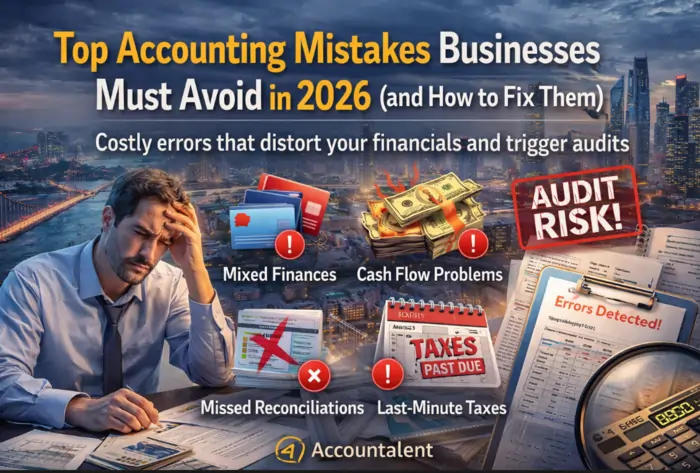
In 2026, the most dangerous accounting mistakes aren’t exotic—they’re the basic errors busy owners keep repeating: mixing personal and business finances, ignoring cash flow, skipping reconciliations, and treating taxes as a last‑minute surprise. These mistakes quietly distort your numbers, create audit risk, and lead to bad decisions.
This guide highlights the top accounting mistakes businesses must avoid in 2026 and, more importantly, how to fix each one using simple systems, modern tools, and—when needed—the support of a professional accounting firm or outsourced finance partner like Accountalent.
It also shows where this article connects with your 2026 guides on whether you really need a firm, statewide “best firm” picks, and in‑house vs outsourced strategies.
Why These Mistakes Matter More in 2026
The stakes are higher this year for three reasons:
- Digital payments and subscriptions mean more small, easy‑to‑miss transactions.
- Many businesses have remote or hybrid teams spread across states and tools.
- Lenders, investors, and tax authorities expect clean, consistent financials.
If your bookkeeping or accounting process can’t keep up, errors pile up fast. Understanding the top mistakes gives you a checklist you can use to clean up your books and prevent problems before they become crises.
Do You Really Need an Accounting Firm for Your Business in 2026 to Avoid These Mistakes?
You don’t need a full accounting firm for every small error—but as your business grows, it gets harder to avoid these mistakes without professional help. The core question is: Do you really need an accounting firm for your business in 2026 or can you still manage with DIY tools and occasional help?
If you’re already struggling with late reconciliations, confusing reports, and tax surprises, this article is a warning sign. For a deeper decision framework, you can also read your dedicated 2026 guide on whether you actually need an accounting firm for your business.
Top Accounting Mistakes Businesses Must Avoid in 2026
Mistake 1: Mixing Personal and Business Finances
One of the most common—and damaging—mistakes is using the same bank or credit card accounts for both business and personal spending.
Why it’s a problem:
- Blurs your profitability and makes it hard to see real performance.
- Increases your audit risk because deductions are harder to prove.
- Makes bookkeeping and year‑end tax work slower and more expensive.
How to fix it:
- Open dedicated business bank and credit card accounts.
- Put policies in place: no personal expenses on business cards (and vice versa).
- Work with a bookkeeper or firm to clean up and reclassify old mixed transactions.
Mistake 2: Ignoring Cash Flow
Many owners focus on profit and forget that cash flow keeps the lights on.
Why it’s a problem:
- You can show a profit on paper but still run out of cash.
- Late customer payments and early vendor payments can create gaps.
- You’re more likely to miss payroll or critical bills.
How to fix it:
- Track accounts receivable (A/R) and accounts payable (A/P) regularly.
- Create a simple 13‑week cash‑flow forecast and update it monthly.
- Review cash‑flow reports with your accountant or outsourced provider.
Mistake 3: Skipping Regular Reconciliations
If you don’t regularly match your books to your bank and credit card statements, errors multiply.
Why it’s a problem:
- Duplicate or missing transactions go unnoticed.
- Fraud or unauthorized charges are harder to catch.
- Your reported cash balance may be wrong, leading to bad decisions.
How to fix it:
- Reconcile all bank, credit card, and loan accounts at least monthly.
- Use modern accounting software with built‑in reconciliation tools.
- Assign responsibility to a bookkeeper or firm and create a recurring task.
Mistake 4: Treating Taxes as a Once‑a‑Year Event
Many businesses still treat taxes as a single annual crisis instead of a predictable, manageable process.
Why it’s a problem:
- Leads to surprise tax bills and cash‑flow crunches.
- Increases the risk of penalties and interest for missed payments.
- Means you miss out on planning opportunities and deductions.
How to fix it:
- Set aside a percentage of revenue or profit for tax reserves each month.
- Work with a tax‑savvy accountant on quarterly estimates and planning.
- Keep documentation and receipts organized throughout the year, not just in April.
Mistake 5: Misclassifying Revenue and Expenses
Putting transactions in the wrong categories can distort your financials and taxes.
Why it’s a problem:
- Misstated profit and margins by product, service, or department.
- Incorrect COGS vs operating expense splits.
- Potential issues with capital vs expense treatment for assets.
How to fix it:
- Use a clear, well‑designed chart of accounts tailored to your business.
- Review classifications regularly with your accountant.
- For complex areas (like SaaS revenue recognition or R&D), consult experts.
Mistake 6: Letting Backlogs Build Up
Waiting months to record transactions or close books turns minor issues into major clean‑ups.
Why it’s a problem:
- You’re always making decisions using old numbers.
- Clean‑up projects become expensive and time‑consuming.
- Tax filings may be rushed or based on inaccurate data.
How to fix it:
- Establish a monthly close process with due dates and checklists.
- Allocate dedicated time each week for updating your accounting system.
- Consider outsourcing if you can’t consistently keep up.
Mistake 7: Relying Only on Spreadsheets
Spreadsheets are flexible, but they’re easy to break.
Why it’s a problem:
- Higher risk of formula errors and version confusion.
- Harder to enforce controls and audit trails.
- Difficult to integrate with bank feeds, payroll, and invoicing tools.
How to fix it:
- Move your core accounting into cloud software (e.g., QuickBooks Online, Xero).
- Use spreadsheets only for what‑if scenarios and analysis, not your general ledger.
- Let a professional firm help design your system architecture.
Mistake 8: Not Reviewing Financial Reports
Some owners diligently record transactions but rarely look at the resulting reports.
Why it’s a problem:
- Opportunities to cut costs or grow revenue are missed.
- Problems in profitability or cash flow stay hidden.
- You can’t speak confidently to banks or investors.
How to fix it:
- Review your P&L, balance sheet, and cash‑flow statement monthly.
- Track a few key KPIs (like gross margin, A/R days, and cash runway).
- Discuss trends with your accountant or outsourced CFO.
Mistake 9: DIY Forever, Even as Complexity Grows
What worked when you were tiny often fails as you grow.
Why it’s a problem:
- Founder time gets wasted on low‑value bookkeeping tasks.
- Mistakes increase as transactions and rules multiply.
- You miss opportunities to structure finances more strategically.
How to fix it:
- Periodically ask: “Is our size and complexity beyond DIY?”
- When the answer is yes, consider partnering with a firm like Accountalent that can take over bookkeeping, tax, and advisory in a structured way.
- Use your “Do you really need a firm?” guide to decide whether it’s time.
Mistake 10: Ignoring Structural Decisions (In‑House vs Outsourced)
Some businesses patch problems with ad‑hoc fixes instead of addressing their overall accounting structure.
Why it’s a problem:
- You may be overpaying for underused internal staff—or underinvesting in outside help.
- Responsibilities are unclear, leading to gaps and duplication.
- You don’t have a roadmap for how your finance function should grow.
How to fix it:
- Step back and decide whether in‑house, outsourced, or hybrid accounting fits your current stage.
- The 2026 comparison of in‑house vs outsourced accounting in California offers a structured way to make this call.
- Once you choose a model, align tools, processes, and staffing accordingly.
How a Firm Like Accountalent Helps Prevent These Mistakes
A modern firm such as Accountalent is built to prevent these issues by design:
- Implementing cloud systems and monthly closes so backlogs don’t pile up.
- Handling tax planning, R&D credits, and compliance proactively.
- Providing regular reporting and CFO‑style insight, so you’re never flying blind.
If you see several of these mistakes in your own business, that’s a strong sign it may be time to bring in professional help—whether through an outsourced model or a longer‑term accounting firm relationship.
For examples of firms that can play this role across California, you can review the 2026 list of the best accounting firms in California for businesses and startups.
Frequently Asked Questions
1. What’s the most common accounting mistake businesses still make in 2026?
The top mistake is mixing personal and business finances, which distorts profitability, complicates taxes, and increases audit risk.
2. How often should I reconcile my accounts to avoid errors?
Most businesses should reconcile all bank, credit card, and loan accounts monthly, and some high‑volume operations benefit from weekly checks.
3. Can I fix past accounting mistakes myself, or do I need a professional?
You can fix very simple errors yourself, but large backlogs or complex issues are best handled by a bookkeeper or accounting firm to avoid introducing new problems.
4. How do I know if my cash‑flow issues are an accounting problem or a business problem?
If your financial records are incomplete or outdated, fix accounting first. Once your numbers are accurate, you can see whether the real issue is low margins, slow collections, or overspending.
5. Are spreadsheets always bad for accounting?
Spreadsheets aren’t bad by themselves; they’re risky when used as your primary ledger. They’re better suited for analysis and planning on top of a proper accounting system.
6. What’s the fastest way to stop mixing personal and business expenses?
Open separate business accounts, start using them exclusively for the business, and work with an accountant to reclassify old mixed transactions.
7. How can I avoid surprise tax bills?
Set aside money for tax reserves each month, work with a professional on quarterly estimates, and keep your books current so projections are accurate.
8. Do I need accrual accounting, or is cash‑basis fine?
Very small, simple businesses can use cash‑basis accounting. If you have inventory, subscriptions, or investors, adopting accrual‑based accounting early is usually better.
9. How often should I review financial reports?
Review your P&L, balance sheet, and cash‑flow statement at least monthly, and more often if you’re in a high‑growth or cash‑sensitive phase.
10. Can outsourcing help me avoid these mistakes?
Yes. A strong outsourced partner implements disciplined processes, tools, and reviews that dramatically reduce the chance of repeated errors.
11. What should I look for in an accounting firm if I make a lot of these mistakes?
Look for firms experienced with cleanup projects, cloud migrations, and small‑business or startup clients, plus clear communication and fixed‑fee options.
12. How do accounting mistakes affect my ability to raise funding or get loans?
Messy books and inconsistent reports can delay or derail financing, because investors and lenders need confidence in your numbers.
13. Are all mistakes equally serious?
No. Some are minor, but others—like unfiled taxes, misreported income, or missing payroll obligations—can create serious legal and cash‑flow issues.
14. How do I prioritize which mistakes to fix first?
Start with issues that affect compliance and cash (tax filings, payroll, bank reconciliations), then move to classification and reporting improvements.
15. Should I document my accounting processes?
Yes. Simple process checklists for monthly close, reconciliations, and tax prep reduce human error and make it easier to train new staff or work with a firm.
16. What role does technology play in preventing mistakes?
Modern cloud accounting tools, bank feeds, and integrated apps reduce manual entry and help enforce consistent processes, lowering error rates.
17. How often should I revisit my accounting setup?
Review your systems, processes, and partner relationships annually, or sooner if you experience rapid growth or major business changes.
18. Can I use this mistakes list as a self‑audit checklist?
Yes. Treat each mistake as a yes/no question about your current process and note where you need changes, then decide whether to fix in‑house or with outside help.
19. When is it time to move from DIY to a professional firm?
It’s time when you’re repeatedly seeing several of these mistakes and don’t have the time or expertise to fix them, or when you’re preparing for lenders, investors, or expansion.
20. How does this article connect to the rest of my 2026 accounting guides?
Use this piece as a diagnostic tool for your current process, the “Do you really need a firm?” guide to decide on professional help, the best‑firm guide to explore options, and the in‑house vs outsourced guide to choose the right structure going forward.