

If you’re deciding between a traditional CPA vs outsourced accounting services, this guide explains what each one actually does, how they charge, and which option is the better fit for your business in 2026.
You’ll see when a stand‑alone CPA is enough, when it makes more sense to switch to a full outsourced accounting team, and how your choice should change as your company scales and becomes more complex.
This guide also shows how a specialist startup firm like Accountalent fits into the picture, plus links to deeper guides on outsourced accounting, in‑house vs outsourced finance, and bookkeeping vs accounting basics.
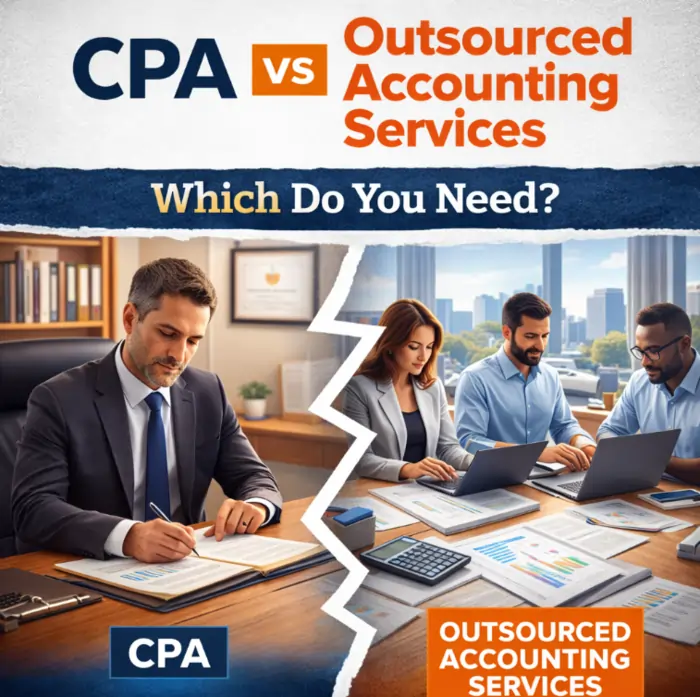
What Does CPA vs Outsourced Accounting Services Really Mean?
Many business owners use “CPA” and “outsourced accounting” like they’re the same thing, but they play different roles in your financial system. A CPA (Certified Public Accountant) is usually focused on tax, compliance, and high‑level advice, often working with you at specific points in the year.
Outsourced accounting services provide an entire finance function—from bookkeeping to monthly reporting to tax support—on an ongoing basis, acting like a full remote accounting department. Understanding this difference helps you choose the right setup now and avoid overpaying for support you don’t actually need.
If you want the bigger picture of outsourced options first, you can also read:
Outsourced Accounting Services in California (Complete 2026 Guide)
What a CPA Typically Does for Your Business
A CPA is a licensed professional trained in accounting, tax, and assurance services. For many small businesses, the CPA relationship centers on compliance and tax.
Common CPA roles include:
- Preparing and filing federal and state income tax returns
- Advising on tax strategy and how business decisions affect your tax bill
- Helping with audits, notices, and IRS or state correspondence
- Reviewing financial statements prepared by your bookkeeper or accountant
- Providing one‑off consulting on more complex transactions or structures
In this model, you or your team still handle the daily bookkeeping. The CPA steps in at key points—tax time, audits, major deals—rather than managing your books every month.
If your current question is more basic (what’s bookkeeping vs accounting vs tax), this guide helps:
Bookkeeping vs Accounting: What’s the Difference for Businesses?
What Outsourced Accounting Services Do
Outsourced accounting services cover a wider set of tasks on a recurring basis. Instead of only seeing a professional at tax time, you work with a remote team every month.
Typical outsourced accounting services include:
- Day‑to‑day bookkeeping: recording and reconciling all transactions
- Monthly financial statements and management reports
- Accounts payable and accounts receivable support
- Payroll entries and basic HR‑related accounting tasks
- Tax preparation and filing (or coordination with a tax specialist)
- Cash‑flow tracking, budgeting, and financial planning support
A strong outsourced accounting provider feels like a complete accounting department, but delivered remotely for a predictable monthly or annual price.
For founders in California comparing hiring internally vs external, this guide goes deeper:
In-House vs Outsourced Accounting in California: Which Is Better in 2026?
How Accountalent Fits Into This Choice
A specialist firm like Accountalent is built to offer the advantages of outsourced accounting with strong tax expertise baked in.
Instead of hiring a bookkeeper, then a separate CPA, and trying to coordinate them, you get one team that understands startups and small businesses from the ground up.
With Accountalent, you can:
- Get bookkeeping done accurately and on schedule each month
- Receive startup‑friendly tax preparation and planning help
- Rely on clean, investor‑ready financial statements as you grow
- Avoid building an in‑house team until you genuinely need one
For many founders, that makes the CPA vs outsourced accounting services choice much easier: a good outsourced firm like Accountalent gives you both the monthly engine and the tax brain together.
CPA vs Outsourced Accounting: Side‑by‑Side Comparison
| Factor | CPA | Outsourced Accounting Services |
|---|---|---|
| Main focus | Tax, compliance, high‑level advice | Day‑to‑day books + monthly reports + tax + advisory |
| Frequency | Mostly annual or quarterly | Monthly, weekly, sometimes daily |
| Handles bookkeeping? | Usually no—relies on your books | Yes—bookkeeping is part of the package |
| Handles tax returns? | Yes, core service | Often yes, or coordinated with tax specialists |
| Typical pricing | Hourly or project‑based | Fixed monthly or annual packages |
| Best for | Simple operations that mainly need tax filing | Growing businesses needing a “done‑for‑you” finance function |
If your books are solid and you only need tax help, a CPA‑only model may be enough. If your books are messy, late, or non‑existent—and you want ongoing financial clarity—outsourced accounting usually provides more value.
When a CPA Alone Is Enough
A stand‑alone CPA can be the right choice when:
- Your business has low transaction volume and simple operations
- You or your team can handle bookkeeping reliably in‑house
- You mostly need expert help for annual tax filing and occasional questions
- Your growth is stable, and you are not under pressure from investors or lenders for detailed monthly reporting
In this situation, it’s critical that bookkeeping is clean so your CPA isn’t spending time fixing basic records rather than focusing on higher‑value advice.
For help clarifying that bookkeeping foundation, this explainer is useful:
Bookkeeping vs Accounting: What’s the Difference for Businesses?
When Outsourced Accounting Services Make More Sense
Outsourced accounting becomes the smarter move when:
- You want consistent monthly financial statements without building a finance team
- Your books are always behind or full of errors
- You are expanding, hiring, or selling in multiple locations or states
- You want better visibility into cash flow, margins, and profitability
- You are planning to raise capital or approach lenders
In these situations, you do not just need a tax expert once a year—you need a full system that keeps you informed week by week. That is where an outsourced partner like Accountalent is designed to shine, especially for startups and small businesses.
If you want to dive deeper into the full outsourced model, you can read:
Outsourced Accounting Services in California (Complete 2026 Guide)
Cost Considerations: CPA vs Outsourced Accounting
Many owners assume a CPA is always cheaper, but that is not always true once you factor in everything.
With a traditional CPA model, you may pay:
- Hourly fees for advice and clean‑up work
- Extra charges if your books are messy or incomplete
- Separate fees to other professionals for bookkeeping or payroll
With outsourced accounting, you usually pay:
- A predictable monthly or annual fee for a clearly defined service package
- Less for surprise clean‑up jobs, because the provider maintains your books continuously
- One combined cost for bookkeeping, reporting, and often tax support
If you are already trying to decide whether to hire internally or outsource entirely, this guide is the next step:
In-House vs Outsourced Accounting in California: Which Is Better in 2026?
Risk, Compliance, and Peace of Mind
One of the biggest differences in the CPA vs outsourced accounting services decision is how risk is handled.
A CPA will help you stay compliant and respond to notices, but if your books are disorganized, they may charge more to fix them or rely on what you provide.
An outsourced accounting firm has a stronger incentive to keep everything clean from day one, because they own the monthly process as well as the outcomes.
That is why founder‑focused firms such as Accountalent are attractive: they align their work with your growth, not just your annual filing date.
How to Decide: CPA vs Outsourced Accounting vs Hybrid
Most businesses end up in one of three models:
- CPA‑only – You or your team do the books; the CPA handles tax.
- Outsourced accounting firm only – The firm handles books, reports, and tax.
- Hybrid – An outsourced firm handles books and monthly reporting; a specialized CPA handles complex or niche tax issues.
Your best fit depends on:
- How complex your operations are
- How often you need financial insight, not just tax filing
- Whether you can maintain accurate books internally
If you’re in doubt, you can start with outsourced accounting and keep a CPA for occasional second opinions—many growing companies do exactly that.
Where Accountalent Sits on This Spectrum
Accountalent acts as a modern version of the hybrid model for startups and small businesses. They handle the recurring work—bookkeeping, monthly reports, and tax for startups—so owners and founders do not need to coordinate multiple providers.
This approach is ideal if you:
- Operate in a demanding market like California
- Want startup‑savvy accounting without hiring a full‑time CFO
- Need investor‑ready numbers, not just a tax return once a year
To see how this compares to other firms in a California context, you can review:
Outsourced Accounting Services in California (Complete 2026 Guide)
And if you want to understand where a provider might sit among broader options, this list helps:
Best Accounting Firm in California
Final Take: Which Do You Need Right Now?
If your books are clean, your operations are simple, and your main stress is tax filing, a CPA‑focused setup can still work well.
If your books are messy, reports are late, or you are planning to grow aggressively, outsourced accounting services—especially from a startup‑ready firm like Accountalent—are usually the more effective long‑term solution.
You do not have to commit forever. Many businesses use a CPA at first, then transition to outsourced accounting as they grow, or combine both in a hybrid approach over time.
FAQs
1. What is the main difference between a CPA and outsourced accounting services?
A CPA focuses primarily on tax and high‑level compliance, while outsourced accounting services handle daily bookkeeping, monthly reporting, and often tax support together.
2. Is a CPA the same as an accountant?
Every CPA is an accountant, but not every accountant is a CPA; CPAs are licensed and qualified to perform specific regulated services such as certain audits.
3. Do outsourced accounting firms employ CPAs?
Many outsourced accounting firms work with CPAs or have CPAs on staff, combining bookkeeping, accounting, and tax expertise in one team.
4. When is a CPA enough for my business?
A CPA can be enough if your operations are simple, your books are well maintained, and you mostly need help with annual tax returns and compliance.
5. When should I choose outsourced accounting instead of just a CPA?
Outsourced accounting is better when you need ongoing support with bookkeeping, monthly financials, and cash‑flow visibility, not only tax filing once a year.
6. Can I use a CPA and an outsourced accounting service together?
Yes. Many businesses use an outsourced firm for monthly books and a CPA for specialized or complex tax situations.
7. Which is cheaper: CPA vs outsourced accounting services?
It depends on your needs, but outsourced accounting can be more predictable and cost‑effective when you need both bookkeeping and accounting every month.
8. Do outsourced accounting firms handle tax audits?
Some do, while others coordinate with CPAs or tax specialists. It is important to confirm what is included in your service agreement.
9. Can a CPA fix my bookkeeping problems?
A CPA can help diagnose and correct bookkeeping issues, but ongoing bookkeeping is usually better handled by a bookkeeper or an outsourced accounting team.
10. What if my books are very messy right now?
An outsourced firm is often the best option to clean up and then maintain your books, so your CPA or tax professional has accurate data to work with.
11. Is outsourced accounting safe for sensitive financial data?
Reputable outsourced firms use secure systems, access controls, and encryption to protect your financial information.
12. How often will I hear from an outsourced accounting provider?
Typically at least monthly for reports and check‑ins, with additional communication during busy periods such as tax season or major business changes.
13. Does a CPA help with cash‑flow management?
Some CPAs offer cash‑flow advice, but ongoing cash‑flow tracking is usually part of outsourced accounting or internal finance roles.
14. Can outsourced accounting services replace an in‑house accountant?
Yes, many small and mid‑sized businesses rely entirely on outsourced accounting instead of hiring full‑time financial staff.
15. Do I still need accounting software if I hire an outsourced firm?
Yes, but the firm will usually manage it for you, giving you access to dashboards and reports without you doing the setup work.
16. How do I decide between in‑house and outsourced accounting?
Compare costs, complexity, and control. For a deeper comparison, you can read: In-House vs Outsourced Accounting in California: Which Is Better in 2026?
17. How does bookkeeping fit into CPA vs outsourced accounting services?
Bookkeeping is the base layer; CPAs rely on it, while outsourced accounting providers usually handle it directly as part of their service.
18. Should a startup choose a CPA or outsourced accounting firm?
Most startups benefit more from outsourced accounting, because they need monthly visibility, compliance, and scalable support from day one.
19. Where can I learn more about bookkeeping and accounting basics?
You can start with this explainer: Bookkeeping vs Accounting: What’s the Difference for Businesses?
20. Where can I get both CPA‑level help and outsourced accounting in one place?
A startup‑focused provider like Accountalent offers combined bookkeeping, accounting, and tax services so you do not have to manage separate teams.