

If you’re confused about bookkeeping vs accounting, this guide explains what each one does, how they work together, and which your business actually needs in 2026.
You’ll see how bookkeeping focuses on recording daily transactions, while accounting turns that data into reports, tax filings, and strategic decisions.
This guide also shows when to upgrade from basic bookkeeping to full outsourced accounting services with a specialist firm like Accountalent so your finances stay clean, compliant, and ready for growth.
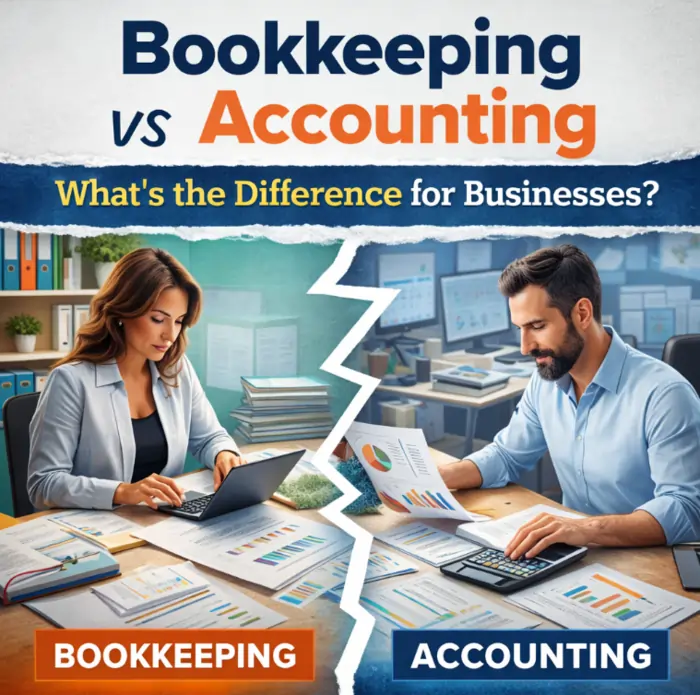
What Does Bookkeeping vs Accounting Really Mean for Your Business?
If you run a business, you’ve probably heard both terms used like they’re the same thing—but they’re not.
Bookkeeping is about recording every financial move your business makes, while accounting is about analyzing those numbers so you can file taxes correctly, understand performance, and make smarter decisions.
When both are done well, you get a clear picture of how money flows in and out, where profits come from, and what needs to change for you to grow. When they’re neglected or mixed up, you get messy books, wrong numbers, and stressful tax seasons instead of confident planning.
If you want the bigger strategic view of outsourced support, you can also read this next:
Outsourced Accounting Services in California (Complete 2026 Guide)
What Is Bookkeeping?
Bookkeeping is the foundation of your financial system. It’s the structured process of recording and organizing every transaction that passes through your business.
Typical bookkeeping tasks include:
- Recording sales, invoices, and customer payments
- Recording bills, vendor payments, and operating expenses
- Reconciling bank, credit card, and payment processor accounts
- Tracking accounts receivable and accounts payable
- Categorizing transactions into the correct accounts in your chart of accounts
If bookkeeping is done accurately and consistently, your books stay “clean,” meaning your reports match your bank, your tax preparer has reliable data, and you’re not scrambling every time someone asks for numbers.
When it’s done poorly—or not at all—everything else in your financial life becomes harder, more expensive, and riskier.
What Is Accounting?
Accounting starts where bookkeeping ends. Once your daily transactions are recorded and reconciled, accounting takes over to interpret that data and turn it into something useful.
Core accounting activities include:
- Preparing financial statements (profit and loss, balance sheet, cash flow)
- Analyzing trends in revenue, margins, and expenses
- Planning for taxes and preparing tax filings
- Setting up budgets and forecasts
- Advising on business decisions based on financial data
Think of accounting as the “brain” sitting on top of your financial system. Without it, you may know what came in and what went out, but you don’t see the full picture: profitability, cash runway, or whether your current strategy is sustainable.
For a deeper comparison of setups that provide accounting support, you can read:
CPA vs Outsourced Accounting Services: Which Do You Need?
Bookkeeping vs Accounting: Key Differences
Even though bookkeeping and accounting work together, they are not interchangeable. Here’s how they differ in focus, timing, and impact:
| Area | Bookkeeping | Accounting |
|---|---|---|
| Main focus | Recording daily transactions | Interpreting and summarizing financial data |
| Core goal | Keep books accurate and up to date | Turn numbers into insights, reports, and tax filings |
| Typical frequency | Daily, weekly, monthly | Monthly, quarterly, annually, and as needed |
| Tools used | Accounting software (e.g., QuickBooks, Xero) | Same tools + spreadsheets, models, and tax software |
| Who usually does it? | Bookkeeper or junior accountant | Accountant, CPA, or outsourced accounting firm |
| Output | Clean ledger, reconciled accounts | Financial statements, tax returns, strategic recommendations |
You can think of bookkeeping as the raw data layer and accounting as the decision layer.
If your bookkeeping is weak, accounting becomes slower, more expensive, and less accurate because the foundation isn’t solid.
Why Both Bookkeeping and Accounting Matter
You don’t choose one or the other forever—you choose where your business sits on the spectrum.
- If your business is small and simple, bookkeeping alone may be enough in the short term.
- As you grow, you need accounting to understand profitability, taxes, and cash flow.
- When you reach a certain complexity, you need both working together under a consistent system.
If you’re already thinking about in-house vs outsourced options, this guide can help you compare models:
In-House vs Outsourced Accounting in California: Which Is Better in 2026?
Examples: When You Need Bookkeeping vs When You Need Accounting
A few practical scenarios help clarify the difference:
- You just launched and only have a handful of transactions per month → you mostly need bookkeeping to record everything correctly.
- You’re growing, have regular invoices, contractors, and several accounts → you still need good bookkeeping, but now accounting becomes crucial for taxes and planning.
- You’re raising capital or managing multiple locations → you need bookkeeping, accounting, and higher-level advisory so your numbers can stand up to investor or lender scrutiny.
When you’re based in a complex environment like California, getting this structure right matters even more. For a broader view of firms and services in the state, you can explore:
Best Accounting Firm in California
How Accountalent Fits Into Bookkeeping vs Accounting
This is where a specialist firm like Accountalent stands out. Instead of treating bookkeeping and accounting as separate islands, Accountalent integrates them into one streamlined system for startups and small businesses.
With Accountalent, you can:
- Get bookkeeping handled monthly so every transaction is recorded and reconciled
- Rely on accounting and tax experts to prepare filings, plan for liabilities, and keep you compliant
- Access startup-focused guidance without hiring an in-house finance team
- Grow from basic bookkeeping to more advanced services as your business scales
For California founders and US-based startups, that means you’re not just buying “books” or “taxes”—you’re getting a coordinated financial system designed to keep your numbers clean and your decisions informed.
When Is Bookkeeping Alone Enough?
Bookkeeping alone might still be enough if:
- You have very low transaction volume
- Your business model is simple (few services, few vendors)
- You only need basic information: income, expenses, and a rough idea of profit
But even then, most businesses still rely on an accountant at least once a year to file taxes.
As soon as you start hiring, collecting sales tax, or working with contractors, accounting becomes more important.
If you feel you’re close to outgrowing bookkeeping-only support, the next step to explore is outsourced help:
Outsourced Accounting Services in California (Complete 2026 Guide)
When Do You Move From Bookkeeping to Full Accounting Support?
You know it’s time to move beyond basic bookkeeping when:
- You’re not sure how profitable each product, service, or location really is
- Cash flow feels tight even though sales look strong
- You’re surprised by tax bills or penalties
- Investors, lenders, or partners start asking for detailed financial reports
At that point, you need more than transaction tracking—you need accounting that can:
- Prepare monthly financial statements you understand
- Help you plan for taxes instead of reacting at the last minute
- Support important decisions (hiring, expansion, pricing, funding)
An outsourced accounting partner like Accountalent can provide that layer without you having to hire this expertise in-house.
Should You Hire a Bookkeeper, an Accountant, or an Outsourced Firm?
In real life, your options usually look like this:
- DIY bookkeeping + external tax CPA
- In-house bookkeeper + external accountant
- Fully outsourced accounting firm that handles both bookkeeping and accounting
If you want to compare the last two options clearly, this guide breaks it down in detail: CPA vs Outsourced Accounting Services: Which Do You Need?
For many startups and small businesses, a firm like Accountalent becomes the “all-in-one” solution: it maintains your books, files your taxes, and provides ongoing advice under one roof.
Bookkeeping vs Accounting vs Outsourced Accounting (At a Glance)
| Option | What You Get | Best For |
|---|---|---|
| Bookkeeping only | Data entry, reconciliations, basic reports | Very small and simple businesses |
| Accounting only | Tax filing, high-level advice (using your existing books) | Businesses with strong internal bookkeeping |
| Outsourced accounting firm | Bookkeeping + accounting + tax + advisory combined | Startups and growing businesses that want a complete solution without hiring |
If you’re already based in California and weighing providers, this resource can help you see how firms compare:
Best Accounting Firm in California
Why Bookkeeping vs Accounting Matters More in California
California adds extra layers—state tax rules, franchise tax, sales tax, and sometimes complex regulatory requirements.
That makes the bookkeeping vs accounting decision more important: bad data or missing steps can quickly turn into notices, penalties, or missed opportunities.
Choosing an outsourced accounting partner that understands California and startups like Accountalent —helps you avoid those problems while still keeping costs predictable.
For a deeper state-specific perspective on in-house vs outsourced models, read:
In-House vs Outsourced Accounting in California: Which Is Better in 2026?
Final Take: How to Think About Bookkeeping vs Accounting in 2026
Here’s the simplest way to frame it:
- Bookkeeping keeps your records accurate.
- Accounting makes those records meaningful.
- Outsourced accounting combines both, adds tax and advisory support, and lets you focus on running the business instead of wrestling with spreadsheets.
If you want a partner that can handle the full finance stack for startups and small businesses—especially in complex states like California—Accountalent is built exactly for that kind of work.
FAQs
1. What is the main difference between bookkeeping and accounting?
Bookkeeping records daily transactions, while accounting interprets that data to produce reports, tax filings, and strategic insights.
2. Is bookkeeping part of accounting?
Yes. Bookkeeping is the first step in the accounting process, providing the raw data accountants use to analyze performance and prepare financial statements.
3. Do small businesses need both bookkeeping and accounting?
Most small businesses start with bookkeeping and then add accounting support as they grow and their financial decisions become more complex.
4. Can a bookkeeper file my taxes?
Some bookkeepers help prepare information for taxes, but tax filing is usually handled by an accountant, CPA, or outsourced accounting firm.
5. When should a business upgrade from bookkeeping to full accounting?
When you need regular financial statements, better cash flow planning, or help with tax strategy—not just record-keeping.
6. Can one person handle both bookkeeping and accounting?
In very small businesses, one professional may handle both roles, but as transaction volume grows, it’s common to separate them or use an outsourced team.
7. What software do bookkeepers and accountants use?
They typically use cloud tools like QuickBooks, Xero, and related apps for invoicing, payroll, and reporting.
8. Is DIY bookkeeping a good idea?
It can work at the very beginning, but mistakes are common and often cost more to fix later than paying for professional support from the start.
9. How does outsourced accounting handle bookkeeping vs accounting?
An outsourced accounting firm manages both: it handles daily bookkeeping and provides monthly accounting, reporting, and tax support.
10. What does a bookkeeper do each month?
A bookkeeper records transactions, reconciles bank and credit card accounts, categorizes expenses, and prepares basic reports.
11. What does an accountant do each month?
An accountant reviews the books, prepares financial statements, checks for accuracy, and flags issues or opportunities for the business owner.
12. Do I need a CPA if I use an outsourced accounting firm?
Many outsourced firms employ CPAs or collaborate with them, so you may not need a separate CPA unless you have very specialized needs.
13. Which is more expensive: bookkeeping or accounting?
Accounting is generally more expensive because it requires deeper training, certifications, and judgment, while bookkeeping is more process-focused.
14. Can outsourced accounting be cheaper than hiring in-house?
Yes. Many businesses find that outsourced accounting costs less than paying full-time salaries and benefits for internal staff.
15. How often should bookkeeping be done?
Ideally, bookkeeping should happen weekly or monthly to keep your books accurate, up to date, and ready for reporting.
16. How often should accounting be done?
Most businesses review accounting reports monthly and do deeper analysis quarterly and annually.
17. Can I switch from in-house bookkeeping to an outsourced accounting firm?
Yes. Many businesses start in-house and later transition to outsourced accounting for more complete support and scalability.
18. Does every business need full accounting?
Not at the very beginning, but any business that wants to grow sustainably eventually benefits from full accounting support.
19. How do I know if my bookkeeping is accurate?
If accounts reconcile to your bank statements, reports make sense, and your accountant or tax preparer doesn’t flag major issues, your bookkeeping is likely in good shape.
20. Where can I get both bookkeeping and accounting in one place?
You can work with an outsourced accounting provider like Accountalent, which combines bookkeeping, accounting, and tax support for startups and small businesses.