

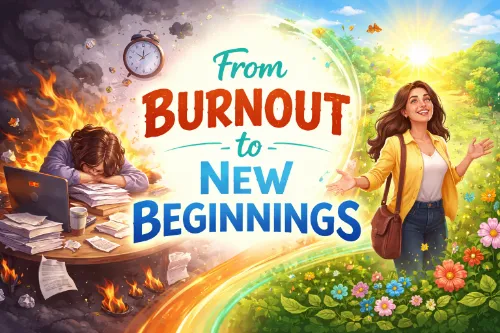
Burnout is not a personal failure; it is a signal that something about how you live and work is no longer sustainable, and that it’s time to redesign your life around energy, meaning, and boundaries instead of constant output. Moving from burnout to new beginnings means honoring the depth of your exhaustion, healing properly, and then rebuilding a life that fits who you are now—not who you were when you started this path.
Understanding Burnout: When “Just Push Through” Stops Working
Burnout is more than feeling tired; it is a state of emotional, mental, and physical exhaustion caused by chronic, unmanaged stress, most often from work or caregiving. It can show up as:
- Constant fatigue that doesn’t go away with sleep
- Cynicism, detachment, or feeling “checked out”
- Reduced performance and difficulty concentrating
- Headaches, sleep problems, or increased illnesses
- Feeling like nothing you do really matters anymore
The American Psychiatric Association notes that burnout emerges when high demands, lack of control, and insufficient support collide over time, and emphasizes that acknowledging it early is essential to protect long‑term wellbeing. BetterUp describes burnout as a progressive process, not a single event, and outlines stages from constant stress and numbness to complete detachment, which is why catching it sooner makes recovery easier.
For a deeper dive into what burnout is and how it develops, you can link to:
- Preventing Burnout: A Guide to Protecting Your Well‑Being – American Psychiatric Association
- How to Recover From Burnout and Love Your Life Again – BetterUp
Stage One: Awareness – Admitting Something Has to Change
Every new beginning after burnout starts with one honest sentence: “This is not working anymore.”
OpenUp’s burnout recovery guide highlights awareness and acknowledgement as the first phase of healing: recognizing symptoms, naming burnout without shame, and giving yourself explicit permission to slow down. Australian psychologist resources echo that the most important first step is admitting you’re burned out and seeking at least an initial consultation with a doctor or mental health professional to rule out other conditions and create a plan.
Questions that can help you move into awareness:
- When did I last feel genuinely rested and present?
- What specific situations or people leave me completely drained?
- Am I telling myself “everyone is tired” to minimize how bad this feels?
MVS Psychology’s guide on the best cure for burnout emphasizes that acknowledging the problem and seeking professional guidance early prevents symptoms from becoming more severe and entrenched. You can reference their framework here:
- Best Cure for Burnout: Ultimate Recovery 2025 – MVS Psychology
- Burnout Recovery: How to Heal & Rebuild Your Energy – OpenUp
Stage Two: Rest and Distance – Giving Your Nervous System a Chance
Once you’ve acknowledged burnout, the next step is creating distance from stressors and prioritizing deep rest.
OpenUp describes a second phase of “distancing and rest,” which includes taking time off if possible, reducing workload, and intentionally stepping away from the environments, tasks, and relationships that are keeping you in constant fight‑or‑flight mode. MVS Psychology similarly recommends creating distance from primary stressors—taking breaks, setting boundaries, delegating tasks—while you stabilize your physical and emotional health.
Practical ways to do this:
- Negotiate lighter duties or short‑term leave if you can
- Say no to non‑essential commitments, even if it feels uncomfortable
- Limit exposure to draining people and conversations
- Replace “hustle” content with calming, grounding inputs (books, nature, slow hobbies)
Baylor Scott & White Health offers simple daily strategies that support this rest phase, such as building an after‑work routine focused on movement, healthy sleep, and micro‑breaks during the day to reset your brain. You can link to:
Stage Three: Support and Self‑Care – You Don’t Have to Do This Alone
Burnout often comes with isolation and shame, but recovery is much faster when you have support.
Therapy Group DC’s guide on recovering from job burnout highlights support networks—friends, family, colleagues, and mental health professionals—as one of the pillars of healing. They recommend:
- Being honest with at least one trusted person about how bad it feels
- Considering therapy or coaching to understand patterns and rebuild coping strategies
- Joining communities (online or offline) where people talk openly about burnout and recovery
Self‑care in burnout recovery is not about bubble baths or “treat yourself” moments; it’s about rebuilding the basics that your nervous system relies on:
- Regular, gentle physical activity (walking, stretching, yoga)
- Consistent, nourishing meals and hydration
- Improving sleep habits with a steady bedtime and screen limits
- Short, daily practices like deep breathing or mindfulness to calm your stress response
These habits are described in detail in:
- How to Recover From Job Burnout: 7 Effective Strategies for Renewal – Therapy Group DC
- Burnout Recovery: How to Heal & Rebuild Your Energy – OpenUp
- 14 Ways to Deal With Burnout and Love Your Life Again – BetterUp
Stage Four: Reclaiming Your Center – Who Are You Without the Hustle?
Once you’ve stabilized your energy a bit, a new question appears: If I am not my job or my productivity, who am I?
White River Manor’s step‑by‑step guide to rebuilding after burnout talks about “reclaiming your center”: revisiting your values, asking what truly brings you alive, and building small daily rituals that reconnect you with yourself. They suggest practices like:
- Writing down three things that still matter to you each evening
- Spending time with what brings you joy—nature, music, art, spiritual practice, loved ones
- Creating a five‑minute morning ritual of silence, breathing, or gentle movement
This is also the stage where you realize that your worth is not equal to your output; you are more than your role, achievements, or income. When you rebuild your life from your center rather than from expectations, you’re less likely to design a “new beginning” that just leads to a new version of burnout.
You can link this deeper reflection to:
Stage Five: Career Clarity – Is It Time for a Change?
For many people, new beginnings after burnout involve a career shift—sometimes small, sometimes radical.
KevinMD describes a five‑stage transformation from “employed, overworked, and exhausted” to career balance for physicians, emphasizing that burnout can be a doorway into more autonomy, aligned work, and sustainable schedules. LifeCoach.com calls this journey “burnout to bliss” and outlines steps such as giving yourself permission to imagine a stress‑free life, creating a vision of ideal work, and understanding what drains versus energizes you.
Key reflective questions:
- Which parts of my current work are truly unsustainable—and which parts could change with boundaries?
- If I could design my ideal workday from scratch, what would it look like?
- Do I want a new job, a new role, a new industry, or a new way of working (e.g., freelance, remote, part‑time)?
Escape the City’s guide on regaining energy for a career change stresses that before you make big moves, you need to recover enough to think clearly and then do a structured self‑assessment: values, interests, skills, and non‑negotiables. Helpful resources here include:
- From Burnout to Balance: 5 Stages of Career Transformation – KevinMD
- Burnout to Bliss: Why a Career Change Might Be the Best Thing for You – LifeCoach.com
- How to Stop Burnout and Regain Energy for a Career Change – Escape the City
Stage Six: New Beginnings – Pivoting Without Starting From Zero
A new beginning doesn’t always mean burning everything down; often, it means carrying your experience into a different context.
Coverdoc’s guide, From Burnout to Breakthrough, focuses on pivoting your career without losing your hard‑earned skills. They outline how to:
- Recognize when burnout is a sign you’ve outgrown your current role or industry
- Identify your transferable skills (problem‑solving, communication, leadership, critical thinking) that apply in many fields
- Map those skills onto opportunities in a new industry so you bring your strengths with you
They also emphasize building a strategic plan:
- Clarify your target direction (industries, roles, work style)
- Fill skill gaps with courses, projects, or certifications
- Network in new professional circles and talk to people who already do the work you want to do
- Celebrate small milestones—finishing a course, updating your portfolio, landing an informational interview—as proof that your new beginning is real, not just a fantasy
Bryant & Stratton College describes a similar approach in From Burnout to Bliss: Finding a New Career, encouraging self‑assessment, mapping a new path, and using education and internships to move toward your next chapter.
You can link these practical career‑pivot resources here:
- From Burnout to Breakthrough: How to Pivot Your Career Without Starting Over – Coverdoc
- From Burnout to Bliss: Finding a New Career – Bryant & Stratton College
Stage Seven: Designing a Burnout‑Proof Life
A true new beginning is not just about recovering once; it is about building a life that doesn’t drag you back into the same pattern.
Core elements of a burnout‑resistant life:
- Clear boundaries: defined work hours, tech‑off time, saying no without guilt, and protecting rest as fiercely as deadlines.
- Sustainable workload: resisting chronic overcommitment, negotiating expectations, and designing systems that support focus instead of constant multitasking.
- Regular values check‑ins: asking whether your work and lifestyle still align with what matters most to you, and adjusting when they don’t.
- Ongoing support: therapy, coaching, peer groups, or at least one person who helps you notice when you’re drifting back into old patterns.
OpenUp frames this as the final stage of burnout recovery: reintegration and prevention, where you return to work or life with new boundaries, habits, and a more compassionate relationship to yourself. Therapy Group DC adds that regularly reevaluating priorities and boundaries is key to preventing future episodes.
Useful references for this stage include:
- Burnout Recovery: How to Heal & Rebuild Your Energy – OpenUp
- Preventing Burnout: A Guide to Protecting Your Well‑Being – APA
- How to Recover From Job Burnout: 7 Effective Strategies for Renewal – Therapy Group DC
A Gentle Roadmap: From Burnout to New Beginnings
You can wrap your post with a simple, compassionate roadmap your readers can remember:
- Name it.
Admit you are burned out and stop gaslighting yourself into “it’s not that bad.” - Rest and retreat.
Create distance from stressors, prioritize sleep and basic self‑care, and let your body and mind begin to exhale. - Get support.
Talk to a professional, lean on trusted people, and join spaces where burnout is understood—not minimized. - Recenter your life.
Reconnect with your values, joy, and identity beyond work, and start building small daily rituals that anchor you. - Decide what changes.
Clarify whether you need new boundaries, a new role, or a new career, and take one small step at a time. - Design your next chapter.
Use your transferable skills, explore new paths, and build a strategic plan so you don’t have to start from zero. - Protect your new beginning.
Keep evaluating your boundaries, workload, and alignment so your new life stays livable, not just impressive from the outside.
From burnout to new beginnings is not a straight line, and it’s rarely quick—but it is absolutely possible to rebuild a life that feels calmer, truer, and more yours than what came before.