

Australian Energy Regulator Price Announcement Key Takeaways
The Australian Energy Regulator Price Announcement sets the default market offer (DMO) for electricity, which directly influences what millions of households pay for power.
- The Australian Energy Regulator Price Announcement raises the DMO by up to 25% in some regions, adding hundreds of dollars to annual electricity costs.
- Households on standard retail plans are most exposed — those who haven’t compared providers in the last 12 months could be overpaying by $300–$600 per year.
- The smartest, most effective way to counter this increase is to switch to a competitive market offer. The AER’s own data shows that switching can save a typical household between $200 and $500 annually.
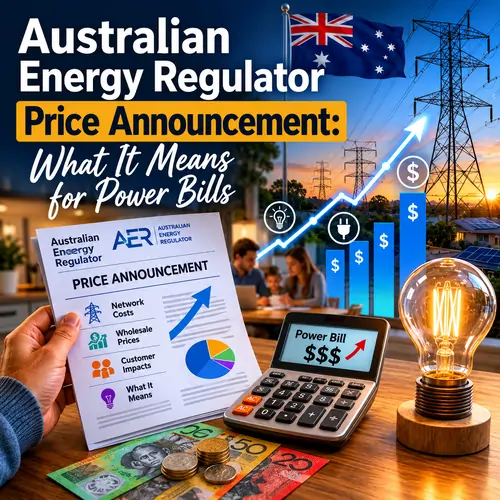
Breaking Down the Australian Energy Regulator Price Announcement
Every year, the Australian Energy Regulator (AER) releases the Default Market Offer (DMO) — the maximum price that energy retailers can charge customers who are on standing offers. This is not a minor regulatory update; it’s the benchmark that sets the baseline for household power bills across New South Wales, South Australia, and parts of Queensland. For a related guide, see Telstra, Optus and Vodafone Price Hike: Australia Mobile Plans Get More Expensive.
In its latest Australian Energy Regulator Price Announcement, the AER confirmed a substantial power bills impact Australia will experience: the DMO is rising by 19.5% to 25% depending on the region and meter type. For a typical household, that translates to an extra $200–$400 per year before any usage changes.
Why is this happening? The AER cites rising wholesale energy costs, network infrastructure upgrades, and the global energy crisis. But while the regulator sets a ceiling, it does not force you to pay that ceiling. Understanding this distinction is the first step toward protecting your household budget.
Who Is Most Affected by the Energy Price Increase?
The rate hike hits two groups hardest:
- Households on standing offers or basic plans — these customers are paying the DMO rate by default and will see the full increase.
- Low-income families and renters who may lack the time or resources to shop around for a better deal.
If you haven’t reviewed your energy plan since the energy price announcement 2023, you are almost certainly paying more than you need to.
1 Smart Way to Offset the Australian Energy Regulator Price Announcement
There is one proven, low-effort strategy that can save you hundreds of dollars in response to the Australian Energy Regulator Price Announcement: switch to a competitive market offer.
A market offer is a retail plan priced below the DMO. Retailers compete for customers with discounts, fixed-rate periods, and bundled benefits. The AER itself recommends that households compare plans at least once a year. Its data shows that customers who switched from a standing offer to the cheapest available market offer saved an average of $315 per year in 2022–2023. That figure is expected to be higher in 2024. For a related guide, see 7 Smart Ways to Use Fuel Watch Perth to Save Money on Petrol.
How to Switch: A Simple 3-Step Process
Step 1: Grab Your Latest Bill
You need your current tariff, usage in kWh, and daily supply charge. This data lets you compare apples with apples on comparison websites.
Step 2: Use an Independent Comparison Tool
Go to the Australian government’s Energy Made Easy website, which is free, impartial, and lists all plans available in your postcode. Enter your bill details to see actual savings.
Step 3: Confirm Fees and Conditions
Before signing, check for exit fees, conditional discounts (e.g., pay-on-time requirements), and whether the rate is fixed or variable. Avoid plans with hidden conditions that could wipe out your savings.
Common Mistakes When Responding to the Australian Energy Regulator Price Announcement
Many Australian households rush into decisions after hearing about price rises. Here are the most common traps:
- Staying with the same retailer out of loyalty. Loyalty is rarely rewarded in energy retail. Even if you like your provider, check if they offer a cheaper market plan than your current standing offer.
- Focusing only on the usage rate. The daily supply charge can vary significantly between plans and may cost you more than a slightly higher usage rate if you are a low-user household.
- Ignoring state-specific rebates. Some states have energy rebates or concessions that reduce bills. Check with your state government to see if you qualify.
Comparison of DMO vs. Typical Market Offer (Example: NSW Household, 4,000 kWh/year)
| Plan Type | Estimated Annual Cost | Potential Saving vs. DMO |
|---|---|---|
| AER DMO (standing offer) | $1,800 | — |
| Average market offer | $1,450 | $350 |
| Best market offer | $1,280 | $520 |
As the table shows, even the average market offer saves a significant amount. The best market offer slashes the bill by over $500 — turning the AER’s price hike from a burden into an opportunity to pay less than before the increase.
What the Future Holds for Power Bills in Australia
The Australian Energy Regulator Price Announcement is an annual event, and future announcements are likely to reflect ongoing volatility in global energy markets, the transition to renewables, and network costs. However, the regulator has signalled that the large jumps seen in 2022–2023 may moderate in 2025 as wholesale prices stabilise.
Households that lock in a competitive market offer now are better positioned to ride out fluctuations. Additionally, investing in energy efficiency — such as solar panels, battery storage, or smart appliances — can further reduce exposure to price changes. But for most families, the simplest, highest-impact action remains reviewing and switching their electricity plan.
Useful Resources
For more information on current energy prices and independent advice, visit these official sources:
- Australian Government – Energy for Households — practical tips and a guide to rebates.
- Australian Energy Regulator – Default Market Offer page — official DMO rates and explanatory documents.
Frequently Asked Questions About Australian Energy Regulator Price Announcement
What exactly is the Default Market Offer?
The Default Market Offer (DMO) is a price cap set by the AER that limits what energy retailers can charge customers on standing offers. It protects consumers from unjustifiably high prices.
Does the DMO apply to all Australian states?
No. The DMO currently applies to New South Wales, South Australia, and parts of Queensland (South East Queensland). Other states have their own price regulation mechanisms.
How much will my power bill increase after this announcement?
If you are on a standing offer, expect an increase of 19.5% to 25%, which could add $200–$400 to your annual bill depending on your region and usage.
Can I avoid the price increase entirely?
You can avoid the full increase by switching to a market offer that is below the DMO. Many households will find a plan that is cheaper than their current bill before the increase.
How often does the AER update the DMO?
The AER reviews and publishes a new DMO once per year, typically in May, with the new rates taking effect from July 1.
Is it worth switching energy providers every year?
Yes. Savings erode over time as introductory discounts expire. Comparing plans annually ensures you are always on a competitive rate.
What if I rent — can I still switch?
Yes. Tenants can choose their own energy retailer in most states, unless the rental agreement specifies otherwise. Check your lease or ask your landlord.
Are there any fees for switching energy plans?
Most market offers have no exit fees, but always check the plan’s terms. Avoid plans that charge exit fees unless the savings are substantial.
Does the DMO affect solar customers?
The DMO affects the supply and usage charges, but not the solar feed-in tariff. Solar households still benefit from shopping around for a better plan and higher feed-in rates.
How does the AER decide on the DMO amount?
The AER conducts a detailed cost analysis of wholesale electricity, network charges, environmental costs, and retailer operating costs. These are published in its annual final determination.
Can I get help if I’m struggling to pay my bill?
Yes. Contact your retailer to request a payment plan or hardship assistance. You may also qualify for state-based rebates or concessions.
What is a standing offer?
A standing offer is the basic electricity plan that every retailer must offer. It has no discounts and is capped at the DMO price. It is typically the most expensive plan.
What is a market offer?
A market offer is a retail plan with discounts, incentives, or fixed rates. It is priced below the DMO and is how retailers compete for customers.
How long does it take to switch energy providers?
Switching is quick. In most cases, the process takes only a few minutes online, and the new plan activates within 2–3 business days. There is no interruption to your power supply.
Will switching affect my solar feed-in tariff?
Different retailers offer different feed-in rates. When you switch, your new plan will include a feed-in tariff. Compare these rates as part of your decision.
Does the DMO apply to gas as well?
No. The DMO only covers electricity. Gas prices are regulated separately by state-based regulators.
Are there any government rebates for low-income households?
Yes. Many states offer energy concessions, rebates, or hardship programs. Check your state government’s website for eligibility criteria.
Can a comparison site give me a biased result?
Some comparison sites receive commissions from retailers. To avoid bias, always check the government’s independent site Energy Made Easy as a baseline.
What if my current retailer has the cheapest plan already?
That is possible. Use the comparison tool to confirm. If your retailer is cheapest, consider staying but ask them if they can offer an even better deal to retain your loyalty.
Is it better to fix the energy price or stay on a variable plan?
A fixed-rate plan protects you from future price rises but may be higher initially. If you expect rates to rise again, a fixed plan could be worthwhile. Otherwise, variable plans offer more flexibility.