

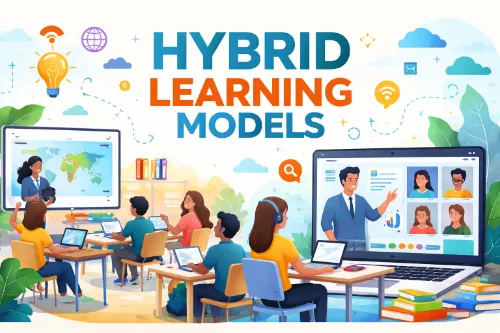
Hybrid learning models blend in‑person and online instruction so students can learn on campus, remotely, or both, often at the same time. When designed intentionally, they merge the strengths of face‑to‑face teaching with the flexibility and reach of digital learning.
What Is a Hybrid Learning Model?
A hybrid learning model mixes classroom teaching with online activities, resources, and interactions. In many setups, some students attend in person while others join live online, and everyone can access asynchronous materials like recorded lectures, quizzes, and discussion boards.
- Owl Labs defines hybrid learning as an educational model where some students attend in person while others participate virtually, with teachers instructing both groups simultaneously in “What is hybrid learning? Here’s everything you need to know”.
- Penn State explains in “What Is Hybrid Learning?” that hybrid courses intentionally combine face‑to‑face instruction with online activities before, during, and after class.
- Neovation clarifies in “What is Hybrid Learning and how can it help your learners?” that hybrid learning differs from blended learning because instructors address in‑person and remote learners at the same time.
Rev’s article “About Hybrid Learning & Its Benefits” offers a plain‑language overview of common hybrid structures.
How Hybrid Learning Models Work
Hybrid learning is a spectrum, but most models use a mix of synchronous and asynchronous learning.
Typical components:
- Synchronous in‑person + online sessions
The instructor teaches a live class with students in the room and others joining via video conferencing platforms, supported by cameras, microphones, and screens. Oxford’s “What is hybrid teaching?” describes this setup as combining remote and on‑site participants in one teaching event. - Asynchronous online activities
Pre‑recorded lectures, readings, quizzes, and discussion forums hosted in an LMS let students engage with content at their own pace. FeedbackFruits’ “Hybrid learning: A comprehensive guide” outlines how to sequence these elements effectively. - In‑class application and discussion
Class time is used for discussion, group work, and problem‑solving, often using flipped‑classroom principles where students review core content beforehand.
Progress Learning’s “What is Hybrid Learning? Benefits and Tips for Teachers” gives practical tips on balancing attention between in‑room and online students.
Benefits of Hybrid Learning Models
Well‑designed hybrid learning offers several advantages for learners and institutions.
- Flexibility and accessibility
Students can choose to attend in person or remotely depending on work schedules, health, or location, making education more accessible for non‑traditional and working learners. Practera’s article “Why Hybrid Learning Is the Future for Higher Education Students” emphasizes this flexibility as a key driver of future‑readiness. - Better use of contact time
Content delivery (lectures, basic explanations) can move online, while face‑to‑face sessions focus on interaction, feedback, and hands‑on practice. - Support for different learning styles
A mix of video, text, interactive tools, and live discussion supports visual, auditory, and kinesthetic learners. - Potentially stronger engagement and outcomes
A 2024 study, “Exploring the Effectiveness of Hybrid Learning Models in Higher Education”, found hybrid models improved accessibility and engagement, though results varied by discipline and design quality.
The NEA’s “Overview: Hybrid Learning Models” also highlights flexibility, continuity of learning, and increased student choice as key benefits.
HyFlex: A Flexible Hybrid Variant
A prominent variant is HyFlex (hybrid‑flexible) learning, which extends the hybrid idea.
- Students can choose for each class whether to attend in person, join live online, or participate asynchronously via recordings and online activities.
- All modes are designed to offer equivalent learning experiences, so no group is “second class.”
ResearchWize’s “HyFlex Technology in 2025: The Latest Trends for Higher Ed” describes HyFlex as a major shift toward learner autonomy while raising concerns about digital equity and data privacy. EdTech Magazine’s “HyFlex Technology in 2025” notes increasing use of AI tools to support captioning, summarization, and personalized support across modalities.
EDUCAUSE’s “Designing for HyFlex/Hybrid Spaces: A Strategic Priority” frames HyFlex as a strategic investment for institutions seeking resilience and accessibility.
Challenges and Implementation Considerations
Hybrid learning also introduces real challenges.
- Technology and equity gaps
Students without reliable internet, devices, or quiet study spaces can be disadvantaged. NEA’s overview warns that hybrid learning can widen existing equity gaps without targeted support. - Instructor workload and complexity
Designing and delivering courses that work well both in‑person and online takes more time, planning, and ongoing adjustment. - Engagement disparities
Remote students can feel like passive observers if interaction is not carefully designed, leading to a “front row vs back row” effect across modalities. - Infrastructure and support
Institutions need investment in classroom tech, IT support, instructional design, and staff training to sustain hybrid and HyFlex models.
The 2025 JDET paper “Hybrid learning in higher education: Considerations for its implementation in course design” stresses aligning course outcomes, assessments, and activities across both online and in‑person components. An EduLearn article comparing hybrid vs online learning in higher education argues that hybrid can outperform fully online formats when supported with robust infrastructure and engagement strategies.
Why Hybrid Learning Models Are Likely to Grow
Post‑pandemic, hybrid learning has shifted from emergency workaround to long‑term strategy.
- Students increasingly expect flexible attendance options, recorded lectures, and digital access to materials as standard features.
- Institutions see hybrid and HyFlex as ways to widen access (working adults, international students), optimize space, and stay resilient during disruptions.
- Ongoing edtech advances—AI tools, learning analytics, better LMS integrations—make high‑quality hybrid delivery more feasible.
Practera’s “Hybrid Learning Is the Future” argues that hybrid models support work‑integrated learning and global collaboration, making programs more attractive to modern learners. EDUCAUSE’s HyFlex spaces article positions hybrid learning as a strategic priority as institutions redesign both physical and digital campus infrastructure.