

Simplified Work Expense Claims: Key Takeaways
Contrary to common misconception, there is no such thing as an $1000 Automatic Tax Deduction. The term often refers to the Australian Taxation Office’s (ATO) simplified rules for claiming work-related expenses, which can reduce record-keeping for eligible taxpayers.
Every tax season, Australian taxpayers look for ways to simplify their returns and maximise their refunds. One option that often causes confusion is the concept of simplified work expense claims. Specifically, many wonder about the rumoured “$1000 Automatic Tax Deduction.” Is it real, and how does it work? This guide cuts through the jargon to explain the ATO’s simplified deduction rules, who can use them, and how to apply them correctly to your tax situation.
Understanding Simplified Work Expense Claims
The informal term “$1000 Automatic Tax Deduction” refers to a simplified method offered by the Australian Taxation Office (ATO) for claiming work-related expenses. It’s not a free bonus or a payment you receive automatically. Instead, it’s a set of rules that allows you to claim deductions for certain work expenses without the need to keep every single receipt, subject to important conditions.
Key Figures Explained
- The $300 Threshold: This is the core ATO rule. If your total claim for work-related expenses is $300 or less, you generally do not need to keep written evidence like receipts.
- The ‘$1,000’ Figure: This is an informal, practical ceiling some use for the simplified method, but it is not a rule, guarantee, or entitlement. You can only claim what you have actually spent, and claims over $300 require receipts for the entire amount.
This method is part of the ATO’s simplified deduction rules for work-related expenses. The idea is to reduce the record-keeping burden for employees with relatively straightforward expense claims. However, “simplified” doesn’t mean “no rules.” You must still have incurred the expenses, and they must be directly related to earning your income.
How the Simplified Deduction Rule Works
The rule states that if your total claim for work-related expenses is $300 or less, you generally don’t need to keep written evidence. For claims over $300, you need written evidence for the entire claim, not just the amount over $300. The “$1,000” figure often comes into play as a practical ceiling for using this method for multiple small expenses, but it is not a guaranteed deduction. You can only claim what you have actually spent.
Eligibility Criteria for Simplified Deductions
Not every taxpayer can use this simplified method. The ATO has specific criteria to determine if you are eligible to claim work-related expenses without detailed receipts.
Who Qualifies?
To be eligible, you must be an employee or contractor who has incurred work-related expenses. Common examples include costs for uniforms, laundry, home office use, tools, and self-education. The primary condition is that you must have spent the money yourself and not been reimbursed by your employer.
Key Eligibility Points
- You must have spent the money (it wasn’t reimbursed).
- The expense must directly relate to earning your income.
- You must have a record of how you calculated your claim, even if you don’t have receipts for every item under $300.
- Your total claim for work-related expenses must be a reasonable reflection of your circumstances.
Step-by-Step Guide to Claiming Your Deduction
Claiming work expenses correctly requires careful steps. Following this process will help ensure your claim is valid and reduces your risk of an ATO review.
Step 1: Calculate Your Total Work-Related Expenses
Start by gathering all potential work-related expenses from the financial year. This includes small purchases like stationery, union fees, phone usage, and internet costs. Tally the total. If it’s $300 or less, you can proceed to claim it without receipts. If it’s over $300, you must have written evidence for the entire amount.
Step 2: Maintain a Record of Your Calculation
Even for claims under $300, the ATO expects you to show how you arrived at the figure. Keep a diary note, spreadsheet, or use a tax app to log small expenses as they occur. For example, note: “$15 per week for work-related phone calls over 48 weeks = $720.”
Step 3: Lodge Your Claim in Your Tax Return
When completing your tax return, you will enter your total work-related expense claim in the designated section (typically labelled “D5 Work-related expenses” in myTax). Enter the total calculated amount. The system does not automatically apply a deduction; you must input the figure you are claiming.
Common Mistakes to Avoid With Simplified Deductions
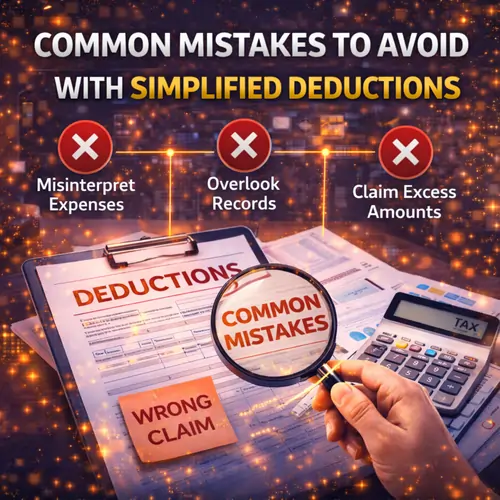
Many taxpayers get tripped up by misunderstandings about these rules. Avoiding these common errors can save you from headaches later.
Mistake 1: Claiming the Full $1,000 Without Spending It
The biggest misconception is that everyone gets an automatic $1,000 off their tax. This is false. You can only claim what you have genuinely spent. Claiming a round $1,000 without the expenses to back it up is a red flag for the ATO.
Mistake 2: Poor Record-Keeping
Assuming “simplified” means “no records needed” is a critical error. While receipts for individual items under $300 aren’t mandatory, you still need a reasonable basis for your claim. The ATO can ask you to explain your calculation at any time.
Mistake 3: Doubling Up on Claims
You cannot claim the same expense twice. For instance, if you use the simplified method for home office costs, you cannot also claim a separate deduction for your office chair under another category. Be careful not to overlap claims.
Useful Resources
For the most accurate and up-to-date information, always refer to official sources. Here are two essential resources from the Australian Taxation Office:
- ATO: Deductions you can claim – The official guide to all allowable deductions.
- ATO: Keeping your tax records – Detailed rules on what records you need to keep and for how long.
Frequently Asked Questions About Simplified Work Expense Claims
Is the $1000 Automatic Tax Deduction real?
Yes, but it’s often misunderstood. It’s not an automatic payment. It refers to the ATO’s simplified rules that allow you to claim work-related expenses up to a certain amount without keeping every receipt, with $1,000 being a common practical limit for many taxpayers.
Do I get $1,000 automatically added to my refund?
No. You must claim the deduction in your tax return for expenses you have actually incurred. It reduces your taxable income, which may increase your refund, but it is not an automatic lump sum added on.
What expenses can I claim under this method?
You can claim any work-related expense necessary for earning your income. Common examples include uniforms, laundry, home office running costs, phone and internet usage, tools, and subscriptions. The expense must not be reimbursed by your employer.
Do I need receipts for a claim under $300?
For a total claim of $300 or less, you do not need written evidence like receipts. However, you should still be able to show how you calculated the amount if the ATO asks.
What if my total claim is $1,200? Do I need receipts?
Yes. If your total claim for work-related expenses is over $300, you need written evidence for the entire claim, not just the amount over $300. So for a $1,200 claim, you need receipts or other documentation for all $1,200.
Can I claim the $1000 Automatic Tax Deduction if I am self-employed?
The simplified method is primarily for employees. Self-employed individuals and sole traders typically use different business deduction rules and should maintain full records for all business expenses.
Does this apply to investment property deductions?
No. The simplified deduction rules for work-related expenses do not apply to rental property expenses. Different, more stringent record-keeping rules apply to investment property deductions.
What is the “cents per hour” method for home office?
This is a specific simplified method for claiming home office running costs. You can claim a fixed rate of 67 cents per hour for heating, cooling, lighting, cleaning, and the decline in value of furniture. This is separate from but can be used alongside other work expense claims.
Can I claim car expenses under the automatic deduction?
Car expenses for work purposes have their own set of rules and methods (like the cents per kilometre method). They are generally claimed separately from other work-related expenses and have specific record-keeping requirements.
What happens if the ATO audits my claim?
If selected for review, you will need to provide evidence to support your claim. For claims over $300, this means receipts. For claims under $300, you’ll need to explain your calculation method (e.g., diary notes, logs).
Is there a difference between a tax deduction and a tax offset?
Yes, a big difference. A tax deduction (like a work expense claim) reduces your taxable income. A tax offset (like the low-income tax offset) directly reduces the amount of tax you owe, dollar for dollar.
Can I use the automatic deduction if I use a tax agent?
Absolutely. A registered tax agent will ask you about your work expenses and help you calculate a legitimate claim using the simplified rules if you are eligible. They can ensure you claim correctly and avoid errors.
What if I have both deductible and private use for an item, like my phone?
You can only claim the work-related portion. You need to keep a record (like a four-week diary) to establish a reasonable pattern of work use versus private use, then apply that percentage to your total annual bill.
Are union fees included in the $1,000 automatic deduction?
Yes, union fees are a common work-related deduction. They would form part of your total work expense claim, which could be calculated using the simplified method if your overall claim structure allows for it.
How does this deduction affect my taxable income?
It reduces it. For example, if you earn $70,000 and claim $1,000 in legitimate work expenses, your taxable income becomes $69,000. You then pay tax on this lower amount, which may result in a larger refund or a smaller tax bill.
Can I claim clothing under this rule?
You can claim for compulsory uniforms, protective clothing, or occupation-specific clothing. Conventional clothing (like a suit for an office worker) is not deductible. Laundry costs for deductible clothing can also be included.
What records should I keep for a claim under $300?
Keep a log, diary, or spreadsheet that notes the type of expense, amount, date, and work connection. For example: “March 15 – purchased work notebook – $12.” This provides a reasonable basis for your claim.
Does the $1,000 limit include GST?
When claiming deductions, you claim the GST-inclusive amount if you are not registered for GST (which most employees are not). So, the $1,000 refers to the total amount you spent, including GST.
What if I forgot to claim a deduction last year?
You can generally amend your prior year’s tax return within a two-year period. You will need to have the records to support the amended claim. It’s best to consult with the ATO or a tax agent to lodge an amendment.
Is the $1,000 figure adjusted for inflation each year?
The $300 threshold for not requiring receipts has been in place for many years and is not automatically indexed. The $1,000 figure is a guideline, not a legislated limit. Always check the ATO website for the current financial year’s rules.
Final Thoughts
Navigating the ATO’s simplified rules for work expense claims can streamline your tax return if you understand the rules and avoid the myths around an “automatic” $1,000 deduction. Remember, these are tools for simplification, not guaranteed entitlements, and the cornerstone of any tax claim is legitimacy: only claim what you actually spend in earning your income and keep enough records to back it up. For broader money‑management context in 2026, including how cash is being used in Australia’s evolving payments landscape, you may also be interested in Cash Out Day 2026: 7 Key Things to Know.