

World Quantum Day Key Takeaways
World Quantum Day is a global initiative held on April 14th to celebrate and educate the public about the transformative potential of quantum science. The day highlights how foundational research is now translating into tangible technologies that promise to reshape industries from medicine to cybersecurity. It serves as a crucial platform for scientists, educators, and policymakers to discuss the future we are building with quantum mechanics.
- World Quantum Day spotlights the rapid progress from theoretical physics to real-world applications.
- Advances in quantum computing, sensing, and cryptography are moving from lab experiments to pilot projects with major corporations and governments.
- The future implications span solving intractable problems in climate science, creating unbreakable encryption, and discovering new materials.
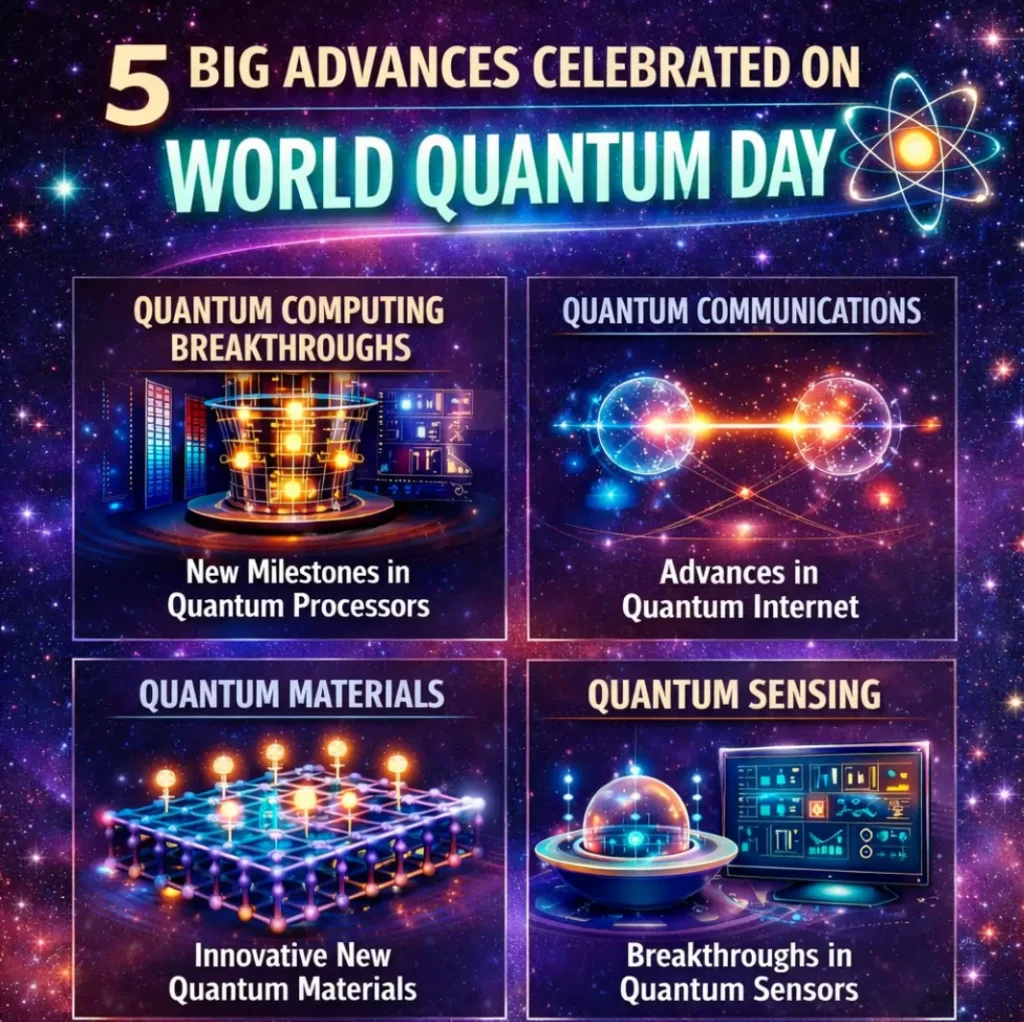
Every year on April 14th, the global scientific community and tech enthusiasts come together to celebrate World Quantum Day. The date, 4.14, is a nod to the first digits of Planck’s constant (approximately 4.14×10⁻¹⁵ eV·s), a fundamental quantity in quantum mechanics. But this day is far more than a numerical pun; it’s a coordinated effort to demystify one of the most complex yet promising fields of our time. As we stand on the cusp of a second quantum revolution, World Quantum Day provides a vital snapshot of how abstract principles are being forged into tools that will define the next century of innovation.
What is World Quantum Day and Why Does It Matter?
Established by quantum scientists from over 65 countries, World Quantum Day is an annual celebration of quantum science and technology. Its mission is to foster public understanding of quantum mechanics and its applications, inspire the next generation of scientists, and create a global dialogue about the ethical and societal implications of these powerful new technologies. Unlike a conference for specialists, this day is designed for everyone, featuring public lectures, lab open houses, art exhibits, and online content that breaks down complex ideas.
The significance of World Quantum Day lies in its timing. Quantum technology is transitioning from a purely academic pursuit to a strategic global industry. Nations and corporations are investing billions, recognizing that quantum advantage—the point where quantum machines outperform classical ones for specific tasks—is no longer a distant dream but a foreseeable milestone. This day matters because it prepares society for a shift as profound as the digital revolution, ensuring we understand the tools that will soon reshape finance, security, medicine, and material science.
Quantum Computing: Beyond Classical Limits
The most famous frontier celebrated on World Quantum Day is quantum computing. Unlike classical computers that use bits (0s and 1s), quantum computers use quantum bits or qubits. Qubits can exist in a state of superposition (being both 0 and 1 simultaneously) and entanglement (a profound connection where the state of one qubit instantly influences another, regardless of distance). This allows them to explore a vast number of possibilities in parallel.
From Quantum Supremacy to Quantum Utility
The field has moved past simply proving a quantum computer can do something a classical computer cannot—a milestone known as “quantum supremacy.” The focus is now on achieving “quantum utility” or “quantum advantage,” where a quantum computer solves a practical, economically valuable problem faster or more accurately than any classical supercomputer. Companies like IBM, Google, and startups are racing to build machines with more stable, error-corrected qubits to tackle real-world challenges.
A Practical Example: Simulating Molecules
One of the most promising near-term applications is quantum chemistry. Simulating the behavior of molecules for drug discovery or fertilizer production is incredibly difficult for classical computers. Quantum computers, by operating on the same quantum rules as the molecules themselves, could model these interactions precisely. This could lead to the design of new life-saving pharmaceuticals or more efficient catalysts to reduce the energy footprint of agriculture, a topic often highlighted in World Quantum Day discussions about climate solutions.
The Quantum Internet and Unhackable Communication
While quantum computing gets most of the headlines, World Quantum Day also emphasizes the parallel revolution in communication: quantum cryptography and the quantum internet. This advance is centered on quantum key distribution (QKD), a method for secure communication that uses the principles of quantum mechanics.
In QKD, information is encoded in the quantum states of particles, like photons. Any attempt to eavesdrop on this communication inevitably disturbs these fragile quantum states, alerting the legitimate users to the presence of an intruder. This makes it theoretically impossible to intercept the key without being detected, creating a foundation for truly secure communication networks.
Global Testbeds and Satellite Links
This isn’t just theory. Nations are actively building quantum networks. China has demonstrated satellite-based QKD over thousands of kilometers, while the EU and the US are developing terrestrial and fiber-based quantum networks. These testbeds are crucial steps toward a future “quantum internet,” where sensitive government, financial, and health data can be transmitted with guaranteed security. The progress in this area is a key talking point each World Quantum Day, underscoring how quantum advances are directly addressing modern cybersecurity threats.
Ultra-Precise Quantum Sensing and Imaging
Perhaps the most immediately impactful quantum advances are in sensing. Quantum sensors exploit the extreme sensitivity of quantum systems to external disturbances to measure magnetic fields, gravity, time, and rotation with unprecedented precision.
For example, quantum gravimeters can detect tiny variations in gravitational pull. This could allow engineers to map underground structures—like pipes, cables, or archaeological sites—without any digging. In medicine, diamond-based quantum sensors containing nitrogen-vacancy centers are being explored to measure the magnetic fields generated by neuron firing in the brain, potentially leading to more advanced, non-invasive brain imaging techniques than current MRI technology.
Navigation Without GPS
Another critical application is in navigation. Quantum accelerometers and gyroscopes are so precise that they could enable submarines, aircraft, or autonomous vehicles to navigate for extended periods without any reliance on external signals like GPS, which can be jammed or spoofed. The development of these robust, portable quantum sensors is a major theme for the future, often explored in depth during World Quantum Day events.
Material Science and the Quantum Discovery Engine
Quantum technologies are not just tools; they are engines for discovery, particularly in material science. Understanding and designing new materials with specific properties—like room-temperature superconductors, more efficient solar cells, or lighter, stronger alloys—is a monumental challenge. The quantum behavior of electrons in materials is too complex for classical computers to model perfectly.
Quantum computers and advanced quantum simulations offer a path forward. By accurately modeling electron interactions, researchers hope to design materials “from the bottom up” for specific purposes. A room-temperature superconductor, for instance, would revolutionize energy transmission, eliminating loss and enabling technologies like levitating trains and vastly more efficient power grids. The potential for such breakthroughs makes material science a cornerstone of the hopeful narrative shared on World Quantum Day.
The Future Shaped by Quantum Advances
The advances celebrated on World Quantum Day are converging to shape a future that is more secure, healthier, and more efficient. We are looking at a world where financial portfolios are optimized by quantum algorithms, where diseases are diagnosed earlier and treated with bespoke medicines designed via quantum simulation, and where critical infrastructure is protected by quantum-encrypted networks.
However, this future also comes with responsibilities and challenges. The same quantum computers that can discover new drugs could also break the current encryption protecting most of the world’s digital data, a threat known as “Q-Day.” This underscores the urgency of developing quantum-resistant cryptography in parallel. Furthermore, ensuring equitable access to these powerful technologies and training a skilled quantum workforce are global priorities. World Quantum Day plays a vital role in fostering these essential conversations about ethics, policy, and education alongside the celebration of scientific achievement. Read also: Education.
Useful Resources
To learn more about the ongoing developments in quantum technology and the global initiatives surrounding it, consider exploring these authoritative resources:
- The official World Quantum Day website provides a global calendar of events, educational resources, and explanations of core concepts for all audiences.
- The IBM Quantum blog offers deep dives into the latest progress in quantum hardware, software, and practical applications from one of the industry leaders.
Frequently Asked Questions About World Quantum Day
What is the date of World Quantum Day and why was it chosen?
World Quantum Day is celebrated annually on April 14th (4/14). The date was chosen because it reflects the first three digits of Planck’s constant (approximately 4.14×10⁻¹⁵ eV·s), a fundamental constant in quantum mechanics that defines the scale of the quantum world.
Who organizes World Quantum Day?
It is a grassroots initiative led by scientists and educators from over 65 countries. There is no single central organization; instead, it is a collaborative effort where universities, research institutes, companies, and science outreach groups worldwide organize local and virtual events.
What is the main goal of World Quantum Day?
The primary goal is to promote public understanding and appreciation of quantum science and technology. It aims to inspire future scientists, facilitate global dialogue, and increase awareness of how quantum advances are shaping our future.
What’s the difference between quantum computing and classical computing?
Classical computers process information using bits that are either 0 or 1. Quantum computers use qubits, which can be 0, 1, or both at the same time (superposition). They also use entanglement, allowing qubits to be interconnected in ways that enable them to solve certain types of complex problems much faster.
What is “quantum supremacy” or “quantum advantage”?
Quantum supremacy (often now called quantum advantage) refers to the milestone where a quantum computer performs a specific calculation that is practically impossible for even the most powerful classical supercomputer to complete in a reasonable timeframe. It demonstrates the unique potential of quantum hardware.
How does quantum cryptography make communication secure?
Quantum Key Distribution (QKD) uses quantum particles (like photons) to create a shared secret key. The laws of quantum mechanics guarantee that any attempt to eavesdrop on the key exchange will disturb the particles, alerting the communicating parties. This makes the interception fundamentally detectable.
Are quantum computers a threat to current internet security?
Potentially, yes. Large-scale, error-corrected quantum computers could one day break widely used public-key encryption algorithms (like RSA). This is why there is a major global effort, led by institutions like NIST, to develop and standardize “post-quantum cryptography”—new algorithms that are secure against both classical and quantum attacks.
What are some real-world applications of quantum sensors?
Quantum sensors have diverse applications, including: mapping underground geology and archaeology without excavation (gravimeters), creating ultra-precise brain imaging scanners (magnetometers), and enabling navigation for vehicles that does not rely on GPS signals (gyroscopes and accelerometers).
How can quantum computing help with climate change?
Quantum computers could model complex chemical processes to design better catalysts for carbon capture, simulate new materials for more efficient solar panels and batteries, and optimize large-scale logistics and energy grids to reduce waste and emissions.
What is a qubit made of?
Qubits can be physically realized in many ways. Common platforms include superconducting circuits (used by IBM and Google), trapped ions (used by IonQ and Honeywell), photons (particles of light), and quantum dots. Each platform has different strengths in terms of stability, speed, and scalability.
What is the “quantum internet”?
The quantum internet is a envisioned future network that would connect quantum computers, simulators, and sensors using quantum communication protocols. Its primary application would be enabling ultra-secure communication and creating distributed quantum computing power across large distances.
How far away are practical, widespread quantum computers?
Experts believe we are in the “noisy intermediate-scale quantum” (NISQ) era. We have quantum computers with dozens to hundreds of qubits, but they are prone to errors. Widespread, fault-tolerant quantum computers that can solve major commercial problems may still be a decade or more away, but progress is accelerating rapidly.
Can I use a quantum computer today?
Yes, in a limited way. Companies like IBM and Amazon offer cloud-based access to their quantum processors. Developers and researchers can run experiments and algorithms on real quantum hardware or simulators to learn and prototype, though the machines are not yet powerful enough for most commercial applications.
What is quantum entanglement?
Entanglement is a quantum phenomenon where two or more particles become linked so that the state of one instantly influences the state of the other, no matter how far apart they are. It is a key resource for quantum computing and quantum communication.
How will quantum technology affect healthcare?
Potential impacts include: dramatically speeding up drug discovery by simulating molecular interactions, enabling early disease detection through ultra-sensitive quantum imaging and biosensors, and personalizing medicine by modeling individual patient biology at a quantum level.
What skills are needed for a career in quantum technology?
The field requires a multidisciplinary mix: strong foundations in physics and mathematics, computer science (especially algorithms), and engineering (for hardware development). Skills in software development, data science, and even philosophy (for quantum information theory) are also highly valuable.
What are the biggest challenges facing quantum computing?
The core challenges are decoherence (qubits losing their quantum state due to environmental interference), error rates, and scalability (building systems with millions of stable, interconnected qubits). Developing error-correction techniques and new qubit materials are active areas of research.
How can students get involved in World Quantum Day?
Students can attend virtual or local events listed on the World Quantum Day website, participate in quantum coding challenges (like Qiskit events), explore online educational platforms, and reach out to university quantum research groups for potential outreach activities or internships.
Is quantum mechanics only about computing?
Absolutely not. Quantum mechanics is the fundamental theory governing nature at the atomic and subatomic scale. Quantum computing is just one application. The field also includes quantum communication, quantum sensing, quantum metrology (measurement), and quantum simulation for chemistry and materials.
What countries are leading in quantum technology research?
The United States, China, the European Union (with major programs in Germany, the Netherlands, France, and the UK), Canada, and Australia are among the leaders, with significant government and private investment. It is a highly competitive global landscape. Read also: 7 Important Updates on Childcare Hours in Australia.