

Introduction
Failure is often considered one of the most difficult experiences for entrepreneurs, executives, and public figures. When mistakes happen privately, recovery can be easier. However, when failure occurs in the public eye—whether through a failed business, leadership controversy, or high-profile mistake—the pressure can feel overwhelming.
Yet history shows that many of the world’s most successful leaders experienced setbacks before achieving long-term success. A comeback after public failure is not only possible but can also become a powerful turning point for growth, learning, and leadership development.
Public failure often forces individuals to confront weaknesses, rebuild credibility, and develop stronger strategies. When handled properly, it can lead to deeper resilience, improved decision-making, and renewed success.
Understanding how individuals recover from public setbacks provides valuable lessons for entrepreneurs, executives, and professionals navigating high-stakes environments.
Understanding Public Failure
Public failure occurs when mistakes or setbacks become widely visible to customers, employees, investors, or the general public. In business, this may include:
- a failed startup launch
- public leadership mistakes
- controversial decisions
- product failures
- financial losses
- reputational damage
Because these events unfold under scrutiny, the consequences can extend beyond financial loss. Reputation, credibility, and personal confidence may all be affected.
However, public failure also creates an opportunity for reflection and reinvention. Many successful leaders attribute their long-term achievements to lessons learned from their most difficult setbacks.
Why Public Failure Happens
Several factors contribute to high-profile business failures.
Risk and Innovation
Entrepreneurs and leaders often take risks to innovate. Not every idea succeeds, and experimentation sometimes leads to failure. Many groundbreaking companies emerged only after earlier attempts failed.
Rapid Growth Challenges
Companies that grow too quickly may struggle with operational complexity, financial management, or leadership coordination.
Market Misjudgment
Even well-planned strategies can fail if leaders misunderstand customer needs, market timing, or competitive dynamics.
Leadership Mistakes
Public failure sometimes results from leadership decisions that were poorly communicated or implemented.
While these factors can lead to failure, they also provide important insights that help individuals grow and improve future decisions.
Emotional Impact of Public Failure
A comeback after public failure often begins with managing the emotional and psychological effects of the setback.
Public criticism can create:
- loss of confidence
- stress and anxiety
- reputational pressure
- fear of future risk
For entrepreneurs and executives, failure may also feel personal because their identity is closely tied to their professional work.
However, many successful leaders emphasize the importance of reframing failure as part of the learning process rather than as a permanent setback.
Steps Toward a Comeback After Public Failure
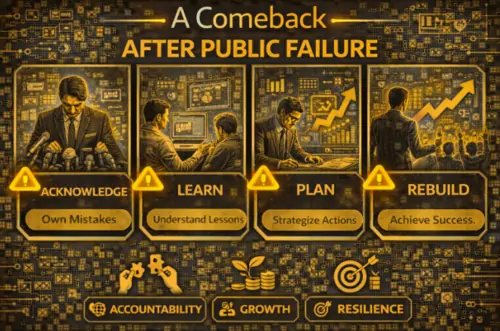
Recovering from a public setback requires a structured approach that focuses on accountability, learning, and rebuilding trust.
Acknowledge the Failure
The first step toward recovery is acknowledging the mistake. Transparent communication can help restore credibility and show responsibility.
Leaders who openly address failures often regain respect faster than those who avoid accountability.
Learn From the Experience
Every failure contains lessons about strategy, leadership, timing, or execution. Identifying what went wrong allows individuals to improve future decisions.
Many successful entrepreneurs say their greatest insights came from analyzing previous failures.
Rebuild Trust
Trust is one of the most valuable assets in business. After public failure, rebuilding trust with stakeholders—employees, customers, and investors—is essential.
This often requires consistent communication, responsible leadership, and delivering on commitments.
Develop a New Strategy
A comeback usually involves a revised strategy based on lessons learned. Leaders may refine their business models, adjust leadership structures, or focus on new markets.
Strategic adaptation is often the difference between repeated failure and long-term recovery.
Maintain Resilience
Resilience is a critical quality in any comeback after public failure. Successful individuals maintain persistence despite setbacks and remain focused on long-term goals.
Resilience allows leaders to transform failure into experience rather than defeat.
Famous Comebacks After Public Failure
Many well-known entrepreneurs and leaders experienced highly visible setbacks before achieving success.
Steve Jobs
Steve Jobs was famously removed from Apple in 1985, the company he helped create. Instead of abandoning his ambitions, he founded NeXT and helped develop Pixar.
Years later, Apple acquired NeXT, and Jobs returned to lead the company. Under his leadership, Apple became one of the most valuable companies in the world.
Walt Disney
Before building the Disney empire, Walt Disney experienced several business failures, including the bankruptcy of his early animation company, Laugh-O-Gram Studio.
Those setbacks did not stop him from pursuing new opportunities. His persistence eventually led to the creation of one of the most successful entertainment brands in history.
Oprah Winfrey
Early in her career, Oprah Winfrey was removed from a television news role because producers believed she was not suited for television. She later reinvented her career in talk shows and became one of the most influential media figures in the world.
These examples show that public failure does not determine long-term success.
Leadership Lessons From Public Failure
A comeback after public failure often produces valuable leadership insights.
Humility
Failure reminds leaders that no strategy is guaranteed. Humility helps leaders stay open to feedback and improvement.
Better Decision-Making
Experience gained from setbacks often improves judgment and strategic thinking.
Stronger Teams
Leaders who recover from failure often place greater emphasis on building resilient teams and stronger organizational cultures.
Long-Term Vision
Failure can shift focus from short-term wins toward sustainable long-term growth.
These lessons often make leaders stronger and more effective.
Turning Failure Into Opportunity
Public failure may appear damaging in the short term, but it can also create opportunities for reinvention.
Many leaders use setbacks to:
- explore new industries
- launch innovative projects
- rethink business models
- strengthen leadership approaches
In many cases, the experience gained through failure becomes a competitive advantage.
Entrepreneurs who learn from failure often develop deeper insight into markets, strategy, and risk management.
The Importance of Reputation Recovery
Reputation is a critical factor in any comeback after public failure. While financial losses can sometimes be recovered quickly, rebuilding credibility may take longer.
Effective reputation recovery includes:
- transparent communication
- responsible leadership behavior
- consistent results over time
Public perception often improves when leaders demonstrate accountability and long-term improvement.
Conclusion
A comeback after public failure is never easy, but it is possible. History shows that many successful entrepreneurs, executives, and public figures experienced major setbacks before achieving their greatest successes.
Public failure can become a turning point when individuals respond with accountability, resilience, and strategic learning. By acknowledging mistakes, rebuilding trust, and adapting to new opportunities, leaders can transform setbacks into powerful lessons.
In the long run, the ability to recover from failure may be one of the most valuable leadership qualities. Those who learn from setbacks often emerge stronger, wiser, and better prepared for future success.
FAQ
What does a comeback after public failure mean?
A comeback after public failure refers to the process of recovering from a widely visible setback and rebuilding success through learning, resilience, and improved strategies.
Can entrepreneurs recover from public failure?
Yes. Many successful entrepreneurs experienced business failures before achieving long-term success.
Why is public failure difficult?
Public failure can affect reputation, credibility, and confidence because it occurs under public scrutiny.
How can leaders rebuild trust after failure?
Leaders can rebuild trust through transparency, accountability, consistent communication, and delivering improved results.
What lessons can be learned from public failure?
Public failure can teach resilience, better decision-making, humility, and the importance of long-term strategy.