

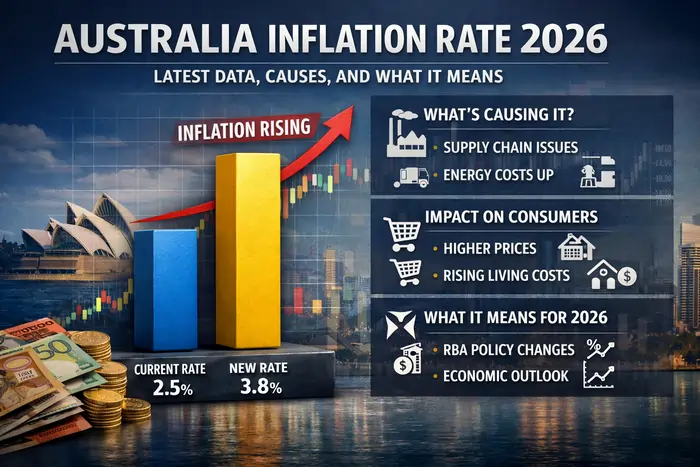
Australia Inflation Rate in 2026 is all about stubbornly high prices, sticky core inflation, and what that means for your budget, your mortgage, and the Reserve Bank’s next moves.
Inflation has stayed front-and-centre in Australia’s economic conversation as 2026 gets underway, with the latest data showing price growth still running above the Reserve Bank of Australia’s preferred 2–3 per cent target band. While the pace of price rises has eased from the peaks of the pandemic years, households are still feeling a persistent cost‑of‑living squeeze driven by housing, energy and everyday essentials.
In this guide, we unpack the latest inflation data, the main causes of Australia’s 2026 inflation rate, and what it all means for households, businesses and the broader outlook.
Overview – Where Inflation Stands in 2026
Inflation is simply the rate at which the general level of prices for goods and services is rising over time, eroding the purchasing power of your money. In Australia, the main gauge is the Consumer Price Index (CPI), published by the Australian Bureau of Statistics (ABS), and watched closely by the RBA when setting interest rates.
As of January 2026, annual CPI inflation sits at 3.8 per cent, unchanged from December 2025, which means prices overall are still climbing faster than the RBA’s 2–3 per cent comfort zone. The central bank’s preferred “underlying” measure, the trimmed mean, is slightly lower but has ticked up to 3.4 per cent, suggesting that price pressures remain broad-based rather than confined to a few volatile categories.
Compared with the peak double‑digit scares of earlier years, today’s inflation rate is lower, but it’s still uncomfortably high for policymakers and households alike. According to the RBA’s February 2026 Statement on Monetary Policy, inflation is now expected to stay above the target range “for a while longer” before gradually easing. You can see the official summary of this outlook in the RBA’s “In Brief: Statement on Monetary Policy – February 2026” on the RBA website.
Latest Inflation Data and Key Numbers
The freshest figures from the ABS show that the CPI rose 3.8 per cent in the 12 months to January 2026, the same annual rate recorded in December. On a monthly basis, prices were broadly stable, but the composition of inflation reveals important shifts beneath the surface.
- Headline CPI: 3.8% year-on-year, slightly above market expectations of 3.7%.
- Trimmed mean (core) inflation: 3.4% year-on-year, up from 3.3% in December, indicating underlying pressures are edging higher.
According to the ABS media release “CPI rose 3.8% in the year to January 2026”, the biggest contributor to annual inflation is Housing, up 6.8 per cent, followed by Food and non‑alcoholic beverages (3.1%) and Recreation and culture (3.7%). You can read the detailed breakdown directly on the ABS website.
The Commonwealth Bank’s January 2026 CPI wrap notes that while headline inflation is flat, underlying measures “edged higher” on the back of housing and electricity costs. Their explainer, “CPI: Housing and energy costs lift but headline inflation flat”, is a useful quick read on the latest data and can be found in the CBA Newsroom.
For at-a-glance charts and historical comparisons, the Australia Inflation Rate page on Trading Economics is a handy visual resource. It shows how inflation has tracked down from higher levels but remains stuck above the RBA’s target.
Main Causes of Australia’s 2026 Inflation
The headline numbers only tell part of the story; understanding what is driving inflation in Australia in 2026 means looking at specific sectors and policy shifts.
Housing and rents
Housing is currently the single biggest driver of annual inflation, with prices up 6.8 per cent over the year to January. This reflects:
- Rising rents amid tight vacancy rates and strong population growth.
- Higher costs for new dwellings, with construction still facing elevated material and labour costs.
An explainer from realestate.com.au notes how housing and electricity costs are fuelling stubborn inflation, linking the rental crisis and construction pipeline to ongoing price pressures. You can explore that context in their article on soaring electricity bills and housing costs on realestate.com.au.
Energy and electricity prices
Electricity costs have surged 32.2 per cent in the 12 months to January 2026, up from 21.5 per cent in December. The ABS attributes much of this jump to households exhausting both the Commonwealth Energy Bill Relief Fund rebates and various state government schemes, which means bills are now reflecting the underlying price of power rather than subsidised rates.
This sharp increase in energy bills is a key reason many households feel like inflation is higher than the headline figure indicates; power bills are both frequent and highly salient in the family budget.
Food and essentials
Food and non‑alcoholic beverages inflation is running at 3.1 per cent, still elevated even though it has eased slightly from 3.4 per cent in December. Within that category, the ABS highlights meals out and takeaway as particularly strong, with prices up 3.9 per cent due to rising wages and ingredient costs.
This dynamic is visible in supermarket results too. For example, coverage of Woolworths’ 2026 profit and food sales shows that shoppers are paying more at the checkout even as retailers face political pressure over pricing practices. You can read more in ABC’s piece on Woolworths shares and food sales on ABC News.
One‑off and global factors
The RBA’s recent speech “Recent Developments in Inflation and the Economic Outlook” argues that part of the pickup in inflation since mid‑2025 reflects sector‑specific pressures and stronger‑than‑expected demand. Some of these influences, such as earlier supply chain issues and temporary support measures rolling off, are expected to fade, while others, like strong domestic spending, may persist.
For a more global, research-heavy view of the drivers, S&P Global’s economic research on Australia highlights how commodity prices, global financial conditions and domestic capacity constraints are all feeding into the inflation outlook. Their report is accessible via the S&P Global Ratings site.
The RBA, Interest Rates, and Policy Response
The Reserve Bank of Australia is tasked with keeping inflation between 2 and 3 per cent on average over time, while also supporting full employment and economic stability. With inflation now firmly above that band and showing signs of persistence, the RBA has shifted back into tightening mode.
At its February 2026 meeting, the RBA Board raised the cash rate by 0.25 percentage points to 3.85 per cent, reversing some of the easing it delivered in 2025 as inflation looked to be coming under control. Reuters reports that the central bank was “forced to raise interest rates” as inflation reaccelerated, and that the RBA is increasingly focused on quarterly trimmed mean readings as a more stable gauge. You can read that analysis via Reuters’ coverage of the RBA and monthly inflation data.
The RBA’s February 2026 Statement on Monetary Policy outlines three key messages:
- Inflation has picked up and is likely to stay above target for some time.
- Stronger‑than‑expected private demand has added to capacity pressures.
- A higher path for interest rates is assumed in forecasts to bring inflation back towards target over the coming years.
For a plain‑English overview of how the RBA thinks about inflation, the explainer “Measures of Consumer Price Inflation” on the RBA website is useful; it covers CPI, trimmed mean and other core measures.
What the Inflation Rate Means for Households
For households, the Australia inflation rate 2026 is not just a macro statistic – it shows up in rent notices, power bills and supermarket receipts.
Cost of living and household budgets
The combination of higher housing, energy and food costs is squeezing disposable incomes, especially for renters and mortgage holders in capital cities. ABC’s coverage of the January CPI release notes that inflation was “slightly hotter than expected”, keeping the prospect of further rate hikes on the table and intensifying political debate about the cost of living. You can read that piece, “Inflation slightly hotter than expected, keeping rate hike on table”, on ABC News.
With rates already higher and the RBA signalling a willingness to tighten further, households with variable‑rate mortgages are seeing repayments climb, leaving less room for discretionary spending.
Real wages and purchasing power
Even if wages are growing, what matters is real wages – pay rises after adjusting for inflation. Survey data from sources like ANZ–Roy Morgan inflation expectations show that Australians still expect prices to rise at a relatively fast pace, which can feed into wage demands and future inflation.
If your wage growth is below the 3.8 per cent inflation rate, your purchasing power is shrinking, meaning each dollar buys less over time. This is why inflation is often described as a “tax” on savings and cash.
Practical tips for households
Articles from major banks and financial advisers stress a few recurring themes for dealing with high inflation and higher interest rates:
- Review fixed vs variable loans and consider whether locking in part of your mortgage makes sense.
- Audit regular bills (energy, subscriptions, insurance) and shop around.
- Build a small buffer where possible, as further rate moves are still a risk.
Perpetual’s “Weekly economic update: Tariffs, inflation and the interest rate outlook” offers a good snapshot of how professionals are thinking about inflation and policy, and includes practical commentary for investors and savers. You can read it on Perpetual’s insights page.
Implications for Businesses and Investors
High inflation and higher interest rates create a challenging landscape for businesses and investors in 2026.
Businesses: costs and pricing power
Businesses face rising input costs (energy, wages, materials) at the same time as customers become more price-sensitive. This can compress profit margins, particularly for smaller firms with less ability to pass on costs. Retailers and consumer‑facing companies also have to navigate political scrutiny around pricing, as seen in the debate over supermarket margins.
Sectors like utilities, resources and some consumer staples may have more pricing power, allowing them to maintain margins, while discretionary retail, hospitality and construction can struggle if demand softens and financing costs rise.
Investors: rates, bonds and equities
For investors, the key questions are how many more rate rises may be coming and how long rates will stay at restrictive levels.
- Bond markets are sensitive to inflation surprises; stronger‑than‑expected CPI prints can push yields higher as traders price in more RBA tightening.
- Equity markets can be more nuanced: some sectors benefit from inflation, while others suffer as borrowing costs and discount rates increase.
Macro commentary from firms like S&P Global and Perpetual emphasises that investors should pay close attention to inflation expectations, not just current CPI, because expectations influence interest rates and asset valuations.
For Australian investors trying to position their portfolios in a higher‑inflation world, it’s crucial to understand both local and global market structures. A good starting point is learning how a major US benchmark works through guides like What Is the Nasdaq Index and Why It Matters to Investors, which explains how tech‑heavy indices respond to interest rate and inflation cycles.
If you’re trading or hedging against inflation via international shares, currencies or CFDs, it’s equally important to assess the platforms you use, including their fees and regulatory protections, which is where a detailed IG Australia Review: Fees, Features, and Is It Safe? can help you compare costs and risks more effectively.
Inflation Expectations and Outlook Beyond 2026
How long will high inflation last in Australia? The answer depends on both economics and policy.
The RBA’s February 2026 Statement on Monetary Policy suggests that inflation is now expected to peak around mid‑2026 before gradually declining towards a little above the midpoint of the target band by mid‑2028. This assumes:
- Some temporary drivers of inflation (like energy rebate changes and specific supply bottlenecks) fade.
- A higher interest rate path dampens demand and cools price growth.
Meanwhile, inflation expectations among households remain elevated. The ANZ–Roy Morgan survey shows inflation expectations around the mid‑5 per cent mark in early 2026, reflecting ongoing cost‑of‑living concerns. Persistent high expectations can be problematic if they become entrenched, prompting businesses and workers to build higher price and wage rises into their plans.
Research pieces such as “Australian forecasts – Economic recovery slows amid rising inflation” from the Australian Industry Group, and S&P Global’s outlooks, warn that risks are tilted to the upside if global commodity prices spike again or domestic wages accelerate faster than productivity.
For a concise snapshot of the RBA’s current inflation forecasts and risks, the In Brief section of the February 2026 Statement on Monetary Policy is one of the most authoritative sources.
Final Thoughts
In 2026, Australia’s inflation rate remains a defining economic challenge: headline CPI stuck at 3.8 per cent, core inflation edging up, and a Reserve Bank willing to raise rates again to wrestle prices back under control. For households, that translates to continued pressure on rents, mortgages, power bills and supermarket costs; for businesses and investors, it means navigating a landscape of higher borrowing costs and shifting consumer behaviour.
To stay on top of the story, it’s worth bookmarking a few key resources: the latest CPI releases on the ABS website, the RBA’s inflation explainers and policy statements on rba.gov.au, and accessible news analysis from outlets like ABC News and Trading Economics.