

In 2026, the world is moving faster than most classrooms can update. Technology is shaping how people work, communicate, and even solve daily problems. That’s why STEM Education Expansion has become one of the most important conversations in education today. It’s not just about producing engineers or programmers. It’s about helping students build problem-solving skills, digital confidence, and future-ready thinking.
For Filipino families, teachers, and school leaders, STEM Education Expansion is not only a global trend. It is a practical pathway toward better job opportunities, stronger communities, and real resilience in a tech-driven world.
This guide explains what STEM Education Expansion means, why it matters, what blocks it, and what solutions actually work—especially in real-world school settings where budgets and resources are limited.
What STEM Education Expansion Means
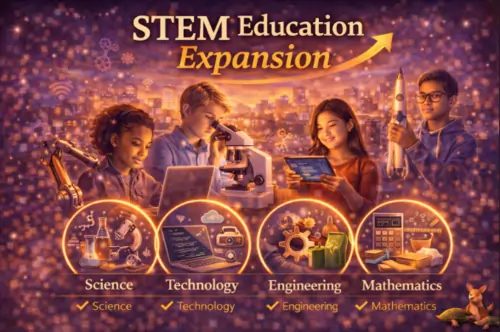
STEM Education Expansion means increasing access to learning in Science, Technology, Engineering, and Mathematics. Expansion can happen in many ways, including:
- More STEM programs in schools
- Better STEM labs, devices, and learning tools
- More trained teachers in math, science, and technology
- Stronger curriculum that includes hands-on projects
- Community programs like STEM clubs and weekend workshops
Some people also mention STEAM (adding Arts), but STEM Education Expansion remains focused on building strong technical thinking and scientific problem-solving.
At its best, STEM Education Expansion is not about memorizing formulas. It is about learning how to think, test, build, and improve ideas.
Why STEM Education Expansion Matters in 2026
The reason STEM Education Expansion matters now is simple: STEM skills are becoming basic life skills.
The job market is changing
Jobs increasingly require:
- Digital literacy
- Data awareness
- Basic coding or tech familiarity
- Critical thinking and structured problem-solving
Even careers that are not “tech jobs” now use technology daily—healthcare, business, logistics, education, and creative work.
AI and cybersecurity affect everyday life
Students need to understand:
- How AI works at a basic level
- How to check information and avoid misinformation
- How to protect accounts and personal data
This is why STEM Education Expansion is now linked to safety, decision-making, and everyday independence.
STEM supports innovation and national growth
Countries that invest in STEM build stronger industries, better research, and more resilient economies. STEM Education Expansion can improve a country’s ability to create solutions instead of only consuming imported technologies.
STEM expansion helps close inequality
Without access, only students in well-funded schools benefit from modern learning. STEM Education Expansion helps narrow gaps for:
- Rural communities
- Low-income families
- Girls and young women in STEM
- Students with disabilities
Barriers to STEM Education Expansion
If STEM Education Expansion is so important, why is it still difficult? Because multiple barriers exist at the same time.
Lack of teachers and training
Many systems struggle to hire and retain qualified teachers in:
- Mathematics
- Science
- Computer education
- Engineering-related electives
Even existing teachers may need training to teach modern STEM topics confidently.
Budget and infrastructure gaps
STEM needs tools:
- Labs and science materials
- Devices like computers or tablets
- Stable internet connection
- Maintenance and tech support
Without these, STEM Education Expansion becomes uneven. Some schools advance quickly while others fall behind.
Curriculum challenges
Some curriculum designs remain too theoretical. Students memorize, but don’t build. Strong STEM Education Expansion requires:
- Hands-on experiments
- Projects and prototypes
- Real-world problem-solving
Student mindset and confidence
Many students struggle with “math anxiety” or fear of failure. STEM learning involves mistakes, trial, and improvement. If students feel judged, they avoid STEM.
This makes STEM Education Expansion not just an academic issue, but also a confidence-building challenge.
Equity and access issues
Students in rural areas may lack:
- Devices
- Reliable internet
- STEM mentors
- Exposure to STEM careers
True STEM Education Expansion means solving access, not just adding new content.
What Effective STEM Education Expansion Looks Like
Successful STEM Education Expansion is not about fancy equipment alone. It’s about the learning experience.
Hands-on, project-based learning
Students learn more when they build. Examples:
- Simple science experiments
- Coding small programs
- Designing solutions to local problems (flooding, waste, water use)
- Building prototypes using low-cost materials
Project-based learning makes STEM feel real, not abstract. That is a core goal of STEM Education Expansion.
Strong teacher support
Teachers need:
- Training and coaching
- Shared lesson resources
- Time for planning
- Communities of practice
When teachers feel supported, STEM Education Expansion becomes sustainable.
Partnerships that scale access
Partnerships can unlock resources:
- Universities and research institutions
- NGOs and community groups
- Tech companies providing mentors
- Local government support for labs and connectivity
Partnerships are often the fastest way to accelerate STEM Education Expansion in resource-limited settings.
Affordable tools and open resources
Not all STEM requires expensive labs. Schools can use:
- Low-cost science kits
- DIY materials for engineering challenges
- Open-source software
- Free coding platforms
This is how STEM Education Expansion becomes possible even with small budgets.
Inclusive design
STEM expansion should include:
- Programs that encourage girls in STEM
- Accessible tools for students with disabilities
- Safe classroom environments where mistakes are normal
Inclusive learning is part of modern STEM Education Expansion.
STEM Education Expansion Strategies at the School Level
Schools can implement STEM Education Expansion through practical steps:
Teacher upskilling
- Short training modules in coding, data literacy, and lab safety
- Peer coaching and lesson-sharing
STEM clubs and competitions
- Robotics clubs, science fairs, math challenges
- Portfolio-building projects
Makerspaces and mini-labs
- Small “STEM corners” with basic tools
- Rotating kits shared across classes
Integrate coding and data literacy
- Not just in one subject
- Across math, science, and even social studies
Parent engagement
- Career talks and STEM exposure sessions
- Home learning support strategies
STEM Education Expansion Strategies at the Community Level
Communities can also support STEM Education Expansion:
Community tech hubs
- Shared spaces with internet and devices
Weekend STEM workshops
- Coding basics, robotics demos, science experiments
Mobile labs
- Bringing experiments and devices to remote areas
Scholarships and sponsorships
- Supporting students with talent but limited access
STEM Education Expansion in the Philippines: A Local View
In the Philippines, the K–12 system includes a STEM strand in Senior High School, which is a strong foundation for careers in:
- Engineering
- IT and software development
- Healthcare and medical fields
- Architecture and design tech
- Data and analytics
However, challenges often include:
- Uneven access to devices and connectivity
- Limited lab resources
- Teacher workload and shortages
- Gaps between curriculum goals and classroom reality
That’s why Philippine-focused STEM often works best through blended strategies: improving school resources, building partnerships, and creating community support.
How to Measure Success
To know if STEM is working, schools and communities can track:
- Enrollment and retention in STEM programs
- Student projects and portfolios (real outputs)
- Skills growth, not just test scores
- Participation of underrepresented groups
- Post-graduation outcomes (college STEM pathways, internships, jobs)
Good measurement helps funding decisions and shows what approaches truly improve learning.
Future Trends in STEM Education Expansion
We can expect STEM Education Expansion to include:
- AI literacy integrated into lessons
- Cybersecurity basics taught earlier
- Data skills included across subjects
- Micro-credentials and modular learning
- More hybrid learning tools for labs and simulations
The goal is to make STEM learning more flexible, more practical, and more connected to real-world needs.
FAQs
What is the best age to start STEM learning?
Early exposure is best. Even elementary students can build STEM thinking through simple experiments and puzzles.
How can schools expand STEM with small budgets?
Focus on project-based learning, low-cost kits, open resources, and partnerships.
Is coding required for STEM success?
Not always, but basic coding literacy is increasingly helpful for many STEM pathways.
How do we support girls in STEM?
Provide role models, safe spaces, encouragement, and inclusive learning environments.
What can parents do at home?
Encourage curiosity, support math confidence, provide simple STEM activities, and celebrate effort—not just correct answers.
Final Thoughts
It is one of the strongest investments a community can make. It builds skills that students carry into any career: critical thinking, problem-solving, teamwork, and digital confidence.
When schools and communities commit to STEM Education Expansion, they do more than prepare students for jobs. They prepare students to solve real problems and build better futures—one project, one lesson, and one opportunity at a time.