

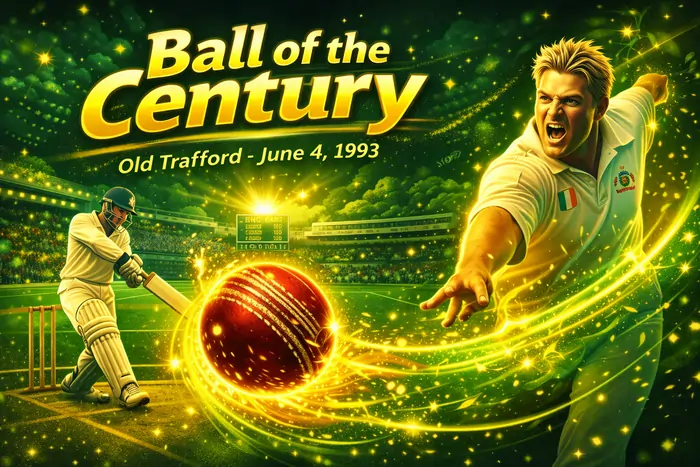
Ball of the Century Explained: Shane Warne’s “Ball of the Century” is widely regarded as the most iconic single delivery ever bowled, a perfect leg-break that showcased the art of spin and symbolised the revival of wrist-spin in modern cricket. Delivered to Mike Gatting at Old Trafford in 1993, it combined revolutions, drift, dip, and extraordinary turn in a way that stunned both batter and spectators and instantly changed the trajectory of Warne’s career.
For readers who want to explore his full journey, records, and Ashes dominance, see our complete guide to Shane Warne Biography, Career Stats, Ashes Glory and Legacy.
Setting the Stage: Ashes 1993 and Warne’s Situation
When Shane Warne ran in to bowl that fateful ball on 4 June 1993, he was still relatively new to international cricket and largely unknown to English crowds. Australia and England were contesting the first Test of the Ashes series at Old Trafford in Manchester, with the hosts in a decent position after bowling Australia out for 289 on a turning surface.
England captain Graham Gooch had turned to his experienced middle‑order batter Mike Gatting, believed to be one of the side’s best players of spin, to anchor the reply. Warne was about to bowl his first ever delivery in Ashes cricket, a moment heavy with opportunity but not yet with legend. For many spectators, he looked like a bowler with a modest run‑up and some promise, but nobody anticipated the magic that was about to unfold.
The conditions were helpful for spin: the Old Trafford pitch had taken some turn, and footmarks were beginning to appear outside the right‑handers’ leg stump. However, helping conditions alone cannot explain what followed. The Ball of the Century would become famous because it combined a favourable surface with supreme skill and nerve at the exact moment when the world was watching.
For a concise background on the match context, the dedicated entry on the Ball of the Century summarises the setting and why this single delivery came to represent far more than one wicket.
Ball of the Century Explained – The Delivery Step by Step
From a purely mechanical standpoint, Warne’s action for the Ball of the Century was typical of his style: a short, economical run‑up, a strong sideways position at the crease, and a powerful snap of the right arm and wrist at release. He approached with only three or four paces, then pivoted and rotated his shoulders and hips to generate immense revolutions on the ball.
To a casual observer, the ball initially looked innocuous. As it left his hand, it was headed down what seemed like a leg‑side line, apparently drifting towards Gatting’s pads. Gatting, reading the line as safe, moved forward slightly, preparing either to defend with bat and pad together or to let the ball pass comfortably. This is where Warne’s skill began to separate this delivery from an ordinary leg‑break.
Because of the enormous spin he had imparted, the ball experienced significant drift in the air, moving sideways from off to leg (from Warne’s perspective) as it travelled towards the batter. This drift is a hallmark of top‑class spin bowling and is caused by the Magnus effect—rotating objects in a fluid (in this case, air) experience a force that makes them deviate from a straight path. Slow‑motion replays show the ball curving further across Gatting than he anticipated, adding to the deception.
The ball then pitched several inches outside Gatting’s leg stump, an area most batters consider relatively safe because deliveries from there rarely threaten the off stump. On many pitches, a leg‑break from that line would either spin past leg stump or turn modestly into the pads, perhaps creating lbw opportunities but not bowling the batter. Instead, Warne’s ball gripped the surface and turned savagely across Gatting, spinning almost the width of his body to hit the top of off stump.
The sequence happened so quickly that Gatting did not move after the ball passed him; he simply stood there, looking back at the shattered stumps with an expression of total disbelief. Umpire Dickie Bird and fielders took a moment to process what had occurred, before the enormity of the dismissal sank in and the crowd erupted.
ESPNcricinfo’s feature “Rewind to 1993: The ball of the century” recounts this sequence from a contemporary journalist’s perspective, capturing how the ball seemed harmless before “fizzing back” to clip the top of off stump. For those who want to see the moment visually, Wisden’s article includes the famous footage in “Watch: The Shane Warne Ball of the Century,” allowing you to study the drift, dip, and turn yourself.
Ball of the Century Explained – Why It Was Technically Extraordinary
To understand why Warne’s Ball of the Century is so revered, it helps to break down the technical components that made it exceptional: revs, drift, dip, pitch position, and turn.
First, Warne’s ability to put massive revolutions on the ball was crucial. Modern leg‑spinners often speak of how he generated “revs” through powerful wrists and strong shoulders, ensuring that the seam rotated rapidly and consistently. More revolutions mean the ball is more likely to drift in the air and then grip the surface, creating sharp turn after pitching. Leg‑spinners like Piyush Chawla and Dinanath Ramnarine, interviewed in ESPN’s retrospective, describe the delivery as a dream ball precisely because of the combination of drift, dip, and violent spin it displayed.
Second, the drift of the ball before pitching was highly deceptive. Typically, when a leg‑spinner aims outside leg stump, the ball will drift slightly inward and then turn away after bouncing, finishing somewhere in the region of off stump or just outside. In this case, the ball drifted so far towards Gatting’s legs that it reinforced his assumption that it was not a threat to his off stump. That misjudgement was exactly what Warne had hoped to induce.
Third, the ball dipped as it neared the batter, landing slightly shorter than a standard length. Dip is vital because it makes a batter misread the length, encouraging them to come forward when they should stay back, or vice versa. Gatting did not get fully to the pitch of the ball, leaving a small but crucial distance between his bat and pad where the ball could turn and slip through.
Fourth, the pitch position—so far outside leg stump—was itself a psychological weapon. Batters are trained to not worry too much about balls that pitch that wide of the leg stump because they rarely threaten the stumps directly. Warne exploited that expectation, starting the ball where Gatting felt safe, then using the surface and spin to bring it back dramatically.
Finally, the amount of turn was extraordinary even on a helpful pitch. Contemporary reports and later analyses note that the ball appeared to turn close to a batsman’s full width, a feat that astonished many experts. While some commentators, such as former fast bowler Fred Trueman, initially suggested that the ball’s greatness was partly due to rough footmarks outside leg stump, even skeptics later acknowledged Warne’s brilliance in exploiting those conditions.
For a technical discussion of what makes this delivery the “perfect leg‑break,” ESPN’s piece “Legspinners look back at Shane Warne’s ball of the century” offers insights from modern wrist‑spinners about revs, drift, and hip drive, explaining how all those elements came together in that one ball. The core narrative and mechanics are also clearly summarised in the Ball of the Century article, which dissects the delivery in accessible language.
Warne’s Own View: Mindset Behind the Magic
Perhaps the most fascinating perspective comes from Warne himself. Reflecting years later on the Ball of the Century, he explained that he knew he needed to “spin the ball as far as he could” to make an early statement in the series. He was bowling to Mike Gatting, whom he considered one of the best players of spin in the world, and he wanted to test Gatting’s technique and confidence immediately.
Warne said that when the ball left his hand, he simply thought it was a good delivery, not necessarily something destined for immortality. In an interview cited by Sporf, he described it as “the perfect leg break,” adding that it was the kind of ball leg‑spinners dream of bowling but rarely achieve. He also admitted that to do it with his first ball in Ashes cricket was a “fluke,” emphasising that he never reproduced that exact combination of factors again.
Psychologically, this mindset is significant. Warne approached the moment with intent—to attack a strong batter, to trust his spin, and to aim big rather than play safe. His confidence in his own skill allowed him to release the ball with full commitment, knowing that if he put maximum revs on it and landed it in the right area, the pitch and conditions would do the rest.
The article “Shane Warne explained what made the Ball of the Century so perfect” offers a focused look at his own explanation, giving readers direct insight into his thinking, preparation, and how he processed the aftermath of that remarkable ball.
Reactions: Gatting, Commentators, and the Cricket World
The immediate reaction to the Ball of the Century was a mixture of shock, amusement, and awe. Mike Gatting himself stood rooted at the crease, almost unable to comprehend how a ball that started outside leg stump had ended up hitting the top of off. Commentators and journalists seized on the moment, coining phrases and analogies that would stick for decades.
British journalist Martin Johnson famously wrote that the delivery “boggles the mind,” wondering how anyone could spin the ball “the width of Gatting.” Another line joked that if the ball had been a cheese roll, it would never have got past Gatting, a humorous way of acknowledging both Gatting’s reputation as a good player of spin and his physical presence at the crease. Such quips became part of cricket folklore, retold in articles and broadcasts whenever the ball is discussed.
Not everyone was immediately convinced it was a once‑in‑a‑century delivery. Fred Trueman, the outspoken former England fast bowler, initially downplayed the ball, arguing that it had pitched in rough footmarks and that Gatting had misplayed it badly by not simply padding it away. Over time, however, even critical voices came to concede that Warne’s skill and the sheer audacity of the moment made it something special.
From a broader perspective, the cricket world responded as if a new star had been born on the spot. For many spectators outside Australia, this was their first extended look at Shane Warne, and the combination of spectacle and effectiveness left a deep impression. BBC Sport’s feature “Shane Warne: Remembering the ‘ball of the century’” recounts how his “coronation as the king of spin bowling” was as swift as it was unexpected, with the ball instantly becoming a symbol of his genius.
Graham Gooch and other senior players would later reflect on the moment as a turning point not just in that series but in how teams thought about facing high‑class leg spin. Interviews and documentaries regularly feature former England players revisiting that dismissal, testifying to how deeply it etched itself into their memories.
To relive these reactions and the broadcast commentary, the BBC’s “ball of the century” feature and Wisden’s video‑backed piece are excellent multimedia resources, combining narrative with original footage.
Tactical and Psychological Impact on the Ashes
Beyond its highlight‑reel appeal, the Ball of the Century had concrete tactical implications for the 1993 Ashes series. By clean‑bowling Gatting—a player specifically picked for his ability against spin—Warne sent a message that even England’s best were vulnerable. Batsmen now approached his spells not just with technical plans but with an undercurrent of anxiety: if he could produce something like that, then no line or length was truly safe.
From that point on, Warne’s presence allowed Australian captains to attack with more confidence. Fielders crowded around the bat, and England’s middle order faced relentless pressure each time Warne came on to bowl. The dismissal at Old Trafford helped Australia seize the initiative in the series, as Warne went on to claim eight wickets in the match and become Player of the Match.
Psychologically, the ball altered the narrative of the rivalry. English batters had to prepare for a bowler who could not only exploit rough patches and helpful pitches but also create something extraordinary out of seemingly innocuous situations. Footage from later Tests shows batters more tentative with their feet and more inclined to make pre‑emptive moves to cover the big leg‑break, opening themselves up to other variations.
This mental edge is a big part of why the ball is said to have “changed Warne’s life.” It instantly elevated his status in the eyes of opponents and fans, giving him a psychological advantage that he would exploit for the rest of his career. The India Today anniversary feature “June 4, 1993: Shane Warne’s ball of the century to Mike Gatting” highlights how Warne himself acknowledged that the ball transformed his career and public image.
Legacy: Why the Ball Still Matters
Three decades on, Warne’s Ball of the Century remains a touchstone for how we talk about leg spin and cricketing genius. Coaches still use it as a teaching aid to demonstrate drift, dip, and turn; young spinners study it to understand what is possible when you fully commit to your craft. It appears in countless highlight packages, documentaries, and tributes whenever Warne’s name is mentioned.
The ball also changed the way fans and players thought about wrist‑spin. At a time when many teams were moving away from leg‑spinners because of the perceived risk of bad balls, Warne showed that a master leggie could be a match‑winner even in high‑stakes series. That realisation helped pave the way for a new generation of wrist‑spinners from around the world, who grew up not just hearing about Warne but watching that single delivery as the “pinnacle of leg‑spin bowling.”
In the broader cultural story of cricket, the Ball of the Century has become a symbol of how a single moment of brilliance can redefine a player’s legacy and reshape a sport’s narrative. It is referenced in articles about Mike Gatting’s career, remembered whenever discussions of great deliveries arise, and remains a central chapter in any serious analysis of Warne’s impact.
For anyone wanting to dig deeper, a great starting point is the Ball of the Century article, which offers a structured overview, followed by ESPNcricinfo’s rewind feature on the ball of the century for narrative colour and player quotes. From there, you can move to ESPN’s leg‑spinners’ perspectives piece and Warne’s own explanation in Sporf’s “Shane Warne explained what made the Ball of the Century so perfect” to gain a complete, multi‑angle understanding of why this one ball still captivates the cricket world.
The Ball of the Century remains one of the defining moments of Warne’s remarkable career. To understand how this delivery fits into his broader achievements, records, and influence on world cricket, read the full Shane Warne Biography, Career Stats, Ashes Glory and Legacy guide.