

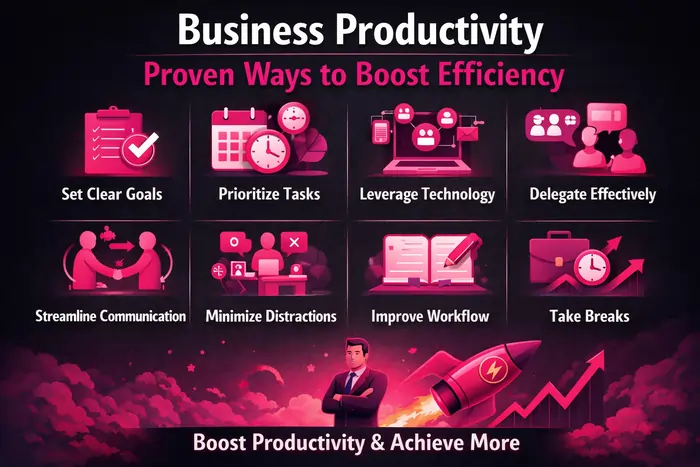
A business can have great products and a talented team and still feel like it’s “stuck in second gear” if productivity is low. Boosting efficiency isn’t about squeezing people harder—it’s about smarter processes, clear priorities, the right tools, and a culture that supports focused work.
Why Business Productivity Matters More Than Ever
In a competitive market, productivity is the lever that lets you do more with the same headcount and budget. IBM notes that higher productivity improves margins, customer satisfaction, and the ability to invest in innovation without necessarily increasing costs. RingCentral adds that when workflows, employee engagement and workspace design are optimised together, businesses see faster delivery times, fewer errors, and more capacity to scale.
At the same time, workplace data shows how much room there is for improvement. Time Doctor’s workplace productivity statistics highlight that many employees report being productive less than 75% of the time and that a significant portion of the day is lost to non‑strategic work and distractions. WorkTime’s 2026 employee productivity trends similarly find that office workers average under three hours of truly focused work per day, with engagement and smart management dramatically changing that picture.
Against that backdrop, Business Productivity: Proven Ways to Boost Efficiency is really about building a system where the right work happens, at the right time, with the least friction.
Step 1: Get Clear on What “Productivity” Means for Your Business
Before installing new tools or launching initiatives, you need a clear definition of productivity for your context.
IBM’s What can a business do to improve its productivity? stresses that a productivity strategy must start with business goals and consider factors like burnout, process bottlenecks and workforce composition. AnswerConnect’s 11 essential strategies to improve business productivity similarly advises setting measurable objectives that link directly to your vision and priorities.
You can:
- Translate strategic goals into SMART targets for teams and individuals (Specific, Measurable, Achievable, Relevant, Time‑bound), as recommended by Time Doctor.
- Identify key output and quality metrics (projects completed, cycle time, error rates, client satisfaction) rather than just “hours worked.”
- Decide which activities are high‑leverage for your business—sales calls, product development, customer delivery—and make them the focus of optimisation.
The Business Development Bank of Canada’s guide How to make your service business more productive suggests taking a step‑by‑step approach, redesigning a few critical processes at a time and measuring results.
Step 2: Streamline Processes and Remove Friction
Once you know what you’re optimising, the next step is to remove drag from everyday work.
Map and simplify workflows
Reclaim’s Top 12 Strategies to Improve Business Productivity (2026 Guide) recommends first taking a close look at current processes: where work gets stuck, where approvals pile up, and where people duplicate effort. MyHours’ 8 Top Strategies and Metrics to Improve Business Productivity stresses that you should treat process improvement as ongoing—reviewing and updating workflows regularly.
Practical moves include:
- Document the actual steps for critical processes (sales, onboarding, support) and look for unnecessary handoffs or delays.
- Standardise common tasks using checklists and templates to reduce decision fatigue and errors.
- Assign specific teams to specific processes for redesign, as BDC suggests, rather than trying to fix everything at once.
Apply the 80/20 rule to focus on high‑impact work
Time‑management frameworks can help you prioritise where to optimise. Marc Zao‑Sanders’ 30 time management techniques and Float’s time management strategies for PMs highlight the Pareto principle (80/20 rule): 80% of outcomes come from 20% of activities.
HPT’s Time Management Model: The Pareto Principle explains how to apply it:
- Identify the 20% of tasks that generate 80% of value.
- Prioritise those tasks, and delegate, automate or drop lower‑impact work.
- Continuously review and refine to ensure your team is spending time where it matters most.
This mindset shift—from “do everything” to “do the most important things better”—is central to sustainable productivity.
Step 3: Leverage Technology and Automation (Without Burning People Out)
Technology can either amplify productivity or create more digital noise. The key is targeted use.
Use tools that cut repetitive work
Reclaim’s guide emphasises automation and the right tech stack as a major productivity booster: scheduling, communication, and specialised software can free people from low‑value admin. MyHours shows how time‑tracking tools can streamline billing, project management and reporting, giving leaders a clear view of where time actually goes.
RingCentral’s How to improve business productivity: 3 key areas to optimize suggests focusing on three categories:
- Communication and collaboration tools (chat, video, shared channels)
- Workflow and project management platforms
- Telephony/contact centre tools for customer‑facing teams
Slack’s Top 10 Strategies for Increasing Productivity at Work adds that streamlining communication channels, using shared channels for cross‑team collaboration, and automating routine tasks (including with AI) prevents information overload and redundant work.
Measure without micromanaging
Productivity analytics can be powerful when handled carefully. Time Doctor’s and Hubstaff’s workplace productivity statistics show that time‑tracking and app‑usage data can reveal underutilised tools, time‑consuming processes and opportunities to adopt asynchronous work. WorkTime’s 2026 data shows non‑invasive monitoring increased active time by up to 46% in some case studies, but also warns that surveillance‑style monitoring can backfire if employees feel unfairly watched.
The healthy pattern (from Time Doctor, WorkTime and Reclaim) is:
- Track high‑level metrics (focused time, context‑switching, process bottlenecks), not every keystroke.
- Share data transparently and use it for joint problem‑solving, not punishment.
- Combine productivity metrics with burnout indicators (overtime, absenteeism, error rates) to avoid over‑driving teams.
Step 4: Invest in People—Skills, Autonomy and Wellbeing
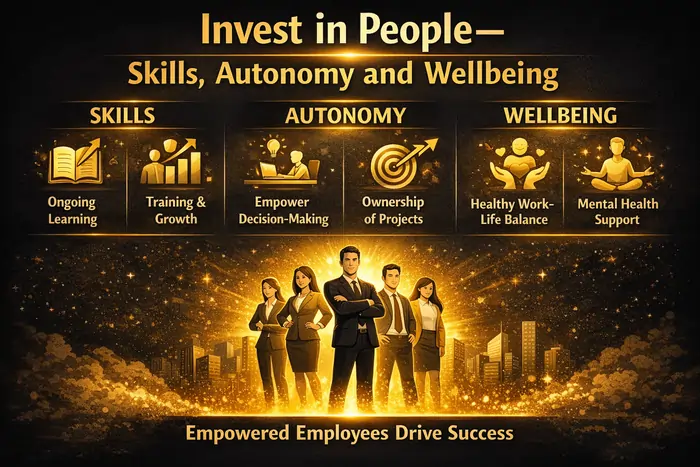
You can’t optimise processes and tools while ignoring the people doing the work.
Train, upskill and align roles to strengths
AnswerConnect notes that investing in training and development significantly boosts productivity by increasing proficiency, adaptability and engagement. Their article lists benefits of ongoing development: better teamwork, higher morale, and a clear signal that the organisation values employee growth.
Reclaim’s 2026 guide and MyHours’ strategies both recommend:
- Identifying skills gaps based on actual work and performance data.
- Offering targeted learning opportunities (courses, mentoring, job shadowing).
- Matching tasks and roles to people’s strengths to reduce friction and increase flow.
BDC adds that delegating tasks based on strengths and expertise is a practical way to reduce bottlenecks and increase throughput in service businesses.
Create conditions for engagement and focus
WorkTime’s 2026 statistics highlight how manager behaviour and employee experience influence productivity: teams with highly engaged managers see employees active 80% of the day, with around 75% of that time spent on productive work. Bucketlist Rewards’ analysis of workplace productivity and recognition statistics shows that nearly 78% of employees say they’d be more productive if they were consistently recognised, and that flexible work plus wellbeing programs correlate with higher performance.
To turn that into practice, many guides (IBM, AnswerConnect, Reclaim, Time Doctor) suggest:
- Encouraging regular, quality breaks instead of glorifying constant grind.
- Offering flexible or hybrid work where possible.
- Implementing recognition programs for meaningful contributions.
- Building psychological safety so people raise issues early and propose improvements.
Step 5: Improve Time Management and Focus at Team Level
Individual productivity techniques become far more powerful when teams adopt them consistently.
Use proven prioritisation and time‑blocking techniques
Marc Zao‑Sanders’ 30 time management techniques and Float’s time‑management guide highlight methods like:
- Eisenhower Matrix – categorising tasks by urgency and importance, to avoid spending time on low‑value urgent work.
- Time blocking – dedicating specific calendar blocks to focused work, meetings and admin.
- Getting Things Done (GTD) – capturing, clarifying and organising tasks into trusted systems.
AnswerConnect recommends techniques such as the Pomodoro Technique (25 minutes work, 5 minutes break) and task batching (grouping similar tasks) to reduce context switching and cognitive overload. Apploye’s I Tried 11 Methods that Improved Workplace Productivity echoes this, suggesting teams use morning energy for deep work, plan the day in advance, and avoid constant multitasking.
Align calendars with priorities
Reclaim emphasises using intelligent scheduling tools to protect focus time, auto‑schedule recurring tasks, and prevent meeting overload. MyHours and Time Doctor both show that once you see where time goes—via time‑tracking or calendar analytics—you can shift schedules to support uninterrupted work on the most important tasks.
Step 6: Strengthen Communication and Collaboration
Poor communication is a hidden productivity killer: duplicated work, misaligned expectations, and endless clarification meetings.
Slack’s Top 10 Strategies for Increasing Productivity at Work recommends:
- Streamlining communication channels (avoiding fragmented conversations across too many tools).
- Using shared channels for cross‑team collaboration to reduce email chains and information silos.
- Removing low‑value tasks with AI (summarising threads, drafting responses, scheduling).
RingCentral similarly suggests consolidating communication platforms and integrating them with CRM and project tools so teams have a single source of truth about customers and projects. BDC’s productivity guide adds that putting a formal suggestion system in place and assigning teams to specific problems encourages front‑line staff to surface improvements, not just management.
Step 7: Design a Workspace That Supports Productivity
Environment matters more than many leaders realise.
RingCentral’s article notes that physical layouts, noise levels and access to collaboration spaces all affect how easily people can focus and interact. WorkTime’s statistics show that regular breaks and a positive employee experience correlate with higher productivity and lower turnover.
Practical considerations include:
- Providing quiet zones or focus rooms for deep work.
- Ensuring teams that collaborate frequently are co‑located (physically or via always‑on digital spaces).
- Offering ergonomic setups and healthy snacks, as MyHours suggests, to reduce fatigue and health‑related productivity dips.
For distributed teams, “workspace” also means digital: are your tools easy to navigate? Do people have clear norms around response times and meeting etiquette? Slack, RingCentral and Reclaim all highlight how explicit communication norms reduce interruptions and increase async work.
Step 8: Measure, Learn and Iterate
The most productive businesses treat optimisation as an ongoing cycle: test, measure, learn, repeat.
Time Doctor recommends translating organisational goals into SMART metrics, using analytics to track productivity, and then centralising data from different tools to see where time is really spent. Reclaim suggests regularly reviewing process and time‑use data, then adjusting workflows, tools and schedules rather than assuming the first solution is perfect.
BDC and MyHours both stress that you should:
- Start with a few high‑impact priorities instead of trying to optimise everything.
- Measure results (cycle times, output, error rates, employee engagement).
- Share outcomes with teams and involve them in deciding the next round of changes.
Bucketlist Rewards’ stats on recognition and wellbeing reinforce that listening to employees—and adjusting based on their feedback—creates a virtuous cycle of trust, engagement and productivity.
Final Thoughts: Building a Sustainable Productivity System
Boosting business productivity isn’t about pushing people to work longer hours; it’s about aligning goals, processes, tools, environment and culture so that focused, meaningful work becomes the default. Research‑backed strategies—from mapping workflows and applying the 80/20 rule, to investing in training, using automation wisely, and tracking the right metrics—can help any organisation move from constant firefighting to steady, scalable execution.
If you’re looking to take the mindset side of this further, many leaders are also exploring how a growth mindset fuels innovation and long‑term performance, as discussed in pieces like Growth Mindset: The Secret to Australia’s 2026 Economic Boom. Combined with the practical productivity tactics above, that kind of cultural shift can turn incremental improvements into a genuine competitive advantage.
Which area do you feel is your biggest productivity bottleneck right now—processes, tools, or people and culture?