

A fixed mindset quietly shapes how you see your abilities, potential and future—and when you don’t notice it, it can keep you stuck in the same patterns at work, in relationships and in your own growth. The good news is that once you can spot the signs, you can start shifting toward a growth mindset that supports learning, resilience and long‑term success.
What a Fixed Mindset Actually Is
Psychologist Carol Dweck’s research shows that our beliefs about ability tend to fall into two broad camps: fixed and growth.
- A fixed mindset assumes intelligence, talent and personality are largely innate and unchangeable—you “have a certain amount and that’s that.”
- A growth mindset assumes abilities can be developed through effort, good strategies and learning, so mistakes are feedback rather than a verdict on your worth.
Maria Popova’s essay Fixed vs. Growth: The Two Basic Mindsets That Shape Our Lives summarises Dweck’s findings: people in a fixed mindset tend to chase approval and strive to prove they’re smart or talented, while those in a growth mindset care more about getting better and treat setbacks as information. A concise overview from The Decision Lab adds that fixed mindsets heighten stress and pressure because you feel like every test or project is a judgment of your innate ability.
If you want a high‑level refresher on the theory before going deeper, Carol Dweck: A Summary of Growth and Fixed Mindsets and Fixed and Growth Mindset Theory offer accessible summaries of how these beliefs shape behaviour.
Subtle Signs a Fixed Mindset Is Holding You Back
A fixed mindset rarely announces itself directly; it shows up in your inner dialogue and everyday choices. Several sources outline common patterns to watch for.
1. You see your abilities as “just who I am”
Nerva Health defines a fixed mindset as seeing intelligence and ability as static traits rather than skills that can grow. Typical thoughts include:
- “I’m just not a numbers person / creative type / leader.”
- “I’ll never be good at speaking / managing / selling—people are just born with that.”
The Decision Lab notes that this belief makes you more likely to feel under constant evaluation and less likely to seek growth opportunities, because you assume your ceiling is already set.
2. You avoid challenges and new experiences
People with a fixed mindset often avoid situations where they might fail or look inexperienced.
Intelligent Change’s article How Having a Fixed Mindset Can Hold You Back includes a checklist that captures this pattern: do you give up easily when you’re not good at something, feel threatened by others’ success, or fear change? Mentorloop similarly notes that those with a fixed mindset “may feel more secure in their abilities, but they may also be more likely to hold themselves back from new experiences and challenges.”
3. You give up quickly when things get hard
Shortform’s 6 Fixed Mindset Examples describes how people with a fixed mindset often interpret early difficulties as proof they’re not cut out for something. If you find yourself thinking “if it doesn’t come easily, I’m not meant to do it” and dropping efforts after a few setbacks, that’s a hallmark fixed‑mindset response.
4. You feel attacked by feedback
Reejig’s interview Mindset Matters: Warning signs of a fixed mindset and Intelligent Change both point out that people with a fixed mindset often:
- Perceive feedback as criticism rather than useful data
- Become defensive or shut down when confronted with mistakes
- Avoid performance reviews, coaching or mentoring conversations
Because you see abilities as fixed, any critique feels like a global judgment of your worth rather than a specific pointer you can act on.
5. You feel threatened by others’ success
When you believe everyone has a limited “slice of talent,” someone else doing well can feel like proof that you’re lacking. Intelligent Change notes that people with a fixed mindset often feel threatened by other people’s success and may prefer to surround themselves with those who won’t challenge their worldview. Shortform adds that children raised in fixed‑mindset environments often fear losing approval if they fail, so they’re hyper‑sensitive to how they compare with others.
6. Your self‑talk is rigid, harsh and absolute
Jo Mitchell suggests listening to your language for clues: fixed‑mindset thinking often sounds like “I’m not good enough,” “I’ll never be able to do that,” or “I’m just not that kind of person.” The ABC article A fixed mindset could be holding you back — here’s how to change it notes that this rigidity can show up in how you respond to mistakes—seeing them as permanent labels (“I’m hopeless”) instead of temporary events.
If several of these signs feel familiar, your mindset may be quietly limiting what you’re willing to try and how far you’re prepared to push yourself.
How a Fixed Mindset Limits Your Career, Relationships and Wellbeing
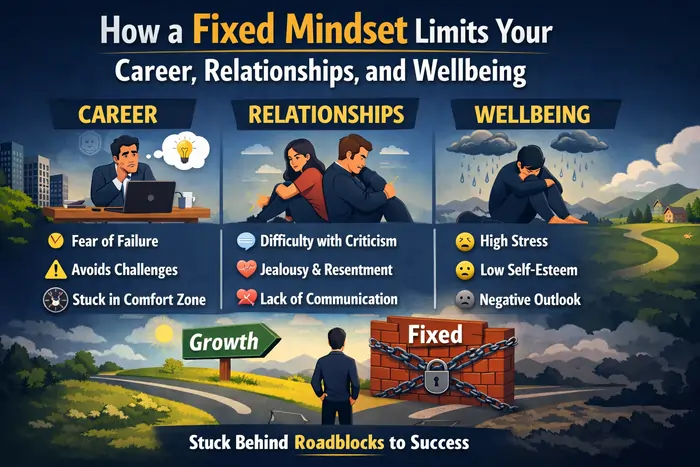
A fixed mindset isn’t just a belief; it drives specific choices that add up over time.
At work: stalled growth and fragile confidence
When you assume your capability is fixed, work becomes a constant test rather than a learning ground. Reejig’s interview with Jo Mitchell explains that leaders who operate from a fixed mindset tend to:
- Avoid stretch goals or new responsibilities for themselves and their teams
- Treat mistakes as something to hide rather than learn from
- Resist feedback, which in turn stagnates motivation, engagement and performance
Intelligent Change points out that people with a fixed mindset often invest energy in hiding deficiencies rather than overcoming them, and may avoid colleagues who challenge them to grow. Over time, that can mean fewer promotions, less innovation and a fragile sense of confidence that depends on always looking competent.
In personal life and relationships: “meant to be” myths
Dweck’s work, summarised on The Marginalian, shows that a fixed mindset can also shape how you see relationships:
- You may believe good relationships should be effortless and “meant to be.”
- Conflict or misalignment feels like evidence you or the relationship are fundamentally flawed.
- You label yourself or others (“I’m just bad at relationships,” “they’ll never change”) instead of working on patterns.
By contrast, a growth mindset sees communication, empathy and relational skills as developable, making it easier to repair and deepen connections over time.
For mental health: more pressure, less resilience
The Decision Lab notes that fixed mindsets heighten stress and performance pressure because you feel every outcome says something permanent about you. Shortform’s examples show how easily a tough day can spiral into “I’m a failure” narratives when you interpret setbacks as global verdicts.
Intelligent Change highlights that if you don’t believe change is possible, you’re more likely to give up on big dreams and “surrender” when things get hard. That combination—high pressure plus low belief in your capacity to change—is a recipe for chronic stress, avoidance and low self‑esteem.
Fixed vs Growth Mindset: What Really Changes
It’s tempting to treat “growth mindset” as a buzzword, but the underlying shifts are concrete.
Nerva Health’s Growth Mindset vs Fixed Mindset summarises Dweck’s core distinction:
- Fixed mindset: “intelligence and ability are seen as innate and unchangeable,” leading people to try to look smart rather than learn.
- Growth mindset: “intelligence and ability can be developed through effort, strategy, and learning,” making people more willing to embrace challenges and see effort as useful.
Harvard Business School Online’s Growth Mindset vs. Fixed Mindset: What’s the Difference? adds that growth‑mindset individuals are more likely to seek feedback, adapt, and persist through difficulties, which directly supports career development. Mentorloop’s Understanding Growth Mindset vs Fixed Mindset echoes this, noting that fixed mindsets may feel safe but often lead to missed opportunities.
On a bigger scale, the mindset of entire organisations and even countries can influence performance. For example, Growth Mindset: The Secret to Australia’s 2026 Economic Boom explores how a culture of learning, innovation and adaptability can underpin national‑level economic growth, mirroring what Dweck found at the individual level.
How to Start Changing a Fixed Mindset (Without Faking Positivity)
Everyone has fixed‑mindset pockets in some areas; the aim isn’t to eradicate them but to notice when they show up and respond differently.
1. Notice and name your fixed‑mindset voice
Rikki Goldenberg’s guide How to go from a fixed to growth mindset in 4 steps starts with acknowledging that fixed mindset rather than denying it. She suggests treating it as a protective “persona” whose job is to keep you safe from risk. When it says “You can’t do this; you’ll mess up,” you can mentally respond, “Thanks for the warning—but I’m going to try anyway and it’s okay if I make mistakes.”
Jo Mitchell similarly recommends “noticing and naming” when a fixed filter is active—like catching yourself thinking “I’m not good enough” or “I’ll look like an imposter”—and using that as a cue to choose a different response.
2. Use the word “yet” and reward progress
SafeCare BC’s Five Secrets to Overcoming a Fixed Mindset and Achieving Growth highlights two practical tools:
- Incorporate “yet” into your vocabulary.
- “I can’t do this” → “I can’t do this yet.”
- “I’m not a good presenter” → “I’m not a good presenter yet.”
- Prioritise progress over goal completion.
Masters In Minds’ Changing from a Fixed to a Growth Mindset adds that recognising the brain’s capacity to rewire—neuroplasticity—can make it easier to believe change is scientifically possible, not just motivational talk.
3. Run small experiments instead of giant “all‑or‑nothing” tests
Ryan McClellan’s How to Actually Change Your Mindset (In 5 Steps That Work) warns against the common trap of trying to disprove a limiting belief with one huge action.
His Step 3—“Run Small Experiments (Not Big Leaps)”—spells out the pattern:
- You notice a belief like “I’m terrible at public speaking.”
- You get inspired and book a high‑stakes keynote as your first talk.
- It goes badly, which “proves” your belief and sets you back further.
Instead, he recommends low‑stakes experiments: present in a small team meeting, then a larger internal session, then an external one. Each experiment gives your brain new evidence that effort and practice improve performance, which is exactly how a growth mindset is built.
4. Redefine what success and failure mean to you
Dweck’s work, summarised on The Marginalian, highlights that in a fixed mindset success = superiority and failure = a label. In a growth mindset, success becomes “working your hardest to become your best” and failures become “motivating, informative input.”
You can operationalise this by:
- Defining a “successful” week as one where you practised a skill X times, not just when you got praise or a perfect result.
- Treating mistakes like data: what did you try, what happened, and what will you adjust next time?
Shortform’s fixed‑mindset examples show how this shift can interrupt the spiral from “I got one bad grade” to “I’m dumb and hopeless.”
5. Design an environment that supports growth
McClellan’s Step 5 stresses that environment is stronger than willpower. If your environment rewards perfectionism and punishes mistakes, changing your mindset is harder to sustain.
He and others suggest:
- Seeking mentors, managers or peers who value learning and experimentation rather than flawless performance.
- Building routines that normalise practice and reflection (e.g., weekly reviews, skill‑practice blocks).
- Limiting exposure to spaces (online or offline) that constantly trigger comparison and “effortless success” narratives.
Peak Human Performance and ABC both note that leaders can intentionally create cultures where mistakes are treated as learning opportunities, which reinforces growth mindsets across teams instead of fixed ones.
When You Might Want Extra Support
For some people, fixed‑mindset beliefs are tightly woven with shame, trauma or anxiety, making them harder to shift alone.
You might benefit from coaching or therapy if you notice:
- Persistent “I’m not good enough” stories, even when evidence suggests otherwise.
- Strong avoidance of growth opportunities (presenting, leadership, new projects) despite wanting change.
- Intense emotional reactions to feedback or minor mistakes.
Reejig’s interview emphasises that working with a psychologist can help you safely unpack these patterns and experiment with new behaviours in bite‑sized steps. Many therapists draw on Dweck’s work alongside CBT‑style tools to help clients reframe beliefs and build more flexible, growth‑oriented thinking.
Shifting away from a fixed mindset isn’t about pretending everything is easy or becoming relentlessly “positive.” It’s about changing how you interpret effort, challenges and feedback, and giving yourself enough evidence over time that you can, in fact, grow. With awareness, small experiments, progress‑focused goals and a supportive environment, you can loosen the grip of “this is just who I am” and open up far more possibility for who you can become.
Where do you most notice a fixed mindset showing up right now—your career, your relationships, or a specific skill you’ve been avoiding?