

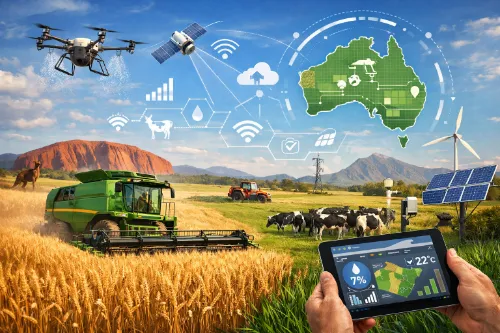
Smart farming technology in Australia is reshaping how farmers manage crops, livestock and water by combining sensors, drones, AI, automation and cloud platforms into data‑driven systems that boost productivity and resilience while cutting inputs and risk. From CSIRO‑built decision tools to drone spraying, smart farms and climate‑smart programs, digital tech is now part of everyday operations on many Australian farms.
What “smart farming” means in Australia
Smart farming (or digital agriculture) refers to using connected technologies—IoT sensors, satellites, drones, AI, robotics and cloud platforms—to monitor conditions in real time and automate decisions on inputs, timing and logistics.
A 2025 review on transforming smart farming for sustainability through agri‑tech highlights three pillars at the core of Australian smart farming: precision agriculture technologies, the Internet of Things (IoT) for real‑time data, and AI‑driven analytics that turn data into recommendations. It notes that these tools are being used to optimise fertiliser and water use, detect pests and disease early, and adapt to climate variability.
CSIRO’s Digital agriculture hub describes smart farming as using “sensors and software for cropping and pastures” plus AI‑enabled decision tools to improve outcomes for farmers, agribusiness and policymakers. Examples include yield‑forecasting apps, grazing‑enterprise planners, water dashboards and carbon‑project tools—all designed for practical on‑farm decisions.
A broader foresighting study on Australian digital agricultural futures argues that digital tech will be central to future competitiveness, but also stresses that social and ethical implications—such as data ownership, skills and equity between large and small farms—must be considered as smart farming scales up.
CSIRO’s smart farming tools: Graincast, GrazPlan, WaterWise and LOOC‑C
Australia’s national science agency is a major engine behind smart farming technology in Australia.
CSIRO’s Digital agriculture page highlights several flagship tools:
- Graincast™ – the first smartphone app that lets Australian farmers forecast grain yields “at the touch of a button”, using satellite data, crop models and weather information. CSIRO recognises Graincast as one of its breakthrough AI innovations, noting that it can rapidly and remotely predict hectares planted for over 20 crops and forecast yields for wheat, barley and canola.
- GrazPlan – a suite of decision‑support tools that model pasture growth, animal performance and economics, helping grazing enterprises plan stocking rates, feed budgets and risk scenarios.
- WaterWise – technology that lets growers see crop water‑stress in real time and predict future water needs, supporting smarter irrigation decisions and water conservation.
- LOOC‑C (“look‑see”) – an app that helps farmers and land managers explore potential carbon‑farming projects on their land and assess whether they can participate profitably in greenhouse‑gas mitigation and carbon markets.
- AgScore™ – the first diagnostic tool that tests seasonal climate models for their relevance to agriculture, helping farmers understand how much confidence to place in seasonal forecasts.
- Paddock‑boundary AI – CSIRO has also used AI to identify the boundary of around 1.7 million paddocks in Australia’s grain‑growing regions from space, a foundational dataset for other digital tools.
CSIRO’s Smart agriculture page highlights Graincast and LOOC‑C as key examples of how AI and digital tools help farmers make timely, informed decisions that boost profitability and resilience, especially under drought and climate stress.
Drones, sensors and IoT: eyes and ears of smart farms
Drones, soil‑moisture sensors, weather stations and connected devices are central to smart farming technology in Australia.
AAGri‑Tech’s article “How Drones Like the Agras T50 Lead the Way” describes how drones equipped with multispectral and thermal cameras are used for:
- Disease and weed detection – identifying crop‑stress zones early so farmers can target spraying.
- Crop mapping and yield forecasting – producing high‑resolution maps for yield prediction and harvest planning.
- Livestock and infrastructure checks – surveying fence lines, water points and herd locations quickly in extensive rangelands.
The same article explains that the Agras T50 drone supports precision spraying and aerial seeding, with intelligent flight‑control software that plans flight paths based on topography, weather and crop data, saving time and improving coverage. In Western Australia’s Wheatbelt, farmers use T50‑mounted sensors to detect weed patches and apply herbicides only where needed, reducing chemical use and runoff.
A 2024 survey on smart agriculture based on IoT using drones finds that unmanned aerial vehicles (UAVs) are highly effective for real‑time visual data acquisition, especially when combined with soil and plant sensors and AI analytics. A 2025 Frontiers review on smart sensors and IoT in precision agriculture further details how soil‑moisture, nutrient, pH and plant‑stress sensors are networked across fields to support variable‑rate irrigation and fertiliser decisions.
Smart farms and live field demonstrations
Australian governments and industry are using “smart farms” and showcases to trial and demonstrate smart farming technology in real conditions.
The Queensland Department of Agriculture and Fisheries’ Gatton Smart Farm hosts open demonstrations of automation, sensors and decision‑support tools in horticulture. In October 2025 the Gatton AgTech Showcase featured:
- Over 20 live in‑crop AgTech demonstrations, including weather stations, soil‑moisture sensors, leachate monitors and cloud‑based dashboards.
- A protected‑cropping greenhouse with sensor‑rich monitoring.
- Projects using real‑time data to support remote auditing, input‑efficiency gains and compliance with sustainability frameworks like Freshcare ENV4 and Hort360.
Hort Innovation’s feature “From smart maps to smart tractors: Hort Innovation’s latest AgTech investments” describes several projects:
- Expansion of the Australian Tree Crop Map, a national smart map showing orchard size, distribution and productivity to support biosecurity, traceability and disaster recovery.
- Trials of Bluewhite’s Pathfinder autonomous tractor system in nut orchards, integrating AI and connectivity to reduce labour dependence, improve safety and optimise orchard operations.
At the field‑day level, the Top Innovations ANFD 2025 showcase in NSW demonstrates:
- Automated tractors, seeders and harvesters that cut time, fuel and labour.
- AI‑powered crop‑monitoring systems to spot stress early and optimise inputs.
- Soil‑moisture and nutrient sensors for real‑time monitoring.
- Autonomous drone seeding and spraying.
- Cloud‑based farm‑management dashboards, yield‑prediction tools and ag‑data analytics integrated with supply‑chain platforms.
These smart‑farm and field‑day programs let producers see smart farming technology in action before investing.
Platforms and data: Smart farming as an integrated system
Smart farming in Australia is increasingly about platforms that integrate devices, data and analytics rather than isolated gadgets.
A 2026 market analysis of the Australia Agricultural Technology Platform (ATP) market notes that the platform market is projected to reach AUD 1.2 billion by 2025, driven by:
- Integration of IoT sensors and satellite imagery for real‑time crop monitoring.
- Deployment of autonomous machinery powered by AI and machine learning.
- A shift towards cloud‑based platforms that support scalable data analytics.
The report highlights platforms such as SmartFarm360, which integrate AI, IoT and blockchain for end‑to‑end traceability, real‑time analytics and autonomous decision‑making, achieving rapid adoption among large farms. It notes that AI‑powered predictive analytics can reduce input costs by up to 20%, while autonomous drones and traceability systems improve supply‑chain transparency.
The policy report Advancing digital agriculture from point solutions to platforms makes a similar argument: Australian digital‑ag innovators already offer world‑class tools—virtual fencing, micro‑climate forecasting, water dashboards—but value will increasingly come from integrated platforms that connect devices, models and services in one place.
Events like ANFD and the Gatton AgTech Showcase demonstrate this platform shift, with exhibitors showing dashboards that combine sensor feeds, machinery data and compliance records into a single interface.
Climate‑smart farming and sustainability programs
Smart farming technology in Australia is tightly linked to climate‑smart agriculture and sustainability.
The Federal Department of Agriculture, Fisheries and Forestry’s Climate‑Smart Agriculture Program aims to “drive agricultural sustainability, productivity and competitiveness,” funding projects that use innovation to improve climate resilience. Program outcomes include boosting adoption of practices and technologies that cut emissions, build soil carbon, and manage climate risk.
CropLife Australia’s media release “Australia Leads the World in Climate‑Smart Farming: Landmark Report” cites a global benchmarking report launched at COP30, which ranked Australia number one for climate‑smart farming among 12 major agricultural exporters. The report attributes this performance to:
- High adoption of precision agriculture and conservation tillage.
- Strong uptake of digital tools for resource efficiency and risk management.
- Regulatory frameworks that support innovation and sustainable practices.
CSIRO’s WaterWise, LOOC‑C and AgScore tools sit squarely within this climate‑smart agenda, helping growers use water more efficiently, participate in carbon markets and make informed decisions based on climate‑risk diagnostics.
Robotics and AI: The intelligence layer of smart farming
Smart farming technology in Australia is increasingly defined by robotics and climate‑tech.
AgriFutures and Agri‑Innovation programs (via growAG) highlight in “Robotics and climate tech set to drive the future of food in 2026” that robotics companies such as 4AG Robotics are using AI‑powered automation to help mushroom growers boost productivity with less labour, and that climate‑tech and robotics are poised to drive the next wave of farm efficiency and sustainability.
The Top Innovations ANFD 2025 feature shows robotics at work on Australian farms, from autonomous tractors and implements to drone seeding and spraying systems that reduce labour, fuel and input costs.
On the AI side, CSIRO’s Graincast and overseas projects like the “Virtual Farm” platform mentioned in Australia–Vietnam collaboration powers sustainable & inclusive agriculture innovation are examples of systems that use real‑world data plus AI to predict, advise and act on farm operations.
A 2026 foresighting report on Australian digital agriculture futures emphasises that AI and automation will be central to addressing labour shortages, climate risk and profitability, but also calls for attention to data governance and farmer agency as these tools become more autonomous.
Why smart farming technology in Australia matters
Bringing these pieces together, smart farming technology in Australia is about:
- Better decisions – with tools like Graincast, GrazPlan, WaterWise and AgScore turning complex data into simple, farm‑ready insights.
- More precise operations – through GPS, sensors, drones, autonomous machinery and IoT networks that fine‑tune inputs and labour.
- Integrated platforms – like SmartFarm360 and other cloud‑based solutions that combine monitoring, analytics, compliance and supply‑chain links.
- Climate resilience and sustainability – via climate‑smart programs, carbon tools and water‑efficiency technologies backed by national policy and global benchmarking.