

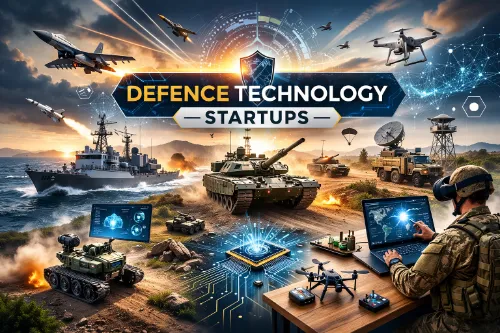
Defence technology startups in Australia are moving from the margins of the ecosystem to the centre of national‑security and industrial strategy, supported by new co‑investment schemes, specialised accelerators and sovereign‑capability programs that target dual‑use deep tech.
From AI‑enabled autonomy and cyber to space, quantum, undersea systems and advanced sensors, founders are building defence‑grade technology with both military and civilian use cases that can plug directly into the Australian Defence Force (ADF) and export markets.
Why defence tech matters in Australia
Australia’s strategic environment is becoming more contested, which has pushed defence and national security to the forefront of government policy and public debate. At the same time, new technologies are moving so quickly that traditional prime contractors and long procurement cycles cannot meet every capability gap on their own.
Defence technology startups help fill this gap by:
- Developing dual‑use products that work for both defence and commercial customers, improving their path to revenue and scale.
- Bringing speed and agility into a traditionally slow, risk‑averse procurement system by iterating and deploying faster.
- Attracting global capital, talent and partners into Australia through differentiated technology such as quantum, space and advanced autonomy.
For a broader policy context on why defence innovation and sovereign capabilities have become a priority, readers can explore ASPI’s analysis in How Australia can supercharge defence innovation efforts.
Key themes in Australian defence technology
Defence technology in Australia is not a single vertical; it spans multiple overlapping domains that share common enablers such as AI, secure communications and advanced manufacturing. Some of the most active themes include:
- Cyber security and offensive cyber – Startups focus on threat detection, secure architectures, incident response tooling and resilience for critical infrastructure, often working with both defence and civilian clients.
- AI, data and autonomy – Founders are building AI‑driven decision‑support systems, autonomous platforms, swarming drones and intelligent mission‑planning tools that reduce cognitive load on operators.
- Space and resilient communications – Companies work on small satellites, space‑derived services and resilient communications so that defence can operate even in contested or denied environments. A strong example is Myriota’s secure satellite IoT for the ADF’s Internet of Military Things, described in Myriota & ADF Innovation Hub enter $5.48M IoT partnership and Myriota wins $5.48 million Defence Innovation Hub contract.
- Quantum, sensing and timing – Quantum‑based navigation, secure communications and ultra‑precise timing systems give defensive and offensive forces an edge in environments where GPS and traditional signals are degraded or jammed.
- Undersea and maritime systems – Autonomous undersea vehicles, advanced sonar and surveillance platforms help secure vast maritime approaches and underwater infrastructure.
Readers who want to understand how space‑enabled defence IoT and resilient communications work in practice can study Myriota’s role in Defence Innovation Hub projects.
Government programs and policy support
Australian policymakers have recognised that defence technology startups require patient capital, classified environments and mission‑driven customers, which is different from typical SaaS startups. As a result, several programs and policy settings have been designed to bring founders closer to Defence users and to de‑risk early‑stage innovation.
Common types of support include:
- Defence innovation programs that fund proofs of concept and prototypes targeting specific capability challenges, such as the Small Business Innovation Research for Defence (SBIRD) program and the Defence Innovation Hub highlighted in Myriota’s IoT partnership and contract win.
- Sovereign industrial capability and defence capability priorities, which bodies like the National Reconstruction Fund Corporation (NRFC) discuss in the snapshot Strengthening Australia’s Defence Capability.
- Co‑investment initiatives where government seeks private partners to scale defence tech. Recent moves include calls for venture capital managers in Australia seeks VC managers for defence tech co‑investment, the new Defence Tech Fund covered in Defence Tech Fund targets future military edge, and the ‘call to arms’ detailed in Call to arms! Government seeks venture capital partners to co‑invest in Australian defence tech.
- Collaboration mechanisms with universities and research organisations, supported by initiatives like the Defence Innovation Partnership and the Defence Trailblazer program showcased on the Innovation & Entrepreneurship hub.
For ongoing updates and asymmetric capability programs, founders can follow the Advanced Strategic Capabilities Accelerator (ASCA).
Defence technology startup ecosystems and hubs
Australia’s defence‑focused startups tend to cluster around existing deep‑tech and innovation ecosystems, often close to major Defence bases, universities and research centres. These hubs give founders easier access to talent, test facilities and potential customers.
Key patterns across the ecosystem include:
- Capital city clusters such as Sydney, Melbourne and Adelaide, where cyber, AI and software‑heavy defence startups can tap into broad technology talent pools as well as Defence and national security agencies. A visible example is the DefenceTech Startup Hub at Stone & Chalk.
- University‑anchored precincts that link engineering, robotics, quantum and advanced manufacturing research directly to founders via incubators and spin‑out pathways supported by Defence Trailblazer and the Defence Innovation Partnership.
- Defence‑proximate regions with strong ties to bases, test ranges and shipbuilding infrastructure, often supported by advanced manufacturing grants like those profiled in Advanced manufacturing grants boost defence technology.
These hubs sit within a broader innovation landscape shaped by programs such as ASCA, NRFC and various manufacturing initiatives.
Dual‑use models and commercialisation pathways
One of the defining features of defence technology startups is their dual‑use model: the same core technology can support both defence missions and commercial use cases. This matters because pure‑play defence sales are lumpy, slow and often dependent on multi‑year procurement cycles.
Common dual‑use pathways include:
- Cyber security platforms that start with commercial customers, then add classified features or integrations for defence and critical infrastructure, aligning with the priority areas flagged in co‑investment calls like Australia seeks VC managers for defence tech co‑investment.
- Space‑based communications and Earth observation services that initially serve agriculture, logistics, maritime and mining, and later add defence use cases such as situational awareness and secure connectivity. Myriota’s satellite IoT platform and its Defence Innovation Hub partnership, contract win and NRFC‑backed $50M funding round are a textbook case.
- Quantum and advanced sensing technologies that address precision timing, finance and telecommunications, while also offering navigation and secure communications for defence missions highlighted in priority sectors such as quantum and undersea warfare.
By examining NRFC’s Strengthening Australia’s Defence Capability and Myriota’s global IoT expansion, readers can see how dual‑use models translate into capital and customers.
Funding environment for defence technology startups
Raising capital for defence technology in Australia requires founders to navigate both non‑dilutive defence funding and private investment.
Founders usually stitch together several sources:
- Non‑dilutive grants and innovation contracts from programs like SBIRD – Small Business Innovation Research for Defence, the Defence Innovation Hub (see Myriota’s IoT partnership and contract win), and capability programs under ASCA.
- Seed and Series A rounds from funds with a thesis on deep tech, cyber, AI, space or advanced manufacturing, catalysed by the government’s proposed co‑investment mechanisms described in:
- Strategic partnerships and joint ventures with primes and large defence contractors, often supported by advanced manufacturing grants such as those in Advanced manufacturing grants boost defence technology.
To understand where public capital is going, NRFC’s defence snapshot is again a key reference: Strengthening Australia’s Defence Capability.
Challenges defence technology startups face
Despite strong tailwinds, defence‑oriented startups in Australia face several structural challenges.
Key challenges include:
- Long and complex sales cycles, with procurement processes that can exceed the runway of early‑stage ventures, even with programs like SBIRD and Defence Innovation Hub support.
- Security and accreditation requirements that demand cleared staff, secure facilities and robust governance, which can be expensive and time‑consuming to obtain.
- Integration and interoperability hurdles when plugging new technology into legacy platforms, systems and standards maintained by Defence and major primes.
- Ethical and reputational questions for founders and investors who are new to defence and national security work and want clear frameworks for responsible innovation, themes discussed in ASPI’s How Australia can supercharge defence innovation efforts.
These issues are also part of the broader policy conversation driven by ASCA and NRFC.
Opportunities and trends shaping the next decade
Looking ahead, several trends are shaping how defence technology startups in Australia will evolve:
- Growing emphasis on interoperability with allies (including AUKUS), which encourages startups to design export‑ready products from day one, aligning with co‑investment and capability priorities discussed in government calls for VC partners and funds such as those in Australia seeks VC managers for defence tech co‑investment and Defence Tech Fund targets future military edge.
- Rising demand for autonomous and uncrewed systems across air, land, sea and space domains, supported by AI, sensing and onboard processing – a focus of both ASCA’s capability programs and advanced manufacturing initiatives.
- Convergence between cyber, space and electronic warfare, which creates opportunities for startups that can secure and manage complex, contested information environments, as seen in satellite IoT providers like Myriota and in government capability snapshots.
- Increasing use of digital twins, simulation and synthetic training environments to accelerate development, testing and operator training, often highlighted in defence innovation roadmaps and policy analysis.
Founders can track these trends through ASPI, ASCA and NRFC publications, plus industry events such as ADM Congress reported in ADM Congress 2026.
How founders can engage with the defence ecosystem
For founders and teams considering a defence‑oriented or dual‑use venture in Australia, there are practical steps to plug into the ecosystem more effectively.
Useful strategies include:
- Engage early with Defence end‑users through SBIRD challenges, Defence Innovation Hub calls and ASCA programs to validate real‑world needs; the Myriota IoT partnership and Hub contract are good examples.
- Build relationships with universities and research organisations via the Defence Innovation Partnership and Defence Trailblazer – Innovation & Entrepreneurship, which connect founders to deep tech and test facilities.
- Design for export and coalition architectures from day one, aligning products with the capability areas highlighted in co‑investment frameworks and AUKUS‑related priorities.
- Blend non‑dilutive funding with venture capital, taking advantage of government‑backed co‑investment mechanisms and manufacturing grants through:
To map where to base or grow a company, founders can look at hubs like the DefenceTech Startup Hub at Stone & Chalk, ASCA’s program map and NRFC’s defence capability snapshot.