

AI Reshaping Workforce trends show that artificial intelligence is no longer just an efficiency tool—it is rebuilding workflows, roles and required skills across almost every industry. From automating routine tasks to enabling new forms of creativity, AI is changing how people are hired, trained and promoted, forcing workers and organisations to rethink what “work” looks like in the next decade.
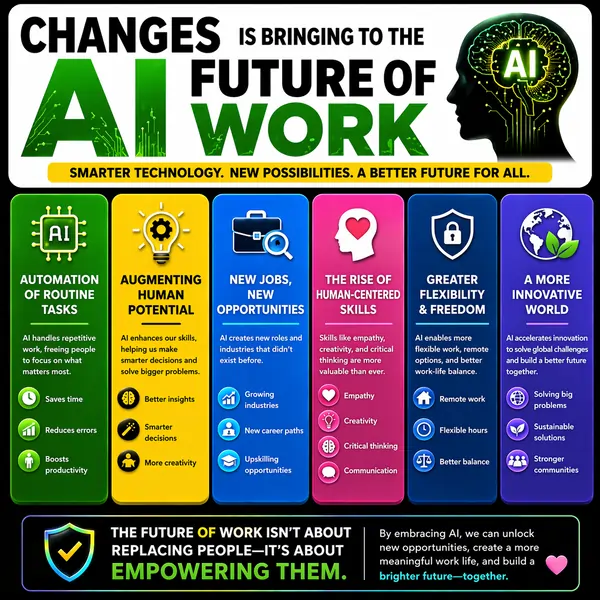
AI is fundamentally reshaping the workforce, changing not just which jobs exist but how work is organised, valued, and learned. As organisations embed AI into everyday processes, the future of work will be defined less by simple automation and more by new human‑AI collaboration models, continuous reskilling, and entirely new career paths.
1. From Automation to Augmentation
The first and most visible way AI is reshaping the workforce is through automation of routine, repetitive tasks, especially in knowledge work. AI systems now handle document processing, basic customer inquiries, data entry and first‑pass data analysis, freeing humans to focus on higher‑value judgement and relationship work.
IBM describes how AI tools are shifting workers from “creation to curation,” where employees spend less time generating content from scratch and more time reviewing, refining and strategically directing AI outputs. You can explore this perspective in AI and the Future of Work | IBM, which outlines how AI is embedded in daily workflows from HR to finance.
Consultancies like McKinsey reinforce this view, arguing that in most occupations more tasks will be changed than fully automated, as machines complement human labour rather than fully replacing it. Their article AI, automation, and the future of work: Ten things to solve for shows how partial automation is pushing workers into more supervisory and problem‑solving roles, such as warehouse operators becoming robot overseers.
Within the broader AI Reshaping Workforce conversation, the emerging consensus is that humans will increasingly act as orchestrators of AI systems—setting goals, providing context, and handling exceptions—rather than doing every step of execution themselves.
2. New Job Roles and Career Paths
AI is also giving rise to entirely new roles while transforming existing ones, which is why many analysts talk about job transformation rather than pure job loss. Research summarised in the International Journal of Advanced Research notes that AI is simultaneously automating tasks and creating new categories of work, particularly in data, AI operations and human‑machine interaction.
Fast Company reports that roles such as AI operations leads, prompt engineers, and “go‑to‑market engineers” have emerged as organisations redesign sales, marketing and operations around AI‑powered workflows. Their piece How AI is reshaping workforce strategy explains how AI‑exposed roles have grown by 38% even as some traditional roles shrink or morph.
Generative AI is also changing creative and analytical jobs. Articles like How Generative AI Is Reshaping Work in 2025 show that rather than eliminating entire professions, AI is shifting the task mix within roles and fuelling growth in positions that can adapt and integrate these tools. This is central to AI Reshaping Workforce dynamics: new hybrid roles combine technical fluency with human strengths in empathy, storytelling and complex decision‑making.
3. Skills Over Titles: The Rise of the Skills‑Based Economy
Another major change is a shift from role‑based to skills‑based thinking in hiring, promotion and workforce planning. As AI tools make it easier to decompose jobs into specific tasks, companies are starting to ask which skills—rather than which job titles—are really needed to deliver value.
Workday’s deep‑dive 25 Ways AI Will Change the Future of Work describes how AI can map skills across an organisation, identify gaps and personalise learning, enabling skills‑based hiring and internal mobility. HEC Paris similarly notes that AI‑powered analytics are transforming workforce development, enabling more targeted learning and smarter deployment of talent. You can read their view in How AI Is Shaping the Workplace and Workforce Development.
Fast Company reports that forward‑thinking organisations are now “hiring curiosity” and adaptability, using AI skills assessments and scenario questions to evaluate how candidates would use AI in their daily work. This reframes AI Reshaping Workforce debates: success increasingly depends on transferable skills like critical thinking, problem framing, and the ability to work productively with AI tools, rather than narrow experience in a single static role.
4. Flattened Hierarchies and Faster Career Progression
As AI copilots and virtual assistants handle more of the rote complexity in white‑collar work, junior employees can take on higher‑level tasks earlier in their careers. People Matters notes that mid‑level roles may feel more pressure than entry‑level ones, because AI allows less senior staff to perform work that previously required years of experience. You can read this analysis in How AI is reshaping jobs, careers and the modern workplace.
Harvard Business Review also points out that as automation changes task composition, many jobs will be “radically transformed” rather than eliminated, with employees needing to reskill into adjacent or higher‑value roles. Their article Reskilling in the Age of AI predicts that 14% of jobs may be fully automated and another 32% significantly changed within 15–20 years, intensifying pressure on mid‑career workers.
All of this contributes to flatter organisational structures where progression is less about time served and more about demonstrated capability in leading human‑AI teams. For anyone tracking AI Reshaping Workforce trends, this means traditional career ladders may give way to more fluid, project‑based paths with rapid jumps for those who master AI tools early.
5. Productivity Booms—and New Inequalities
AI’s impact on productivity is already measurable. Organisations that invest in AI training and upskilling see significantly higher productivity gains than those that do not. A Forbes analysis found that companies actively investing in AI training see around 15% higher productivity improvements than peers that simply deploy technology without building human capability. You can explore this in AI Is Reshaping Work Faster Than Companies Can Upskill.
At the same time, McKinsey and others warn that AI could deepen wage and opportunity inequalities if access to tools and training is uneven. The IJAR article Exploring How AI Is Reshaping Employment Landscapes notes that AI can polarise wages, boosting high‑skill workers while displacing some routine roles unless there is strong policy support for reskilling.
This dual effect is central to AI Reshaping Workforce policy debates: the same technologies that unlock unprecedented productivity can also leave behind organisations and workers that fail to adapt, creating a new divide between “AI‑ready” and “AI‑lagging” labour markets.
6. Always‑On Reskilling and Lifelong Learning
Reskilling is no longer a one‑off initiative; it is becoming a permanent feature of work in the AI era. Harvard Business Review argues that billions of workers globally will need to transition into new roles or significantly reconfigure their skills over the next two decades, requiring sustained investment from both employers and governments.
Deloitte’s report Generative AI and the Future of Work highlights that generative AI amplifies this need by changing not just tasks but entire business models, which in turn changes the skills portfolio organisations require. AI‑driven learning platforms can identify individual skill gaps and deliver personalised training at scale, reinforcing the idea of “learning in the flow of work.”
Workday notes that AI‑powered learning tools will make AI Reshaping Workforce transitions more manageable by offering micro‑learning, coaching and career pathing that respond dynamically to market demands. For workers, the key mindset shift is to treat learning as a continuous part of the job rather than a separate, occasional activity.
7. Human Skills Become More Valuable, Not Less
Paradoxically, as AI gets better at technical and analytical tasks, distinctly human skills become more valuable. HR Challenges lists “being human will be a skill” as one of the top ways AI will change work, emphasising empathy, communication, ethical judgement and creative problem‑solving. You can read their overview in 10 Ways AI Will Change Your Work.
Forbes similarly argues that AI will flip the traditional assistant dynamic: humans will increasingly assist machines by providing context, nuanced judgement and emotional intelligence where algorithms fall short. Their article How Artificial Intelligence (AI) Is Changing The Future Of Work explains how collaboration between professionals and AI tools is already transforming coding, finance and law.
In the context of AI Reshaping Workforce strategies, this means organisations must design roles that explicitly combine AI capabilities with human strengths, rather than trying to replace people outright. Workers who cultivate self‑awareness, collaboration and ethical reasoning will be better positioned than those who focus only on technical skills.
8. More Flexible Work Patterns and Autonomy
AI is also changing when, where and how work gets done. As automation handles routine monitoring and reporting, humans can organise their schedules around deep‑focus work and collaboration, often with more flexibility about location and hours. HR Challenges points out that AI‑driven analytics can reveal each employee’s most productive times, enabling more personalised schedules.
Their article 10 Ways AI Will Change Your Work notes that as connectivity and data improve, knowledge workers will gain greater control over their time, focusing on high‑impact tasks from anywhere in the world. AI tools can coordinate complex workflows across distributed teams, making hybrid and remote models more viable.
Deloitte emphasises that AI Reshaping Workforce trends are not just about efficiency but also about rethinking work design to promote wellbeing, engagement and inclusion. When used thoughtfully, AI can reduce administrative overload, support better work‑life balance and enable more flexible careers—though this requires conscious decisions by employers, not just technology deployment.
9. Data‑Driven, Less Biased (But Not Bias‑Free) Decisions
AI promises more data‑driven decisions in areas like hiring, promotion, performance evaluation and workforce planning, potentially reducing some forms of human bias. A LinkedIn article, The 10 major changes AI will bring to the world of work, highlights how AI can analyse large datasets to identify patterns and weak points, supporting faster and more objective decisions in recruitment and management.
However, IBM and others caution that AI systems can replicate or even amplify existing biases if trained on skewed data or deployed without oversight. That is why many frameworks for AI Reshaping Workforce emphasise the need for transparent algorithms, continuous monitoring, and human review loops to ensure fairness.
In practice, the future of decision‑making is likely to be a hybrid model where AI surfaces insights and recommendations, but humans retain ultimate responsibility, especially in high‑stakes areas like hiring, lending or legal judgements.
10. Strategic Workforce Transformation, Not Just Tech Adoption
Finally, AI is forcing leaders to rethink workforce strategy at a fundamental level. Fast Company argues that organisations built “leaner and around AI” are beginning to outperform traditional firms, not because they have more technology, but because they have redesigned team structures, roles and incentives around AI‑enabled workflows.
Deloitte’s Generative AI and the Future of Work stresses that generative AI is a business transformation, not an IT upgrade, requiring integrated strategies across technology, people, processes and culture. Similarly, IBM notes that HR leaders who adopt AI are shifting from administrative tasks to becoming champions of employee experience and strategic talent planning.
In this sense, AI Reshaping Workforce is as much an organisational design challenge as a technical one. Companies that navigate it successfully will be those that align AI adoption with clear human‑centric goals: better jobs, smarter collaboration, and continuous learning, rather than cost‑cutting alone.
Conclusion
AI is no longer a distant concept; it is actively reshaping the workforce by changing how jobs are designed, which skills are in demand, and how organisations operate day to day. As automation, augmentation and new AI‑driven roles continue to emerge, workers and businesses that commit to continuous learning, ethical adoption and human‑centred design will be best positioned to thrive in this new landscape.
To stay competitive, professionals need to treat AI literacy as a core career skill, while leaders must align technology rollouts with clear communication, thoughtful reskilling programs and a focus on wellbeing, not just efficiency. In this environment, understanding how digital tools evolve more broadly also becomes important for future‑proofing your work life.
If you want to see how rapid, software‑driven change affects everyday users in another domain, it’s worth reading The Truth About the Latest Windows Update, which unpacks what a major operating system update really means for performance, compatibility and security. Looking at both AI in the workplace and platform updates like these together helps you build a holistic view of how technology is transforming not just specific jobs, but the entire digital environment we rely on to work, collaborate and create.
Frequently Asked Questions About AI Reshaping Workforce
What does “AI Reshaping Workforce” actually mean?
“AI Reshaping Workforce” describes how artificial intelligence is transforming job roles, required skills, and workplace processes across industries. It involves automating routine tasks, enhancing human decision-making, and creating entirely new types of roles that combine technical and human-centric skills.
Is AI going to replace my job completely?
In most cases, AI replaces specific tasks—not entire jobs. Many roles are evolving so AI handles repetitive work, while humans focus on creativity, strategy, and complex problem-solving.
Which jobs are most affected by AI Reshaping Workforce trends?
Jobs that rely on repetitive, predictable tasks—such as data entry or basic customer support—are most vulnerable. Meanwhile, roles requiring empathy, judgement, and human interaction are more likely to be enhanced rather than replaced.
What new roles are emerging because of AI?
AI is creating roles like prompt engineers, AI product managers, data ethicists, and AI operations specialists. Many traditional jobs are also evolving into hybrid roles combining human expertise with AI tools.
What skills will matter most in an AI-driven workplace?
While technical skills like data literacy are important, human skills—critical thinking, creativity, communication, and adaptability—are becoming even more valuable in an AI-driven environment.
How can I prepare my career for AI-driven change?
Start by learning basic AI concepts and tools relevant to your field. Focus on transferable skills and commit to continuous learning through courses, certifications, and hands-on practice.
Will AI make work more stressful or more flexible?
It depends on implementation. Poor use of AI can increase pressure, but well-designed systems can reduce workload and enable more flexible, remote, or hybrid work setups.
How does AI change hiring and recruitment?
AI is used to screen resumes, rank candidates, and analyze interviews. While this speeds up hiring, it also raises concerns about bias and transparency, requiring human oversight.
What does AI mean for workplace training and reskilling?
AI enables personalized learning paths, helping employees upskill continuously. Training is no longer a one-time activity but an ongoing process aligned with evolving job demands.
Are small businesses affected differently than large enterprises?
Yes. Large companies invest in custom AI systems, while small businesses adopt affordable tools for automation, marketing, and customer service. Both face challenges in implementation and data management.
How does AI affect salaries and job security?
AI can increase salaries for high-skill roles while putting pressure on easily automated jobs. Job security now depends more on adaptability and continuous learning than on fixed roles.
Will AI reduce or increase inequality in the workforce?
AI can either widen or reduce inequality. Access to education, tools, and opportunities will determine whether its impact is inclusive or uneven across different groups.
How should leaders manage AI transformation in their teams?
Leaders should focus on transparency, training, and employee involvement. Successful AI adoption requires balancing technology with people-focused strategies.
What ethical issues should we consider as AI reshapes work?
Key concerns include data privacy, algorithmic bias, transparency, and accountability. Ethical AI use must be a core part of any workforce transformation strategy.
How can I talk to my team about AI without causing fear?
Be honest but optimistic. Emphasize opportunities, provide training support, and involve employees in the transition to build trust and engagement.