

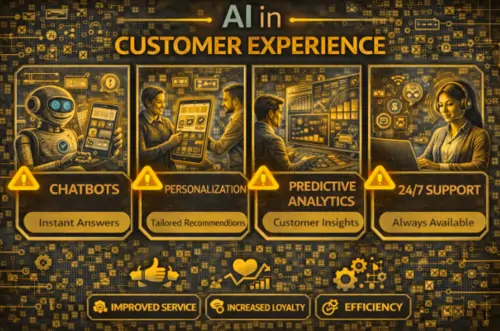
Introduction
AI in customer experience is no longer a future concept. It is already changing how brands communicate with customers, resolve issues, personalize interactions, and manage service at scale.
What began with simple chatbots and automated workflows has evolved into a broader shift where artificial intelligence supports customer journeys across service, sales, marketing, and operations.
This matters because customer expectations are rising fast. Zendesk’s 2026 CX Trends report says customers increasingly expect instant resolutions, deeper personalization, and greater transparency in AI-powered experiences, while Salesforce’s 2025 State of Service report says AI is expected to handle half of all customer service cases by 2027, up from 30% at the time of the survey.
For businesses, the appeal is clear. AI can reduce response times, improve support efficiency, uncover customer insights, and help teams deliver more consistent service. But strong results depend on more than adding automation. The real value of AI in customer experience comes from combining speed with relevance, accuracy, and human oversight.
What AI in Customer Experience Means
At its core, AI in customer experience refers to the use of artificial intelligence to improve how customers interact with a brand across different touchpoints. This includes chat support, email service, personalization, call routing, sentiment analysis, self-service tools, and predictive recommendations.
AI can support customer experience in several ways:
- answering common service questions
- routing cases to the right team
- summarizing conversations for agents
- personalizing product or content recommendations
- predicting customer needs or churn risk
- analyzing feedback and sentiment
- helping teams respond faster and more accurately
The goal is not only automation. The bigger goal is to create smoother, more useful, and more relevant experiences for customers.
Why AI in Customer Experience Is Growing
The rise of AI in customer experience is being driven by two forces at the same time. The first is customer demand. People want quicker answers, more personalized support, and less friction. The second is business pressure. Companies need to improve service while controlling costs and scaling operations.
Salesforce’s 2025 service report found that AI had become the number two priority for service leaders, second only to improving customer experience itself. Adobe’s 2026 AI and Digital Trends report also says generative and agentic AI are transforming the customer journey faster than many organizations can adapt.
This combination is pushing brands to move from small AI experiments to more integrated customer experience strategies.
Key Ways AI Improves Customer Experience
Faster Customer Support
One of the most obvious benefits of AI in customer experience is speed. AI-powered assistants can handle routine questions instantly, guide users through common tasks, and reduce wait times for human support.
This is especially valuable for high-volume service teams. Customers do not want to wait for simple issues like order tracking, password resets, billing questions, or policy information. AI makes it easier to resolve these questions immediately.
At the same time, AI can assist human agents by summarizing prior conversations, suggesting responses, and surfacing knowledge base articles. That means agents spend less time searching for information and more time solving complex issues.
Better Personalization
Personalization is another major advantage of AI in customer experience. AI systems can analyze past behavior, preferences, purchase history, and browsing patterns to tailor messages and recommendations.
This can improve:
- product recommendations
- support responses
- onboarding journeys
- retention campaigns
- loyalty experiences
Zendesk’s 2026 CX Trends report emphasizes that contextual intelligence is becoming a new standard in customer experience, reflecting stronger expectations for relevant and personalized interactions.
Good personalization makes customers feel understood. Poor personalization makes automation feel generic. That is why data quality and context matter so much.
More Consistent Omnichannel Service
Customers now move across websites, apps, email, chat, phone, and social platforms without thinking in channels. They expect the brand to recognize them and continue the conversation smoothly.
AI in customer experience helps support this by pulling together information across touchpoints. It can help brands maintain conversation history, detect intent, and deliver continuity from one channel to another.
This makes the overall experience feel more connected rather than fragmented.
Proactive Customer Engagement
AI can also help businesses move from reactive support to proactive service. Instead of waiting for customers to complain, systems can predict problems and act earlier.
Examples include:
- alerting customers to delivery delays
- flagging unusual account activity
- offering help when a customer seems stuck
- identifying churn signals before cancellation
This is one of the most promising areas of AI in customer experience because it improves both satisfaction and retention.
Lower Service Costs With Smarter Scaling
AI helps companies scale support without increasing headcount at the same rate as customer demand. That does not mean replacing all human agents. It means using AI to absorb repetitive work and support teams more efficiently.
Intercom’s 2026 customer service transformation report and Salesforce’s recent service findings both point to a broader transition from experimentation toward more mature AI deployment in customer service.
When implemented well, AI can reduce operational pressure while improving service availability.
Common AI Tools Used in Customer Experience
Several types of tools now shape AI in customer experience.
AI Chatbots and Virtual Assistants
These are often the first tools companies adopt. Modern assistants can answer common questions, guide workflows, and escalate issues when needed.
Agent Assist Tools
These tools work behind the scenes to help human support teams. They can summarize calls, draft responses, recommend next steps, and pull knowledge from previous interactions.
Sentiment Analysis
Sentiment tools analyze customer language to detect frustration, urgency, or satisfaction. This helps teams prioritize and respond more effectively.
Recommendation Engines
These systems personalize offers, product suggestions, and content based on customer behavior.
Predictive Analytics
Predictive models help identify likely outcomes such as churn risk, upsell opportunities, or rising service demand.
Together, these tools make AI in customer experience broader than just customer support. It becomes part of the full customer journey.
Challenges and Risks of AI in Customer Experience
Even though the benefits are significant, there are real risks in using AI in customer experience.
Inaccurate Answers
If the system gives wrong or misleading information, trust can fall quickly. Public examples of chatbot failures have shown how damaging this can be when AI is not properly controlled.
Lack of Human Escalation
Customers still want access to human help, especially for emotional, urgent, or complex issues. AI should not trap people in endless loops.
Weak Personalization
AI without context can feel robotic or irrelevant. Personalization only works when the data and logic behind it are strong.
Privacy and Transparency Concerns
Customers want to know when they are talking to AI and how their data is being used. Zendesk’s 2026 CX report highlights transparency as an important customer expectation in AI-powered experiences.
Internal Readiness
Many organizations want AI results faster than their systems, teams, or processes can support. Adobe’s 2026 report stresses that the pace of AI change is exceeding how quickly many brands can adapt.
Best Practices for Using AI in Customer Experience
To get strong results, businesses need a disciplined approach.
Start With High-Volume, Low-Complexity Use Cases
Simple support questions are often the best first step.
Keep Human Escalation Easy
Customers should always have a clear path to a human when needed.
Train AI on Quality Content
Good AI depends on strong knowledge sources, accurate policies, and updated information.
Measure More Than Cost Savings
Track customer satisfaction, resolution quality, containment rate, escalation rate, and retention impact.
Be Transparent
Tell customers when AI is being used and make sure the experience feels trustworthy.
The best AI in customer experience strategies do not focus only on automation. They focus on confidence, usability, and outcomes.
The Future of AI in Customer Experience
The next phase of AI in customer experience will likely be more contextual, more proactive, and more integrated across the business. Brands are moving beyond simple bots toward systems that understand customer history, detect intent, support human teams, and personalize actions across channels.
Adobe’s 2026 report says the AI strategy shift is already here, while Zendesk’s latest CX research points to contextual intelligence as a growing standard. Together, those signals suggest that the future of customer experience will depend less on whether a company uses AI and more on how intelligently and responsibly it uses it.
Companies that balance efficiency with empathy will likely see the strongest long-term results.
Conclusion
AI in customer experience is reshaping how brands serve, support, and retain customers. It can improve speed, consistency, personalization, and operational efficiency. It can also help teams work better by reducing repetitive tasks and surfacing better insights.
But successful AI adoption depends on more than technology. It depends on trust, context, transparency, and good design. Customers want fast answers, but they also want accurate help and the ability to reach a human when it matters.
The businesses that win with AI in customer experience will be the ones that use automation to improve relationships, not weaken them.
FAQ
What is AI in customer experience?
AI in customer experience refers to the use of artificial intelligence to improve customer interactions through faster support, personalization, automation, and predictive insights.
How does AI improve customer experience?
AI improves customer experience by reducing response times, personalizing interactions, assisting support teams, and making service more consistent across channels.
Can AI replace human customer service agents?
AI can handle many routine tasks, but it does not fully replace human agents. Complex, emotional, or sensitive issues still need human support.
What are the biggest risks of AI in customer experience?
The main risks include inaccurate answers, poor personalization, privacy concerns, and weak escalation paths to human support.
Why is AI becoming important in customer service?
AI is becoming more important because customers expect faster service and businesses need more scalable ways to deliver support efficiently. Salesforce expects AI to handle half of service cases by 2027.