

The 2026 F1 standings mark a dramatic new era in Formula 1, led by rookie Andrea Kimi Antonelli as Mercedes-AMG Petronas Formula One Team dominates early races. With new hybrid power-unit rules, active aerodynamics, and sustainable fuel, the season reflects a major competitive reset, reshaping the championship battle and team hierarchy.
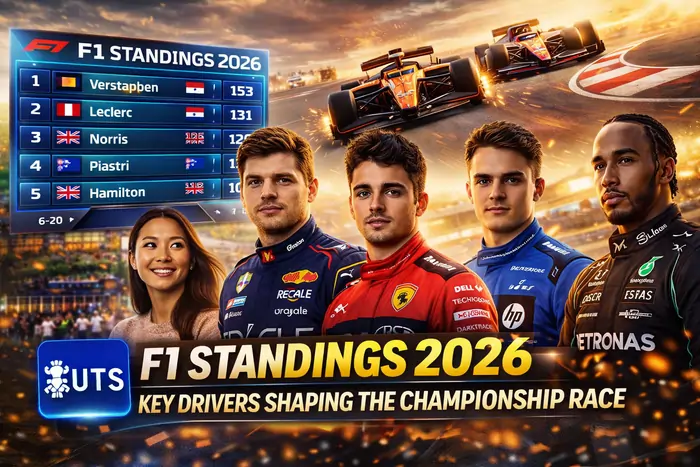
The 2026 F1 standings tell a very different story from the Verstappen‑dominated years: a teenage rookie leads the championship, Mercedes has rebuilt itself into the team to beat, Ferrari is resurgent with a superstar pairing, and Red Bull is suddenly on the back foot. With new power‑unit regulations pushing F1 toward a 50‑50 split between internal combustion and electric power, this season feels like the first true chapter of a new era—and the early championship order reflects that.
1. The 2026 F1 standings after the opening fly‑aways
After the first few rounds of the 2026 Formula 1 World Championship, the F1 standings have a clear pattern: Mercedes on top, Ferrari chasing, McLaren in the mix, and Red Bull surprisingly on the defensive.
Across multiple live‑standings sites (Sky Sports, RacingNews365, Motorsports.com and team pages), the drivers’ championship currently reads:
- Andrea Kimi Antonelli (Mercedes) – 72 points
- George Russell (Mercedes) – 63 points
- Charles Leclerc (Ferrari) – 49 points
- Lewis Hamilton (Ferrari) – 41 points
- Lando Norris (McLaren) – 25 points
- Oscar Piastri (McLaren) – 21 points
- Oliver Bearman (Haas) – 17 points
- Pierre Gasly (Alpine) – 15 points
- Max Verstappen (Red Bull) – 12 points
- Liam Lawson (Racing Bulls) – 10 points
- Arvid Lindblad (Racing Bulls) – 4 points
- Isack Hadjar (Red Bull) – 4 points
- Gabriel Bortoleto (Audi) – 2 points
- Carlos Sainz (Williams) – 2 points
- Esteban Ocon (Haas) – 1 point
- Franco Colapinto (Alpine) – 1 point
In the constructors’ F1 standings, Mercedes holds a commanding early lead:
- Mercedes – 135 points
- Ferrari – 90 points
- McLaren – 46 points
- Haas – 18 points
- Alpine – 16 points
- Red Bull – 16 points
- Racing Bulls – 14 points
- Audi – 2 points
- Williams – 2 points
- Cadillac – 0 points
- Aston Martin – 0 points
For a live, always‑updating table, keep one of these open while you read:
- F1 Championship Standings – 2026 season (drivers & teams)
- 2026 Driver F1 standings – RacingNews365
- Official‑style 2026 standings – Motorsport.com
- 2026 F1 Drivers Standings – ESPN
2. Why the standings look so different: the 2026 rules reset
The shake‑up in the F1 standings is not happening in a vacuum. The 2026 season brings one of the biggest regulation shifts since the hybrid era began, with new power‑unit rules and active‑aero concepts designed to push sustainability and close racing.
Key changes include:
- Power units: Still 1.6‑litre turbo V6s, but with the MGU‑H removed and a much more powerful MGU‑K, targeting roughly 50:50 power split between internal combustion engine and electric energy.
- Sustainable fuel: Cars run on 100% advanced sustainable fuel, part of F1’s net‑zero 2030 push.
- Active aero: Switchable “Straight Mode” and “Corner Mode” aero configurations reduce drag on straights and increase downforce in corners, replacing old‑style DRS with a more integrated system.
- Overtake mode / Recharge & Boost: More emphasis on tactical energy deployment, with overtaking support baked into the hybrid system rather than just a rear‑wing flap.
McLaren’s explainer puts it simply: “After 11 seasons with, in essence, the same power unit architecture, F1 has had a rethink for 2026,” with the MGU‑K now recovering and deploying about three times as much energy, and roughly half the car’s power coming electrically. Formula1.com’s official regs guide emphasises the 50‑50 split, the new active aero modes, and the goal of making cars lighter, more agile, and more reliant on driver skill and energy‑management tactics.
Read more:
- Explaining F1’s new 2026 regulations – McLaren
- F1 2026 engine rules and penalties explained – RacingNews365
- Beginner’s guide to the 2026 regulations – Formula1.com
- All you need to know about F1’s new power units
- 2026 Formula One World Championship – background
Why it matters for the standings:
Teams that nailed hybrid integration, energy management and aero‑efficiency under the new rules—most notably Mercedes and Ferrari—have jumped up the F1 standings, while those that relied heavily on previous‑era strengths (like Red Bull’s ultra‑efficient MGU‑H package and high‑rake aero philosophy) are still catching up.
3. Andrea Kimi Antonelli: the rookie leading the championship
Front‑and‑centre in the 2026 F1 standings is Andrea Kimi Antonelli, the Italian teenager leading the championship with 72 points after the early fly‑away races. That puts him ahead of his far more experienced team‑mate George Russell and a stacked field that includes multiple world champions.
Across standings sites, he appears consistently at the top:
- Sky Sports standings: Kimi Antonelli, Mercedes, 72 points.
- RacingNews365: Andrea Kimi Antonelli, 72 points.
- Motorsport.com: A. Antonelli, Mercedes, 72 points.
- Team and fan sites replicate the same order.
Antonelli’s early lead reflects:
- A car that suits his aggressive but precise style under the new regs.
- Strong qualifying pace translating into front‑row starts.
- Mature race management for his age, especially in energy deployment and tyre management.
He’s not just a feel‑good rookie story; he’s defining the F1 standings, and his results are forcing veterans to recalibrate their expectations for the season.
To watch his position in real time, keep an eye on:
4. George Russell: consistency that keeps Mercedes on top
While Antonelli has grabbed headlines, George Russell’s consistency is a huge factor behind Mercedes’ 1‑2 in the F1 standings and their 135‑point lead in the constructors’ table.
Russell sits on 63 points, just nine behind Antonelli, across multiple tables:
- P2, Mercedes, 63 points, with regular podiums and a strong points haul in the opening fly‑aways.
Race‑by‑race breakdowns (for example, after the Chinese GP) show Russell regularly finishing in the top two or three, banking crucial points even when he doesn’t win. That’s classic championship‑contender behaviour: let the rookie expand the envelope, while you quietly build a rock‑solid title campaign.
If Antonelli suffers a dip or reliability issues, Russell is perfectly placed to capitalise and take over the lead in the F1 standings.
5. Ferrari’s new era: Leclerc and Hamilton as the main challengers
Ferrari entered 2026 with arguably the most intriguing line‑up on the grid: Charles Leclerc and a returning Lewis Hamilton. The early F1 standings confirm that the red cars are the main threat to Mercedes.
Leclerc sits third on 49 points and Hamilton fourth on 41 points in the drivers’ table. In the constructors’ standings, Ferrari holds second place with 90 points, comfortably ahead of McLaren but still 45 behind Mercedes.
Key factors in Ferrari’s resurgence:
- A power unit that adapted well to the 50‑50 hybrid rules.
- Aero that works well with the new active aero modes and sustainable fuel.
- Two elite drivers who can deliver results even when the car is slightly off the Mercedes pace.
Ferrari’s challenge is to convert strong single‑lap and race pace into consistent wins. If they can chip away at Mercedes’ advantage through the European leg of the calendar, expect Leclerc and Hamilton to remain central to any shake‑ups in the F1 standings.
To see how Ferrari’s points compare race‑to‑race, refer back to:
6. McLaren’s orange wave: Norris and Piastri anchoring the midfield chase
Behind the big two, McLaren has cemented itself as “best of the rest” in the early 2026 F1 standings. Lando Norris (25 points) and Oscar Piastri (21 points) hold P5 and P6 respectively, giving McLaren 46 points and third place in the constructors.
This reflects:
- A chassis that responds well to the new active aero and lighter car regs.
- A strong driver pairing who can maximise opportunities when Mercedes or Ferrari hit trouble.
- Continued momentum from McLaren’s upward trajectory in 2023–2025.
While they currently lack the outright pace to fight for the title, McLaren are well placed to pounce on any missteps from the frontrunners and defend P3 in the F1 standings, especially if rivals like Red Bull or Aston Martin keep underperforming.
7. Surprise packages: Bearman, Gasly and the new‑look Haas and Alpine
One of the most interesting parts of the 2026 F1 standings is how many “non‑traditional” teams and younger drivers sit in and around the top 10.
- Oliver Bearman (Haas) – P7 with 17 points, making Haas the surprise P4 in the constructors with 18 points.
- Pierre Gasly (Alpine) – P8 with 15 points, helping Alpine tie Red Bull on 16 constructors’ points.
- Franco Colapinto (Alpine) – on the board with a point, showing that Alpine can score with both cars when opportunities arise.
Bearman’s points haul hints at:
- A Haas that’s moved beyond “backmarker” status under the new regs.
- Smart race strategies and execution, capitalising on reliability issues or mistakes from bigger teams.
Gasly’s presence near the front of the midfield shows that Alpine remains dangerous, even amid management turbulence and structural changes in recent years.
For a clean view of how these midfielders are shaping the F1 standings, RacingNews365’s table is handy:
2026 driver F1 standings – RacingNews365
8. Red Bull on the back foot: Verstappen and Hadjar in an unfamiliar position
Perhaps the biggest shock in the 2026 F1 standings is Red Bull’s position. Max Verstappen, three‑time champion and former dominant force, currently sits ninth with just 12 points, while team‑mate Isack Hadjar has 4 points. The main team and its junior outfit Racing Bulls sit sixth and seventh respectively in the constructors, both behind Haas and Alpine.
Reasons indicated by technical analysis and rule explainers:
- Red Bull’s previous power‑unit advantage around the MGU‑H and finely tuned aero balance doesn’t carry over directly to the MGU‑K‑heavy, active‑aero 2026 package.
- The new regs place a premium on electric deployment strategies and aero modes that may better suit Mercedes’ power‑unit partners and Ferrari’s development path.
RacingNews365’s engine‑rules explainer notes that the 2026 allocations and energy‑deployment limits have fundamentally changed how drivers attack races, with more emphasis on battery management and less on old‑style exhaust‑energy recovery. This may be an area where Red Bull needs time to adjust its philosophy.
It’s far too early to write Verstappen out of the title, but the current F1 standings show that Red Bull’s days of easy dominance are over—at least for now.
9. New manufacturers and the back of the grid
The 2026 grid also features fresh branding and manufacturer interest (e.g., Audi and Cadillac), reflecting F1’s success in using the new power‑unit regs to attract more engine builders.
In the lower reaches of the F1 standings, we see:
- Audi – 2 points (largely thanks to Gabriel Bortoleto).
- Williams – 2 points, including an early score for Carlos Sainz.
- Cadillac – 0 points so far.
- Aston Martin – 0 points so far, a steep drop from their 2023–2024 highs.
Audi’s onboarding and Cadillac’s zero‑point start highlight how challenging the new era is for entrants, even under regulations designed to make power units more road‑relevant and opportunities more open. It may take the full season—or longer—before these new projects regularly trouble the top 10 of the F1 standings.
10. The calendar context: 24 races, 6 sprints and a long way to go
It’s crucial to remember that we’re only a few races into a 24‑round campaign. The official 2026 calendar runs from Melbourne in March to Abu Dhabi in December, with six sprint weekends and a more geographically efficient layout.
Formula1.com lists the 2026 schedule as:
- March 6–8: Australia (Melbourne)
- March 13–15: China (Shanghai, Sprint)
- March 27–29: Japan (Suzuka)
- April 10–12: Bahrain (Sakhir)
- April 17–19: Saudi Arabia (Jeddah)
- May 1–3: USA (Miami, Sprint)
- May 22–24: Canada (Montreal, Sprint)
- June 5–7: Monaco
- June 12–14: Spain (Barcelona‑Catalunya)
- June 26–28: Austria (Spielberg)
- July 3–5: Great Britain (Silverstone, Sprint)
- July 17–19: Belgium (Spa‑Francorchamps)
- July 24–26: Hungary (Budapest)
- August 21–23: Netherlands (Zandvoort, Sprint)
- September 4–6: Italy (Monza)
- September 11–13: Spain (Madrid)*
- September 24–26: Azerbaijan (Baku)
- October 9–11: Singapore (Sprint)
- October 23–25: USA (Austin)
- October 30 – November 1: Mexico (Mexico City)
- November 6–8: Brazil (São Paulo)
- November 19–21: USA (Las Vegas)
- November 27–29: Qatar (Lusail)
- December 4–6: Abu Dhabi (Yas Marina)
(*Madrid subject to FIA homologation.)
See the full calendar and explanations here:
With this many races and sprint points in play, today’s F1 standings are a snapshot, not a final verdict. Reliability trends, development rates, and mid‑season upgrades will all reshape the order.
Where to track live F1 standings and rules

To keep up with how the 2026 championship race evolves, use these as your go‑to external resources:
- Live standings and results
- Rules and regulations
Conclusion: F1 standings 2026 and the drivers shaping a new era
The 2026 F1 standings are more than just a leaderboard; they’re a snapshot of how teams and drivers have adapted to the most significant rule change since the hybrid era began. Mercedes’ one‑two punch of Andrea Kimi Antonelli and George Russell, Ferrari’s resurgent Leclerc‑Hamilton pairing, McLaren’s consistent Norris‑Piastri duo, and surprise packages like Bearman and Gasly all show that this generation is not content to race in Verstappen’s shadow. With 24 rounds, six sprints, and a rapidly evolving development race, the championship is wide open—and every update to the F1 standings will tell us a little more about who truly owns this new era of Formula 1.
If you enjoy tracking emerging talent and momentum swings in other sports as much as you do in F1, golf offers a similarly rich narrative of form, pressure, and breakthrough performances. For a great example of how a leaderboard can capture the rise of new contenders in real time, check out 7 Rising Stars Climbing the Houston Open Leaderboard, which breaks down the golfers making a move at one of the PGA Tour’s key early‑season events.
FAQs About the 2026 F1 Season
How many races are in the 2026 F1 season?
The Formula 1 2026 season features 24 Grands Prix, running from March to December, including six sprint weekends.
Why do the 2026 F1 standings look so different?
Major 2026 regulation changes in power units and aerodynamics have reshaped performance, allowing some teams to surge while others adapt.
What changed in the 2026 F1 power-unit rules?
Cars still use 1.6L turbo V6 engines, but with no MGU-H, a stronger MGU-K, and a 50:50 split between electric and combustion power using sustainable fuel.
How does the new aero system affect racing?
The new active aero system switches between low-drag and high-downforce modes, improving efficiency, cornering grip, and overtaking.
Why is Mercedes-AMG Petronas Formula One Team leading the standings?
Mercedes has built a well-balanced car with strong power, efficient aero, and top drivers, leading to consistent podium finishes.
Who is Andrea Kimi Antonelli?
He is a rookie sensation driving for Mercedes, quickly becoming a title contender with strong performances.
How is George Russell performing?
Russell delivers consistent results and podiums, keeping him firmly in the championship fight.
What’s different about Scuderia Ferrari in 2026?
Ferrari has a competitive car and elite lineup, with Charles Leclerc and Lewis Hamilton pushing for wins.
Why is Red Bull Racing struggling?
The team is adjusting to new hybrid and aero demands, which differ from their previous strengths.
Which midfield teams are over-performing?
Teams like McLaren, Haas F1 Team, and Alpine F1 Team are scoring strong results.
How do sprints affect the standings?
Sprint races offer extra points, making them crucial for championship momentum, especially early in the season.
How important is reliability in 2026?
Reliability is critical, as failures can lead to lost points and penalties under strict component limits.
Can the standings change later in the season?
Yes—development upgrades can dramatically shift team performance across the 24-race calendar.
How do the 2026 rules support sustainability?
The rules introduce 100% sustainable fuel, more electric power, and improved efficiency, aligning with F1’s net-zero goals.
Where can fans follow updated F1 standings?
Fans can track standings via official F1 platforms, broadcasters, and major motorsport websites for real-time updates.