

Learn real estate investment strategies: rentals, flips, BRRRR, REITs, crowdfunding, financing, deal analysis, and risk control.
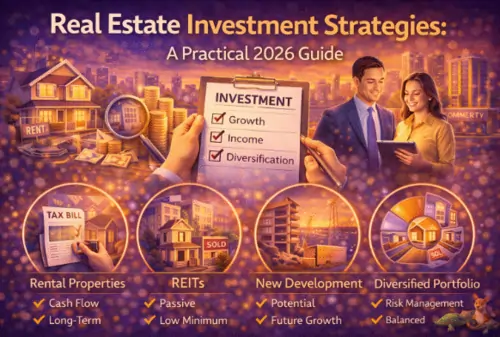
Real estate can be a powerful wealth-building tool because it combines income (rent), long-term value growth (appreciation), and leverage (using financing to control a larger asset). The catch is that real estate rewards planning more than hype.
The best investors don’t chase “hot” properties—they choose a strategy that matches their budget, time, and risk tolerance, then repeat it consistently.
In 2026, many professional outlooks emphasize prioritizing cash-flow growth and being selective by sector and location rather than relying on easy appreciation.
This guide breaks down the most practical real estate investment strategies, how to pick the right one, how to run the numbers, and how to avoid costly mistakes—written in a simple, beginner-friendly way.
Why real estate still works as an investment
Real estate investment often works well for long-term investors because it can offer:
- Monthly cash flow if rent exceeds expenses
- Equity growth as you pay down a loan
- Potential appreciation over time
- Control (you can renovate, raise rents, improve operations)
- Portfolio diversification compared with stocks in some cases
The key is not treating real estate investment like a lottery ticket. Treat it like a small business: you buy an asset, manage risk, and grow returns through smart decisions.
Start here: choose your investor profile
Before picking a strategy, decide what kind of investor you are.
Your main goal
- Cash flow: stable monthly income (common for rentals)
- Growth: value increase and equity (common for value-add/BRRRR)
- Fast profit: short-term gains (flips and some wholesale deals)
Your available time
- Hands-on: you can manage tenants or renovations
- Semi-hands-on: you’ll use property managers and contractors
- Passive: you want minimal involvement (REITs, some funds)
Your risk tolerance
- Lower risk tends to mean slower gains (stable rentals, diversified REITs)
- Higher risk can mean bigger upside (flips, development, distressed deals)
Core real estate investment strategies
Buy-and-hold rentals
This is the classic strategy: buy a property, rent it out, and hold long-term.
Why people choose it
- Predictable structure (rent in, expenses out)
- Builds equity over time
- Works well for steady wealth building
Key decisions
- Long-term tenants vs short-term rentals (short-term can be higher income but higher workload and regulation risk)
- Self-manage vs hire a property manager
- Single-family vs condo vs multi-family
Beginner-friendly tip
If you’re starting, focus on a property that cash flows even after conservative expenses (vacancy, repairs, maintenance, insurance, taxes, and management). Don’t assume “it will work out later.”
House hacking
House hacking means you live in the property and rent out part of it to reduce your housing cost.
Common examples:
- Renting out spare bedrooms
- Buying a duplex/triplex, living in one unit, renting the others
Why it’s powerful
- Lower monthly housing expense
- Easier financing in many markets for owner-occupied homes
- Builds equity while tenants help pay the mortgage
Reality check
You’re mixing “home” and “investment.” Be honest about whether you’re comfortable living close to tenants or housemates.
BRRRR method
BRRRR stands for Buy, Rehab, Rent, Refinance, Repeat. The idea is to buy an undervalued property, improve it, rent it out, then refinance to recover capital and repeat the process.
Why investors love BRRRR
- Can scale faster than saving up a new down payment each time
- Value is created through renovation and better operations
Where BRRRR fails
- Renovation overruns
- Delays (especially expensive if you use short-term financing)
- After-Repair Value (ARV) comes in lower than expected
- Rent demand is weaker than projected
Beginner-friendly tip
Only do BRRRR if you have a clear renovation scope, contractor plan, and conservative ARV assumptions.
Fix-and-flip
A flip is buying a property, renovating it, then selling it for a profit.
What makes flipping profitable
- Buying at the right price (this is the biggest factor)
- Tight rehab budgeting
- Fast timeline and clean project management
- Clear buyer market for the finished product
Common mistakes
- Underestimating hidden repairs
- Over-improving for the area (spending more than the neighborhood supports)
- Relying on price appreciation to save the deal
Flips can work, but they’re not the easiest “first strategy” unless you already have experience with construction and pricing.
Wholesaling
Wholesaling means finding a deal, getting it under contract, then assigning that contract to another buyer for a fee.
Why people do it
- Lower capital needed (in some structures)
- Builds deal-finding skills quickly
Big caution
Rules vary by location, and wholesaling can involve compliance issues if done incorrectly. If you pursue it, learn local regulations and work with professionals.
Passive real estate strategies
REITs
A REIT (Real Estate Investment Trust) lets you invest in income-producing real estate through a company that owns and often operates property assets.
Why REITs are popular
- No tenants, no repairs
- Easier to diversify across property types
- Often pays dividends
Trade-offs
- REIT prices move with the market
- Dividend taxation rules depend on your country
- You have less control than owning property directly
REITs are a strong option if you want real estate exposure but prefer a passive approach.
Crowdfunding and syndications
These involve pooling money with other investors to fund a property or portfolio.
Pros
- Access to larger projects
- Potential diversification
Cons
- Fees can be complex
- Liquidity can be limited (your money may be locked in)
- Sponsor quality matters a lot
Do deeper due diligence here—especially on track record, fee structure, and exit plan.
Deal analysis fundamentals you must know
If you want consistent wins, your deal analysis should be conservative.
Cash flow basics
- Income: rent + other fees (parking, laundry, etc.)
- Expenses: mortgage, taxes, insurance, maintenance, repairs, vacancy, utilities, HOA (if any), property management
If rent barely covers costs on paper, it won’t work in real life.
Cap rate and cash-on-cash (simple definitions)
- Cap rate: income return relative to property price (ignores financing)
- Cash-on-cash: return based on the cash you actually invested (includes financing)
Stress test your deal
Run your numbers under “bad but realistic” scenarios:
- vacancy increases
- interest rates change (if using adjustable loans)
- repairs cost more than expected
- rent growth is slower
In 2026, many investors and institutional outlooks focus on underwriting for durable cash flow rather than assuming easy price gains.
Financing strategies (and how leverage can hurt you)
Financing is a tool. It can boost returns, but it also increases risk.
Common financing approaches:
- Traditional mortgages
- Owner financing (seller carries part of the loan)
- Value-add financing (for renovation projects)
- Refinance strategies (often used in BRRRR)
Rule of thumb
If a property only “works” with perfect conditions, it’s a risky deal.
Location strategy: how to pick the right market
A great property in a weak area can still struggle. Look for:
- Job and population stability
- Strong rental demand (low vacancy, reasonable rent-to-income levels)
- Infrastructure and accessibility
- Local regulations that affect rentals (especially short-term rentals)
Also watch for oversupply risk: too many new units can slow rent growth.
Risk management and scam prevention
Real estate investment involves large transactions, which attracts fraud.
Protect yourself from transaction scams
Wire fraud and fake payment instructions are a known risk in real estate closings.
Simple protections
- Verify wiring instructions by calling a known number (not from an email)
- Never change payment details based only on email/text
- Use secure portals when possible
Always do due diligence
- Title checks and liens
- Proper inspections
- Contractor verification
- Insurance review
- Clear lease and tenant screening plan
How investors scale a portfolio without blowing up
Scaling usually looks like:
- Build stability with 1–2 solid properties
- Add systems (property manager, contractor list, bookkeeping)
- Expand carefully by repeating what works
- Diversify when you have enough cash flow and reserves
Scaling too fast with thin reserves is one of the most common ways investors get forced to sell at the wrong time.
Mistakes first-time investors make
- Buying based on emotion, not numbers
- Underestimating repairs and maintenance
- Ignoring vacancy risk
- Overleveraging (too much debt, not enough reserves)
- No exit plan (what if you need to sell fast?)
Real estate investment strategy checklist
- Clear goal (cash flow, growth, or fast profit)
- Strategy match (buy/hold, BRRRR, flip, REIT)
- Conservative deal analysis
- Strong financing plan
- Emergency reserves
- Due diligence complete
- Exit plan defined
FAQs
What is the safest real estate strategy for beginners?
A conservative buy-and-hold rental or diversified REIT exposure is often the simplest starting point, depending on your risk tolerance and capital.
What is the BRRRR method?
BRRRR is Buy, Rehab, Rent, Refinance, Repeat, a strategy to recycle capital by forcing appreciation through renovations.
Are REITs “real” real estate investing?
Yes—REITs are companies that own and typically operate income-producing real estate, allowing individuals to invest without buying property directly.
How do I avoid real estate wire fraud?
Verify payment instructions through trusted channels and don’t rely on email-only changes—wire fraud is a recognized risk in real estate transactions.
What matters more: strategy or location?
Both matter, but location can amplify or ruin a strategy. A great plan in a market with weak demand is still a hard win.