

Colon cancer is a major health concern in Australia, and risk is shaped by age, family history, genetics, existing bowel conditions and lifestyle. Australians who are over 45, have relatives with bowel cancer, live with inflammatory bowel disease, or follow high‑risk habits (such as eating lots of processed meat, smoking, or being inactive) fall into higher‑risk groups and may need earlier or more frequent screening. Understanding who is at risk for colon cancer Australia‑wide—and acting on that knowledge through lifestyle changes, participation in the National Bowel Cancer Screening Program and prompt attention to symptoms—can significantly reduce the chances of late‑stage diagnosis and improve long‑term outcomes.
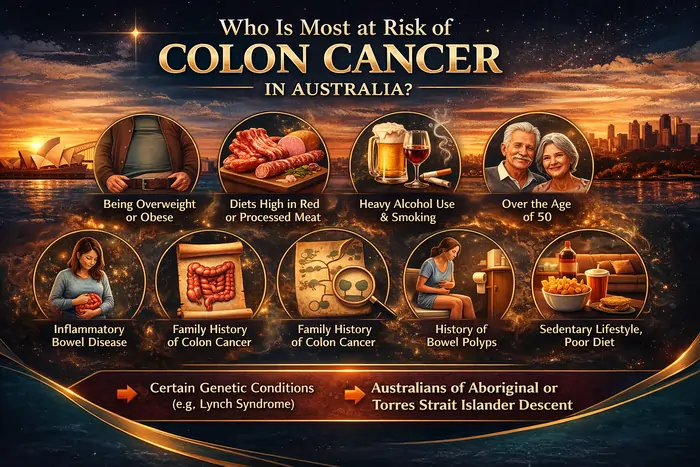
Colon cancer is one of the most common cancers in Australia, and while it can affect anyone, some people face a much higher risk than others. Understanding who is at risk for colon cancer Australia‑wide helps you and your doctor decide when to start screening, how often to test, and what you can do to lower your chances of getting sick.
What does “who is at risk for colon cancer Australia” really mean?
Risk is not just a yes/no label; it’s a spectrum. On one end, some people have inherited syndromes or strong family histories that make them highly likely to develop colon cancer. On the other, some have no known risk factors but are still vulnerable through age and environment. In between, many Australians carry a mix of moderate genetic and lifestyle factors that subtly shift their risk up or down.
Broadly, your risk is shaped by:
- Non‑modifiable factors: age, sex, genetics, family history, and certain medical conditions.
- Modifiable factors: diet, weight, exercise, alcohol, smoking and other lifestyle patterns.
- Health‑system factors: whether you participate in screening and seek help early for symptoms.
Knowing where you sit on this spectrum is the first step toward smart prevention and timely detection.
Age: how risk changes over your lifetime
Age is one of the strongest predictors of colon cancer risk, which is why screening systems are built around it.
Under 30
- Absolute risk is low, but not zero.
- Cases in this age group usually involve strong genetic factors (e.g., Lynch syndrome, FAP) or significant inflammatory bowel disease (IBD).
- Any persistent symptoms in this age group, particularly with family history, deserve attention.
30–44 years
- Risk remains lower than in older adults, but this is the group where early‑onset colon and rectal cancers are rising most quickly.
- Symptoms are more likely to be mislabelled as IBS, haemorrhoids or “just stress.”
- People in their 30s and early 40s who also have lifestyle risks or family history are a very important part of who is at risk for colon cancer Australia today.
If you want a symptom‑focused deep dive for this younger group, Colon Cancer Symptoms in Australians Under 50: Rising Concern explains what to look out for and when to seek medical advice.
45–74 years
- This is the core age range for the National Bowel Cancer Screening Program (NBCSP), and where the majority of diagnoses still occur.
- Australians in this bracket receive free at‑home bowel screening kits (FIT) every two years.
- Risk increases steadily with age, particularly after 50.
75+ years
- Risk remains high, but screening decisions become more individualised, based on overall health and life expectancy.
- Some older adults continue colonoscopies and/or FIT tests, while others stop based on doctor advice.
Family history: when relatives raise your risk
Family history is one of the clearest indicators of who is at risk for colon cancer in Australia.
Factors that increase risk:
- First‑degree relatives with colon or rectal cancer (parent, sibling, child).
- Relatives diagnosed before age 50.
- Multiple affected relatives on the same side of the family.
- Relatives with numerous or advanced polyps.
In simple terms:
- One first‑degree relative with bowel cancer roughly doubles your risk.
- Multiple relatives and early‑onset cases can raise risk several‑fold.
What this means for you:
- You may need to start colonoscopy earlier than the usual screening age.
- You may need more frequent colonoscopies (e.g., every 3–5 years rather than 10).
- Your GP might refer you for genetic counselling if your family pattern suggests an inherited syndrome.
For a clear Australian‑specific breakdown of these patterns, see Who Is Most at Risk of Colon Cancer in Australia?.
Genetic syndromes: inherited conditions that dramatically increase risk
Some families carry mutations that almost guarantee an elevated colon cancer risk. These genetic syndromes are a key part of the “high‑risk” end of who is at risk for colon cancer Australia‑wide.
Lynch syndrome (Hereditary Non‑Polyposis Colorectal Cancer, HNPCC)
- Increases lifetime risk of colon cancer and several other cancers (e.g., endometrial).
- Cancers often occur at younger ages (30s–40s).
- Affects both men and women.
Familial Adenomatous Polyposis (FAP)
- Causes hundreds to thousands of polyps in the colon and rectum, often starting in adolescence.
- Without preventive surgery, nearly all affected individuals develop colon cancer.
- Requires intensive surveillance and sometimes early removal of the colon.
Other polyposis syndromes
- MUTYH‑associated polyposis and other rare conditions also cause numerous polyps and high risk.
Signs you should ask about genetic testing:
- Multiple family members with bowel cancer across generations.
- Very early diagnoses (before 40).
- A family member with both colon cancer and other cancers linked to Lynch syndrome.
- Personal history of a large number of polyps.
Genetic counselling services in Australia can guide testing and surveillance plans if a syndrome is suspected.
Inflammatory bowel disease (IBD): higher risk when the colon is inflamed
If you live with long‑standing inflammatory bowel disease such as ulcerative colitis or Crohn’s disease affecting the colon, you are part of the group at increased risk.
Why IBD raises risk:
- Chronic inflammation leads to repeated damage and repair of the bowel lining.
- Over time, this can trigger pre‑cancerous changes (dysplasia) and eventually cancer.
Risk is higher when:
- You’ve had colitis for 8–10 years or more.
- Large sections of your colon are affected.
- Inflammation has been severe or poorly controlled.
What happens if you’re in this group:
- Regular surveillance colonoscopies (often every 1–3 years).
- Random and targeted biopsies to check for dysplasia.
- Close collaboration with a gastroenterologist.
Healthdirect’s overview of bowel cancer (colon and rectal cancer) and Cancer Council’s bowel cancer pages are good starting points if you have IBD and want to understand your surveillance needs.
Lifestyle and behaviour: everyday choices that increase colon cancer risk
Even if you have no notable family or medical history, your routine habits significantly help define who is at risk for colon cancer Australia‑wide.
Diet
Higher risk is associated with:
- Regular intake of processed meats: bacon, sausages, salami, deli meats.
- High consumption of red meat, especially when charred or heavily barbecued.
- Low intake of fibre: minimal vegetables, fruits, whole grains and legumes.
- Frequent ultra‑processed foods: packaged snacks, fast food, sugary drinks.
These patterns are common in modern Australian diets and strongly linked with bowel cancer in research.
Body weight and physical activity
- Being overweight or obese, especially with a large waistline, increases risk.
- Sedentary lifestyles—lots of sitting with little exercise—add to the problem.
- Regular physical activity lowers risk, partly by improving bowel motility and reducing inflammation.
Alcohol and smoking
- Smoking is a major cancer risk factor, including for bowel cancer.
- Heavy alcohol use also raises colon cancer risk, especially in combination with poor diet and smoking.
Sleep, stress and environment
- Chronic sleep deprivation and ongoing psychological stress can indirectly influence risk by impacting hormones and immune function.
- There is emerging research into environmental exposures (e.g., microplastics, pollutants), but evidence is still developing.
For a practical, behaviour‑focused explanation of these factors, see 12 Lifestyle Choices That Can Increase Colon Cancer Risk. It’s a useful checklist if you’re ready to make changes.
Young Australians: early‑onset colon cancer risk
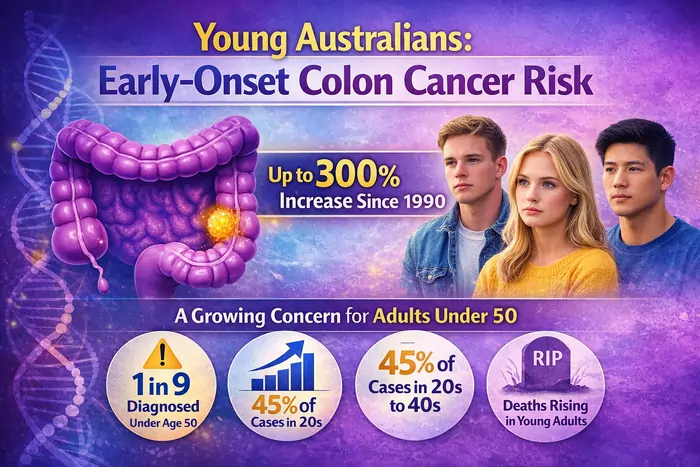
One of the most concerning trends in who is at risk for colon cancer Australia is the rise of early‑onset cases in younger adults.
Why this matters:
- Many people in their 20s, 30s and early 40s assume they are “too young” for bowel cancer.
- Symptoms are often attributed to benign conditions, delaying diagnosis.
- Early‑onset cancers can be more aggressive in some cases and are often diagnosed at later stages.
Key risk combinations in younger Australians:
- Strong family history plus poor lifestyle habits.
- Genetic syndromes (Lynch, FAP) plus delayed surveillance.
- IBD plus inadequate follow‑up.
- High processed food intake, sedentary behaviour and obesity, even without known genetic risk.
For a symptom‑and‑awareness piece that complements this risk‑focused article, read Colon Cancer Symptoms in Australians Under 50: Rising Concern.
Average risk vs increased risk: where do you fit?
Another way to frame who is at risk for colon cancer in Australia is to separate people into two broad categories: average‑risk and increased/high‑risk.
Average‑risk Australians
Typically:
- Over 45.
- No personal history of bowel cancer, advanced polyps or IBD affecting the colon.
- No strong family history or known genetic syndromes.
What this means:
- Follow national screening with the NBCSP (FIT test every two years).
- Respond quickly to symptoms such as bleeding, bowel changes, abdominal pain or unexplained weight loss.
Useful links:
- Cancer Council: Bowel cancer – Cancer Council Australia
- Cancer Council NSW: Bowel cancer symptoms
- Healthdirect: Bowel cancer (colon and rectal cancer)
Increased‑risk or high‑risk Australians
Include those with:
- Multiple close relatives with bowel cancer, especially early‑onset.
- Known genetic syndromes.
- Long‑standing IBD affecting the colon.
- Previous colon cancer or advanced adenomas.
What this means:
- Earlier and more frequent colonoscopy, not just FIT.
- Tailored surveillance schedules.
- Possible genetic testing and family screening.
RACGP guidance (written for GPs but helpful to reference) outlines how Australian doctors stratify and manage risk:
- RACGP: Colorectal cancer
Screening in Australia: how risk shapes recommendations
Screening is one of the most powerful tools for reducing both incidence and mortality.
National Bowel Cancer Screening Program (NBCSP)
- Offers free FIT home test kits to eligible Australians, currently starting at 45 and continuing every two years.
- Designed primarily for average‑risk people.
To better understand and explain the screening process, you can link to:
- Cancer Institute NSW: Bowel cancer screening
- Cancer Council: Bowel cancer | Guide to best cancer care
Colonoscopy and high‑risk groups
If you’re at increased risk:
- Colonoscopy is the gold standard for detecting and removing polyps and early cancers.
- Your schedule (starting age and interval) depends on your specific risk profile.
- You may not rely on FIT kits alone.
The Australian Commission on Safety and Quality in Health Care also provides professional resources around colonoscopy and prevention:
- Bowel cancer prevention resources (via the colonoscopy clinical care standard).
Recognising symptoms when you’re at risk
Being high‑risk makes symptom awareness even more crucial. Warning signs include:
- Blood in stool or on toilet paper.
- Persistent changes in bowel habits (diarrhoea, constipation, narrower stools).
- Ongoing abdominal pain, cramps or bloating.
- Unexplained weight loss and fatigue.
- Mucus in stool or constant urge to pass stool (tenesmus).
You can learn more at:
- Cancer Council: Bowel cancer symptoms
- Healthdirect: Bowel cancer
If you know you are in an increased‑risk group and experience any of these symptoms, you should see your GP promptly—even if you are younger than the usual screening age.
Reducing your colon cancer risk: practical strategies
Regardless of your risk level, you can almost always lower it further.
Key strategies:
- Know your family history and share it with your GP.
- Participate in screening when invited.
- Improve your diet: more fibre, less processed and red meat, fewer ultra‑processed foods.
- Stay active and minimise prolonged sitting.
- Maintain a healthy weight or work toward gradual loss if needed.
- Avoid smoking and limit alcohol.
- Take symptoms seriously and seek help early.
If you’re ready to act on lifestyle, 12 Lifestyle Choices That Can Increase Colon Cancer Risk offers a clear, behaviour‑by‑behaviour guide tailored to everyday life.
FAQs: Who Is at Risk for Colon Cancer in Australia?
Who is considered high risk for colon cancer in Australia?
People with strong family histories, known genetic syndromes, long-standing inflammatory bowel disease (IBD) involving the colon, or a history of bowel cancer or advanced polyps.
What does “average risk” mean?
Average-risk Australians have no major family or personal risk factors and typically follow standard screening recommendations starting around age 45.
Does having a parent with colon cancer increase my risk?
Yes. A first-degree relative with colon cancer significantly raises your risk, especially if diagnosed before age 50 or if multiple relatives are affected.
Can Australians under 50 be at high risk?
Absolutely. Younger adults with strong family histories, genetic syndromes, IBD, or unhealthy lifestyles can still fall into a high-risk category.
How does lifestyle affect who is at risk for colon cancer in Australia?
Lifestyle plays a major role. Diet, weight, physical activity, smoking, and alcohol use can all influence your risk level.
Does inflammatory bowel disease always lead to cancer?
No, but it increases the risk. Many people with IBD never develop bowel cancer if their condition is well managed and monitored.
Can a healthy lifestyle cancel out genetic risk?
Not completely. A healthy lifestyle can reduce risk but cannot eliminate strong genetic factors. Early and regular screening is still essential.
Are women less at risk than men?
Men generally have slightly higher rates, but many early-onset cases occur in women. Both should take symptoms and screening seriously.
At what age should I start worrying about colon cancer risk?
You should understand your risk at any age. Most average-risk individuals begin screening around 45, while high-risk people may need earlier checks.
What should I do if I think I’m high risk?
Speak with your doctor. Bring your family history and ask about genetic testing, earlier colonoscopy, or a personalized screening plan.
Can changing my diet really make a difference?
Yes. Increasing fibre intake and reducing processed and red meat can significantly lower long-term risk.
Is alcohol a big factor in colon cancer risk?
Yes. Regular heavy drinking increases risk, so limiting alcohol intake is an important preventive step.
Does obesity significantly increase risk?
Yes. Excess body weight, especially abdominal fat, is strongly linked to higher colon cancer risk.
If I have no family history, am I safe?
No. Many people diagnosed with colon cancer have no known family history. Lifestyle and age still play key roles.
Where can I learn more about who is at risk for colon cancer Australia-wide?
Start with trusted sources like Cancer Council Australia, Healthdirect, and Bowel Cancer Australia for reliable guidance and support.