

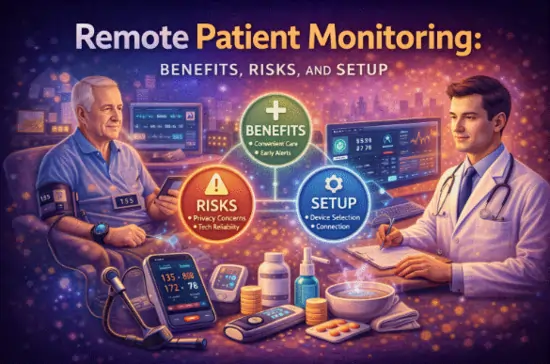
Remote Patient Monitoring (RPM) is a way for healthcare teams to track a patient’s health while the patient is at home (or anywhere outside a clinic). Instead of waiting for the next appointment, RPM uses connected devices to collect health data and share it with clinicians so they can spot problems earlier and adjust care when needed.
Telehealth.HHS describes Remote Patient Monitoring as a form of asynchronous telehealth where devices collect and send patient data and clinicians review it to manage conditions and detect risks.
This guide explains RPM in plain language: what it is, how it works, who benefits most, what to watch out for, and how to choose a safe setup.
This is educational information, not medical advice.
What Remote Patient Monitoring is
Remote Patient Monitoring is the use of digital devices to collect health measurements outside the traditional healthcare setting and send those readings to a healthcare team for review. It’s usually “asynchronous,” meaning you don’t need a live video call every time you send a reading.
Common examples of RPM data include:
- Blood pressure
- Heart rate
- Oxygen saturation (SpO₂)
- Weight
- Blood glucose
- Temperature
- Symptom check-ins (like shortness of breath or dizziness)
AHRQ’s PSNet describes Remote Patient Monitoring as telehealth where providers monitor patients outside traditional settings using digital medical devices, and data is electronically transferred for care management.
How RPM works
Most RPM programs follow the same flow:
- A clinician sets a plan (what to measure, how often, what thresholds matter)
- The patient measures at home using a device (or wearable)
- Readings are sent through an app, hub, or portal
- A care team reviews trends (not just one reading)
- The team contacts the patient if action is needed (med change, appointment, urgent care)
What makes Remote Patient Monitoring valuable is the trend line. It helps clinicians see patterns over days and weeks rather than relying on one measurement taken in a clinic.
RPM vs telehealth: what’s the difference?
Telehealth often means a live appointment (video or phone). RPM is more like “ongoing tracking” between visits. Remote Patient Monitoring can be used alone or combined with telehealth follow-ups. Telehealth.HHS specifically frames RPM as asynchronous telehealth that does not require live interaction each time.
Who benefits most from Remote Patient Monitoring
RPM is most useful when a person’s condition can change between visits and early detection helps.
Common use cases include:
- Hypertension (blood pressure trends)
- Heart failure (daily weight + symptoms)
- Diabetes (glucose patterns)
- COPD/asthma (SpO₂, symptoms, inhaler use)
- Post-surgery recovery (vitals + symptom check)
- Older adults at risk of deterioration
RPM is also used to support “hospital-at-home” and virtual ward models in some health systems, where care is delivered at home with monitoring plus clinician check-ins.
Why RPM can improve health and wellness
When implemented well, Remote Patient Monitoring can support better outcomes because it:
- Spots worsening health earlier (so action can happen sooner)
- Reduces avoidable emergency visits for some patients
- Improves self-management (patients learn what affects readings)
- Builds healthy routines (consistent tracking + feedback)
- Helps personalize treatment (dose adjustments based on real-world trends)
CMS also highlights RPM as a structured healthcare service and includes fraud-prevention guidance, which reflects how widely RPM is being adopted in routine care systems.
Common RPM devices
RPM can use simple devices or wearables. Typical devices include:
- Blood pressure cuff
- Pulse oximeter
- Digital scale
- Thermometer
- Glucose meter or continuous glucose monitor (CGM)
- Smartwatch/wearable (heart rate and activity tracking)
Important note: not every consumer wellness gadget is accurate enough for medical monitoring. That’s why the program should clarify which devices are acceptable and how readings are reviewed.
Risks and limitations to understand
RPM is helpful, but it’s not perfect. The most common issues are:
False alarms and anxiety
A single “high reading” can cause worry even when it’s not dangerous. RPM works best when you look at trends and have a clear plan for what to do.
Inaccurate measurements
Wrong cuff size, poor technique, low battery, or cheap devices can create bad data. Training matters.
Data overload
Clinicians can’t safely monitor huge volumes of data without proper workflows. You should know who reviews your data and how often.
Privacy and security concerns
RPM involves personal health data. A reputable program should be clear about data storage, access, and consent.
Not for emergencies
RPM is not the same as emergency care. If you have serious symptoms (chest pain, severe shortness of breath, fainting, stroke symptoms), you need urgent medical attention.
How to choose a safe RPM program
Before joining (or setting up your own), use this checklist:
Program clarity
- What exactly are you measuring?
- How often do you measure?
- What readings require action?
Clinical oversight
- Who reviews the data?
- How quickly are abnormal results reviewed?
- What happens if a reading is concerning: do you call them, or do they call you?
Device quality
- Is the device clinically validated or supplied by the clinic?
- Is there training on correct use?
Privacy basics
- Who can access your data?
- Is data encrypted and stored securely?
- Can you opt out and have data deleted (where applicable)?
Practical tips for patients using RPM
- Measure at the same time daily (consistency improves trends)
- Follow the correct technique (especially for BP cuffs)
- Don’t change medication based on one reading unless your clinician told you to
- Write down symptoms alongside readings (numbers + how you feel is more useful)
- Bring your device to appointments sometimes to compare accuracy
FAQs
What is Remote Patient Monitoring?
Remote Patient Monitoring uses connected devices to collect health data at home and share it with clinicians for review and care decisions.
Is RPM the same as a video consultation?
No, RPM usually sends readings asynchronously while telehealth visits are typically live calls.
Who should consider RPM?
People with chronic conditions or higher risk of deterioration between visits often benefit most from RPM programs.
Does RPM replace emergency care?
No, RPM is for monitoring and follow-up and should not be used for urgent symptoms requiring emergency services.
What devices are commonly used for RPM?
Common RPM devices include blood pressure monitors, pulse oximeters, scales, and glucose monitoring tools.