

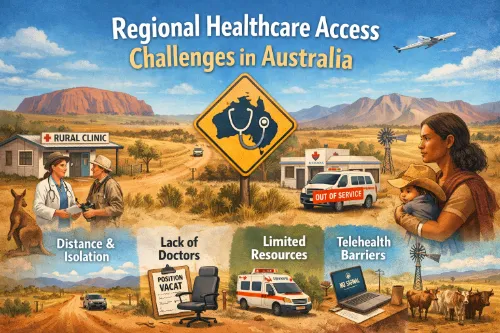
Regional Healthcare in Australia face significantly worse access to people in major cities, driven by geography, workforce shortages, and longstanding structural inequities. These gaps are particularly stark for Aboriginal and Torres Strait Islander peoples in remote areas, where disease burden and life expectancy lag far behind non‑Indigenous Australians.
1. The regional health access gap in Australia
Around seven million people (28% of the Australian population) live and work in rural and remote areas, yet they consistently have poorer access to healthcare and poorer health outcomes than city residents. The Australian Institute of Health and Welfare (AIHW) has documented higher rates of chronic disease, injury and potentially preventable hospitalisations outside major cities.
The Department of Health’s Rural Health Outreach Fund notes that barriers include long distances to services, fewer health professionals, and limited local infrastructure, all of which contribute to delayed care and worse outcomes. AIHW’s “Australia’s health 2024” summary likewise shows that rates of potentially preventable hospitalisations are two to three times higher in remote and very remote areas compared with major cities.
2. Health workforce shortages and maldistribution
A core driver of regional access challenges is the shortage and uneven distribution of health workers.
A 2025 PLOS ONE study, “Interlinkage between health workforce availability and socio-economic status in rural and remote Australia”, finds that Australians living in rural and remote areas face a higher burden of disease while having poorer access to essential health services. The authors note that the number of full‑time equivalent health workers per head decreases with increasing remoteness, meaning workforce is “inversely distributed” relative to need.
A systematic review of interventions for health workforce retention in rural and remote areas highlights that recruitment and retention are global problems, and that evidence on effective strategies is mixed. It notes that rural background and extended rural training increase the likelihood that clinicians will work rurally, but that place‑based factors—such as remoteness, social isolation and fewer amenities—undermine long‑term retention.
An allied health report for the Australian Council of Deans of Health Sciences, “Development of and support for the rural and remote allied health workforce”, concludes that regional areas face chronic shortages of allied health professionals and that improving access will require both a larger overall workforce and better distribution, including more graduates working in regional settings and stronger regional universities.
Independent MP Helen Haines summarises the situation bluntly in “Reasons for workforce shortages in rural health are many and complex”, pointing to inadequate resourcing, inflexible training pathways, housing and childcare shortages, and a general lack of support as key barriers to attracting clinicians to regional Australia.
3. Social determinants, inequalities and avoidable harm
Access challenges intersect with the social determinants of health, creating deeper inequalities in regional Australia.
A 2024 analysis in the journal Rural and Remote Health, “Regional health inequalities in Australia and social determinants of health”, finds that rural and remote communities have benefited from innovative primary healthcare and investment in Aboriginal Community Controlled Health Organisations, but remain under‑resourced by an estimated AUD 4 billion for non‑metropolitan health services. The authors show that reduced premature and avoidable mortality in some areas is linked to stronger local services and attention to social determinants, yet large gaps persist.
The National Rural Health Alliance’s “Rural Health in Australia – Snapshot 2025” highlights stark patterns, including:
- Higher rates of potentially preventable hospitalisations outside major cities, 2–3 times higher in remote and very remote areas.
- A strong relationship between hospitalisation for self‑harm and remoteness, with rates rising as remoteness increases.
- Difficulties accessing disability and aged care services in rural and remote areas.
The Rural and Remote Health article also emphasises that digital technologies and better internet access are crucial for reducing these inequalities, enabling both technology‑supported health services and improved access to education and employment.
4. First Nations health and “Closing the Gap”
For Aboriginal and Torres Strait Islander peoples, especially those in remote areas, regional access challenges are compounded by historical and structural disadvantage.
The Australian Government’s “How we support Aboriginal and Torres Strait Islander health” page outlines the National Aboriginal and Torres Strait Islander Health Plan 2021–2031 and the government’s commitments under the National Agreement on Closing the Gap. It notes that the Commonwealth will spend AUD 4.1 billion on Indigenous‑specific health initiatives to 2022–23, including the Indigenous Australians’ Health Programme and support for Aboriginal Community Controlled Health Organisations (ACCHOs).
An Open Access Government article, “First Nations health: Closing the gap and improving lives”, reports that First Nations people in remote areas face higher disease burden and lower life expectancy than those in non‑remote areas. It links these disparities to differences in education, employment, housing, and access to healthy food and healthcare, and notes that mental health contributes about 10% of the health gap, with suicide rates more than twice those of non‑Indigenous Australians.
The official Closing the Gap targets and outcomes page lists 19 socio‑economic targets, many directly related to health, housing and employment. The National Agreement calls for formal partnerships, building the community‑controlled sector, transforming government organisations, and shared access to data at regional level—reforms that are particularly relevant for remote health planning.
5. Tertiary and specialist care: distance and delays
Regional Australians face major barriers accessing tertiary and specialist services, which are typically concentrated in metropolitan centres.
A 2024 article on ScienceDirect, “Current status of tertiary healthcare services and its accessibility in rural and remote Australia”, describes how geographic isolation, limited infrastructure, and workforce shortages combine to restrict access to high‑level services such as oncology, cardiology and complex surgery. Patients often travel long distances, incur high travel and accommodation costs, and experience delays that can worsen outcomes.
The Rural Health Snapshot 2025 shows that these access constraints contribute to higher rates of potentially preventable hospitalisations and worse outcomes for acute conditions, as early diagnosis and timely specialist intervention are harder to achieve outside major cities. This reinforces the need for outreach, telehealth, and better referral pathways linking primary care to tertiary centres.
6. Government programs and policy responses
Australian governments have rolled out a range of programs to address regional healthcare access challenges, with mixed results.
Outreach and visiting services
The Department of Health’s Rural Health Outreach Fund aims to improve access by supporting health professionals—including specialists—to visit rural and remote communities. The program targets chronic disease, eye health, maternity and paediatric services, and mental health, with the explicit goal of reducing travel and wait times.
Workforce initiatives
The PLOS ONE workforce study points to initiatives like the Rural Health Multidisciplinary Training program, which supports rural training and recruitment of rural students, as important contributors to addressing workforce shortages, even if overall distribution remains uneven.
The allied health workforce report recommends expanding expedited pathways to registration for priority professions and building strategic alliances with key source countries to attract international practitioners to undersupplied regions. It also argues for integrating allied health more effectively with GPs and nurses to get “more efficient spend of health funding based on greater integration of allied health with general practitioners and nurses.”
The Department of Health’s Regional, Rural and Remote Home Care Workforce Support Program provides another example: it aims to add 4,000 home care workers over three years to support older people living in non‑metropolitan areas.
Value‑based and system‑level approaches
The Australian Healthcare and Hospitals Association explores more systemic responses in “Applying value‑based health care to address rural health workforce shortages”. The piece argues that limited housing, amenities and social support deter workers from rural settings, and that value‑based care models should be used to align funding with outcomes and encourage investment in integrated, community‑driven services.
7. Retention, innovation and the way forward
Addressing regional access challenges in Australia ultimately requires both more resources and smarter deployment of those resources.
A review on improving rural and remote health workforce retention amid global shortages emphasises that retention policies must tackle workplace factors (management, workload, career progression) and place‑based factors (housing, schools, social life) alongside pay and incentives. Without this, programs risk attracting staff briefly but failing to keep them.
The Rural and Remote Health inequalities paper underscores the role of Aboriginal Community Controlled Health Organisations and community‑designed services in delivering culturally appropriate, holistic care, especially in remote areas. It also stresses that digital health and connectivity are key enablers for both service delivery and the broader social determinants of health.
Policy analysts and advocates increasingly argue that closing the access gap will require:
- Stable, adequate funding that addresses the estimated AUD 4‑billion shortfall in non‑metropolitan health services.
- Stronger, long‑term investment in regional training pipelines, including rural campuses and local career pathways.
- Support for community‑controlled and culturally safe services, particularly for First Nations communities.
- Continued expansion and evaluation of telehealth and digital solutions, coupled with improved rural connectivity.
- Alignment of incentives and funding with value‑based care and local health outcomes, rather than activity alone.