

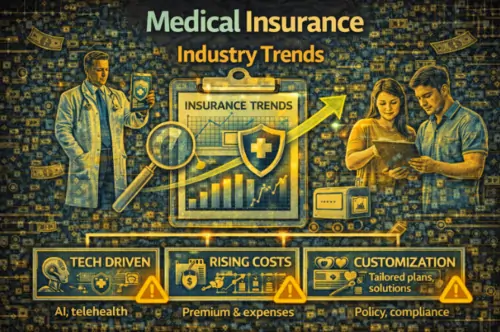
Medical insurance is changing fast because healthcare costs keep rising, customers expect faster service, and insurers are under pressure to manage claims more tightly.
If you’re a Filipino employee choosing a company plan, a family comparing coverage, an HR manager handling renewals, or a student studying finance and healthcare—understanding medical insurance industry trends helps you make smarter decisions.
In 2026, one theme is loud and clear: medical inflation is still high, especially in Asia-Pacific. WTW’s 2026 Global Medical Trends Survey projects medical cost increases in Asia Pacific around 14% in 2026 (up from 13.2% in 2025).
Mercer’s Health Trends 2026 Asia infographic also highlights double-digit medical trend rates in most markets and stresses proactive risk management for sustainable benefits programs.
Those cost pressures drive almost every other trend you’ll see below.
Medical costs keep rising, and premiums follow
When hospitals, doctors, medicines, and diagnostics get more expensive, insurers face higher claim payouts. To stay sustainable, they usually respond through a mix of:
- higher premiums at renewal
- tighter benefit limits or sub-limits
- stricter approval rules for high-cost procedures
- narrower provider networks
- stronger claims auditing and fraud controls
For Philippine readers, this shows up most clearly in how HMO and insurance plans adjust pricing, coverage rules, and provider access. Local performance updates from the Insurance Commission are one of the most reliable ways to track the direction of the Philippine HMO industry.
A recent report citing the Insurance Commission noted the Philippine HMO industry’s strong profit performance in 2025, which was linked to higher membership fees and revenue growth—another sign that pricing and cost management are actively shifting.
Digital claims and automation become “table stakes”
One of the most practical medical insurance industry trends is the move toward faster, more automated claims.
What’s changing:
- more online claims submission (member portals, apps)
- faster pre-authorization and claim status updates
- automation in basic claim checks (eligibility, benefit limits, duplicate detection)
- stronger digital documentation requirements
Why it matters:
- For members: quicker approvals and fewer surprises if information is clear.
- For insurers: lower admin costs and better fraud detection.
In plain terms, insurers are trying to reduce the “manual back-and-forth” that makes claims slow and frustrating.
Telehealth is now built into many benefit designs
Telehealth is no longer “extra.” In many markets, it’s part of the default care pathway: teleconsult first, then labs or in-person follow-up if needed.
Even outside the Philippines, policy direction signals telehealth staying power. The U.S. HHS telehealth policy updates show extensions that keep telehealth broadly available through December 31, 2027 for Medicare providers under current rules. While PH regulations and payer rules are different, the global takeaway is that telehealth has moved into the “standard care option” category, not a temporary pandemic workaround.
What Filipino members should watch:
- Is teleconsult included in your plan?
- Is it limited to certain platforms/providers?
- Are e-prescriptions and lab referrals supported smoothly?
Telehealth is often positioned as a convenience feature, but it’s also a cost-control tool for insurers—especially for low-acuity cases.
Preventive care and wellness benefits expand
As medical inflation climbs, insurers and employers increasingly push prevention because preventing one hospitalization can be cheaper than paying for repeated high-cost admissions.
Expect more emphasis on:
- annual checkups and screenings
- vaccinations and basic labs
- wellness programs tied to corporate plans
- education and coaching for chronic disease risk
Mercer’s Health Trends 2026 Asia notes that proactive risk management is becoming necessary for sustainable benefits programs. This aligns with what many employers feel in the Philippines: renewals get expensive when utilization is high, so prevention becomes part of the strategy.
A practical tip for Filipino readers:
If your company offers a free annual physical exam or screening benefit, use it. Preventive benefits are valuable only when used.
Mental health benefits grow, but limits remain
Mental health coverage is expanding in many plans, but it often comes with restrictions such as:
- limited number of sessions per year
- provider network requirements
- pre-authorization for ongoing therapy
The trend is positive, but the member experience depends heavily on network availability and how approvals are handled. For HR teams, mental health often becomes part of retention strategy—not just a “nice to have.”
Underwriting and risk pricing become more data-driven
For individual plans (and sometimes small-group coverage), underwriting is getting smarter and sometimes stricter.
What you might notice:
- more detailed medical questionnaires
- more attention to pre-existing conditions and waiting periods
- more structured exclusions and benefit limitations
- potential incentives for healthy behavior (varies by market and plan type)
For corporate plans, the “risk pricing” often shows up in renewal negotiations, where insurers look at:
- loss ratio (claims vs premiums)
- top drivers of claims
- frequency of high-cost claimants
- provider utilization patterns
This is why HR teams are paying closer attention to claims analytics.
Provider networks get tighter and more structured
To control costs, many insurers build preferred provider networks and negotiate rates. This can improve affordability but reduce choice.
Common network trends:
- preferred hospitals and clinics (lower out-of-pocket)
- tiered networks (lower premium if you accept a smaller network)
- more pre-authorization for high-cost imaging, surgeries, and admissions
What Filipino families should do:
Before buying a plan, check if your preferred hospital and doctor are in-network. A “good plan” that you can’t use where you want is a bad experience waiting to happen.
Microinsurance and “lighter” products keep growing
In markets where affordability is a major barrier, simpler coverage products expand. These can include:
- fixed inpatient benefits
- emergency coverage
- limited outpatient add-ons
This trend is often distributed through digital channels and partnerships. The upside is access. The risk is misunderstanding exclusions and benefit limits.
A simple rule:
If the policy is cheap, read the limits twice. Many “budget” plans are designed for specific scenarios, not full protection.
Fraud control and claims review intensify
As costs rise, fraud and leakage become more painful. Insurers respond by:
- improving anomaly detection
- requiring clearer documentation
- auditing provider patterns
- tightening approvals for procedures that are frequently abused
For members, this can feel like “more requirements,” but for the system, it’s part of keeping premiums from rising even faster. Capgemini’s health insurance trends for 2025 highlight technology transformation, improved security, and innovative coverage models in response to rising costs and claims pressures. The direction continues into 2026 because the cost problem has not disappeared.
Philippines context: HMO market signals matter
In the Philippines, many people experience “medical insurance” mainly through HMOs, especially via employer-provided benefits. That makes local HMO industry indicators important.
Two reliable checkpoints:
- Insurance Commission HMO statistics for quarterly/annual performance snapshots
- local reporting that references Insurance Commission updates for context on pricing, payouts, and industry performance
What it often means in practice:
- premiums and corporate renewals may stay under pressure
- utilization management becomes stricter (pre-auth, documentation)
- networks and benefit designs may adjust to manage claims
What these trends mean for Filipino readers
For individuals and families
- Prioritize network fit: your nearby hospitals and doctors should be covered.
- Look at total cost, not just premium: check deductibles, co-pays, and sub-limits.
- Read exclusions and waiting periods carefully, especially for pre-existing conditions.
- Ask about claims process: digital submission, turnaround time, and escalation path.
For employers and HR teams
- Track claims drivers and loss ratio to manage renewals.
- Improve employee education to reduce misuse and preventable ER visits.
- Consider prevention programs and mental health support as cost-control tools, not only perks.
- Evaluate provider networks and service experience, not only pricing.
For students and career builders
Growing roles include:
- claims analytics and operations
- underwriting support
- health economics and actuarial work
- product design and provider network management
- fraud and compliance analytics
FAQs
Is HMO the same as health insurance?
Not always. HMOs commonly focus on managed care and networks, while traditional health insurance can be reimbursement-based or broader—plan structure depends on the product.
Why do premiums increase almost every year?
Because medical costs and claims can rise due to inflation, utilization, and higher treatment costs. Asia-Pacific medical trend rates are projected to remain high in 2026.
What’s the biggest mistake people make when buying coverage?
Choosing based on price alone without checking provider network, exclusions, and real out-of-pocket costs.
Is telehealth covered now?
Many plans include some form of telehealth, and global policy direction shows virtual care becoming more established.
What should I check before signing a policy?
Network hospitals, benefit limits, exclusions, waiting periods, claim filing steps, and how disputes/appeals work.