

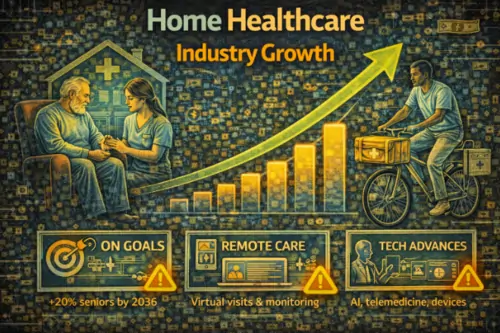
Home healthcare is care delivered in a patient’s home instead of a hospital or facility. It can include clinical services (like nursing care, wound care, rehab) and support services (like help with daily activities, companionship, meal prep).
Across the world—and increasingly in the Philippines—home-based care is growing because it matches three realities: people are getting older, chronic illnesses are more common, and families want care that feels safer and more human.
The “home healthcare industry growth” story is not only about more patients. It’s also about new service models, technology, and workforce systems that make home care easier to deliver and easier to monitor.
What counts as home healthcare?
A simple way to separate the terms:
Home healthcare (clinical)
Care that typically involves licensed health professionals and medical tasks—nursing visits, rehab, post-surgery monitoring, medication management.
Home care (non-clinical support)
Help with daily living—bathing, dressing, mobility, meal prep, companionship.
Hospital-at-home (advanced model)
A structured program where selected hospital-level services are delivered at home with strong monitoring and clinical oversight.
In the Philippines, you’ll also see community and government-linked programs that support older persons at home. For example, DSWD has a manual for Home Care Support Services for Senior Citizens (HCSSSC), focused on comprehensive home care support for elderly individuals.
Why home healthcare industry growth is accelerating
Aging populations are pushing demand upward
Globally, the number of older adults is increasing fast, and health systems are under pressure to adapt. WHO notes the pace of population ageing is accelerating, and by 2050, a large share of older people will live in low- and middle-income countries.
For Filipino families, this trend often shows up as more households needing:
- senior support at home
- chronic disease monitoring
- post-hospital recovery care
Chronic conditions require long-term support, not one-time treatment
More people live longer with diabetes, hypertension, heart disease, and mobility limitations. These conditions don’t always require a hospital bed—but they do require consistency: follow-ups, monitoring, and caregiver support.
Home-based care fits family preferences
Many families prefer home care because it feels:
- more comfortable
- more private and dignified
- easier for family involvement
It can also reduce the stress of travel and waiting times—especially in major cities where traffic can be a barrier to clinic visits.
Cost pressure shifts care away from hospitals
Hospitals are expensive. As systems try to manage costs, there is a natural push to move appropriate care to lower-cost settings—especially for stable patients who mainly need monitoring and support.
Home healthcare industry growth in the Philippines: what’s driving it
The Philippines has unique demand signals that make home-based care especially relevant:
Strong family caregiving culture
Multi-generational households often choose home care first, then escalate to hospital care when needed.
Urban congestion and travel time
Home visits can be more practical than repeated clinic trips.
Insurance and coverage expansion signals
Broader health system coverage trends under UHC efforts shape demand and access patterns. One market research summary notes high PhilHealth registration (including dependents) as of mid-2024—an indicator of broad enrollment even as “full universality” remains a target.
(For home healthcare businesses, this matters because payer mix—out-of-pocket vs HMO vs insurance—affects pricing and growth.)
Government and community support for older persons
Programs like DSWD’s HCSSSC reflect ongoing institutional attention to home-based support for seniors.
The service lines growing the fastest
Home healthcare industry growth is being powered by a few “high-demand” service types:
Post-acute care (after hospitalization)
- wound care and dressing changes
- medication management
- mobility and rehab support
This is one of the clearest growth areas because it reduces readmissions and supports faster recovery at home.
Chronic disease support
- regular vitals monitoring
- lifestyle support (diet, movement routines)
- reminders and adherence support
This is especially relevant in the Philippines where chronic disease is common and follow-up compliance can be difficult without structure.
Elderly care and functional support
- help with Activities of Daily Living (ADLs)
- fall-risk reduction and home safety checks
- caregiver education and routines
Palliative and comfort-focused support
Not always widely available everywhere, but demand tends to rise as families look for comfort-focused options for serious illness care.
Technology trends fueling home healthcare industry growth
Home healthcare is growing faster because tech makes home care easier to coordinate and safer to monitor.
Telehealth as a “connector”
Telehealth supports follow-ups, caregiver check-ins, and quick clinician guidance—especially for families in provinces. It doesn’t replace all home visits, but it reduces unnecessary travel and helps clinicians scale.
Remote patient monitoring basics
Even simple tools—blood pressure monitors, glucose meters, pulse oximeters—can support structured home monitoring when paired with guidance and escalation protocols.
Operational tech: scheduling, routing, documentation
Home healthcare is logistics-heavy. Providers win when they manage:
- clinician scheduling
- travel routing
- standardized documentation
- incident tracking and quality checks
Data privacy becomes more important
When home care becomes digital, protecting patient data becomes non-negotiable. (This is also where credible providers differentiate themselves from informal operators.)
Business models that are scaling
If you’re an entrepreneur or investor, these are the models most aligned with home healthcare industry growth:
Agency model (staffing + scheduling + QA)
A central organization manages:
- screening and training
- scheduling
- standard care protocols
- customer support and quality assurance
This model scales when it builds trust and consistent service delivery.
Care bundles (fixed-price packages)
Examples:
- “14-day post-surgery recovery bundle”
- “weekly nursing visits + vitals monitoring”
Bundles reduce pricing confusion and help families budget.
Partnership models
Home healthcare providers often partner with:
- hospitals and clinics (referrals, discharge planning)
- labs and diagnostics (home sample collection)
- pharmacies (med delivery coordination)
Subscription-style chronic care support
A monthly plan that includes:
- routine monitoring
- telehealth follow-ups
- periodic home visits
This can be attractive for families supporting seniors long-term.
Workforce trends: the growth bottleneck
Home healthcare industry growth depends heavily on people—nurses, caregivers, PT/OT, and trained support staff.
Common workforce challenges:
- scheduling complexity (travel time reduces visit capacity)
- burnout risk (long hours, night support)
- training quality variation
What strong providers invest in:
- caregiver training (infection control, dementia basics, safe transfers)
- clear documentation standards
- supervision and escalation protocols
- fair compensation structures and predictable schedules
This is where “trust” is built—because families don’t only buy a service, they buy peace of mind.
Regulation and policy signals to watch
Even if you’re not a policy person, policy shapes growth.
Philippines: health system coverage framing
DOH’s policy framing around access to preventive, promotive, curative, rehabilitative, and palliative care under UHC context signals the direction of service coverage expectations, even if funding and implementation vary across services.
Philippines: older-person home care support
DSWD’s HCSSSC manual is a concrete reference that home-based senior support is an ongoing program area.
Australia as a global comparison (useful for investors and operators)
Australia launched Support at Home on 1 November 2025, replacing earlier home care programs, with additional transitions planned later.
Even if you’re PH-based, the lesson is important: when governments formalize and reform home-care programs, demand, pricing, and compliance standards can shift quickly.
The biggest risks and challenges
Home healthcare industry growth is real—but it comes with risks:
Quality control in different home environments
Every home is different. Safety, hygiene, and space vary, so protocols and training matter.
Informal providers and inconsistent standards
Some services operate without clear training standards, which can damage trust in the sector.
Data privacy and cybersecurity
Especially if telehealth or monitoring tools are used.
Affordability barriers
A major challenge in the Philippines: many families pay out-of-pocket, so providers need tiered service options and transparent pricing.
What to expect in 2026 and beyond
These are likely growth directions:
More standardized care bundles
Families want clarity and predictability.
More chronic care support packages
Because chronic illness is long-term and requires repeatable routines.
Better caregiver training systems
Providers that invest in training will win trust faster.
More partnerships with hospitals and clinics
Especially for post-discharge care pathways.
Slow but steady movement toward more formal standards
As home healthcare becomes more common, expectations for quality and documentation rise.
FAQs
What’s the difference between home care and home healthcare?
Home healthcare typically includes clinical services delivered by licensed professionals. Home care focuses on daily living support like bathing, meals, and companionship.
Is home healthcare safe for seniors?
It can be safe when providers use trained staff, proper protocols, and clear escalation steps—especially for post-acute and chronic care monitoring.
How do families choose a reliable provider?
Look for clear pricing, staff credentials, training standards, documentation habits, and a clear process for emergencies and complaints.
What services are most in-demand?
Post-hospital recovery support, chronic disease monitoring, and elderly functional support are common demand drivers as populations age.
Can telehealth replace home visits?
Telehealth helps with follow-ups and guidance, but many services still require in-person visits—especially clinical tasks and mobility support.