

Colon cancer symptoms change with each stage, starting with subtle bowel habit changes and mild rectal bleeding in early disease, then progressing to persistent abdominal pain, fatigue, unexplained weight loss, and signs of spread (like jaundice or chronic cough) in advanced stages. Understanding colon cancer symptoms by stage helps you recognize early warning signs, seek prompt medical care, and see why regular screening—such as colonoscopy and stool-based tests—is vital even before symptoms appear.
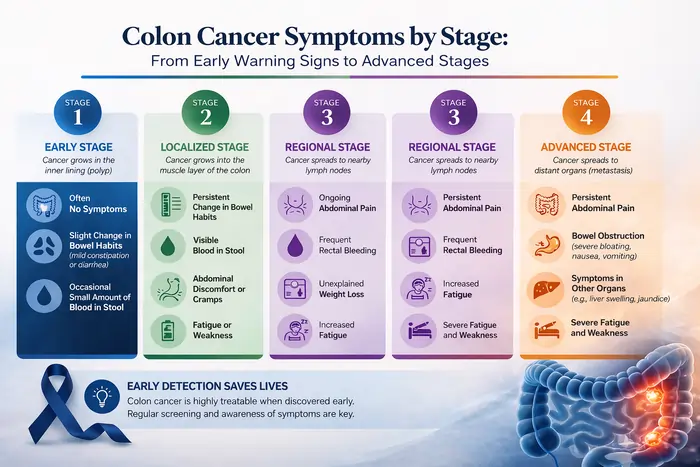
Colon cancer symptoms by stage can range from almost invisible early on to severe, life‑threatening problems in advanced disease.
Below, we’ll walk through 7 key colon cancer symptoms, how they typically present from Stage 0–I up to Stage IV.
What Is Colon Cancer and Why Staging Matters
Colon cancer starts in the large intestine, often from small noncancerous growths called polyps that can slowly turn into cancer over several years. As the tumor grows and spreads, the pattern and severity of symptoms change, which is why “colon cancer symptoms by stage” is a useful way to understand the disease.
Doctors generally use these stages:
- Stage 0 – Abnormal cells limited to the inner lining of the colon (carcinoma in situ).
- Stage I – Cancer has grown into the inner muscle layer of the colon wall but not outside it.
- Stage II – Tumor has grown through the wall and may involve nearby tissues, but not lymph nodes.
- Stage III – Cancer has spread to nearby lymph nodes.
- Stage IV – Cancer has spread (metastasized) to distant organs such as the liver, lungs, or brain.
For a clear, patient‑friendly overview of colon cancer stages, symptoms, and treatment options, it’s helpful to review a comprehensive guide like colon cancer: symptoms, stages, causes, and treatment at Medical News Today or colon cancer – symptoms and causes from the Mayo Clinic.
Why Early Detection Matters
One of the most important things to know about colon cancer is that early stages often cause few or no symptoms. Many people feel normal until the tumor is larger or has already spread. This is why experts emphasize regular colorectal cancer screening, including colonoscopy and stool‑based tests, even when you feel well. You can learn more about screening timelines and options in the American Cancer Society’s colorectal cancer screening guideline update published via Stand Up To Cancer.
Other reliable resources for background include:
- Colon cancer: symptoms, stages, outlook, and more – Healthline
- Colon Cancer: Symptoms, Causes & Treatment – Cleveland Clinic
- Colorectal cancer: symptoms, stages, and outlook – Medical News Today
The 7 Key Colon Cancer Symptoms by Stage
In practice, many different signs can appear, but seven core symptom patterns account for most of what patients experience as colon cancer progresses:
- Change in bowel habits
- Blood in stool or rectal bleeding
- Abdominal pain, cramping, or bloating
- Feeling of incomplete evacuation
- Fatigue and iron‑deficiency anemia
- Unintentional weight loss and appetite changes
- Symptoms of spread (metastatic disease), such as jaundice or chronic cough
Below, we’ll look at each of these symptoms and how they typically appear from early to advanced stages, incorporating your main keyword Colon Cancer Symptoms by Stage naturally.
1. Change in Bowel Habits
Early Stages (Stage 0–I)
In early stages, a change in bowel habits is often subtle and easy to overlook. People may notice:
- Mild constipation or diarrhea that persists for a couple of weeks or more
- Slight changes in stool consistency (softer, looser, or more fragmented)
- Occasional narrow or pencil‑thin stools
Because these symptoms are so common and nonspecific, they are often attributed to diet, stress, or mild infections. However, if you notice a persistent change in bowel habits, especially if it’s new for you, it’s worth discussing with a healthcare professional. An accessible overview of early signs and staging is available in Colon Cancer: 8 Early Warning Signs and 4 Stages from MedicineNet.
Intermediate Stages (Stage II–III)
As the tumor grows and begins to narrow the bowel, the change in bowel habits usually becomes more obvious and more persistent:
- Chronic constipation or diarrhea
- Alternating between constipation and diarrhea
- More frequent urgent bowel movements
- Noticeable narrowing of stool over time
At this point, the symptom may be present most days rather than occasionally. A good clinical description of how bowel habit changes evolve across stages can be found in Colon (Colorectal) Cancer Signs and Symptoms from WebMD.
Advanced Stages (Stage IV)
In late stages, especially if the tumor is causing a partial obstruction:
- Severe, long‑standing constipation
- Very limited or no stool passage
- Repeated episodes of diarrhea “around” an obstructing tumor
- Inability to pass gas, associated with abdominal swelling and pain
These more dramatic bowel changes are a hallmark of advanced disease and sometimes signal an emergency such as a full bowel blockage. The progression from mild to severe bowel changes is discussed in many advanced resources, including Colorectal Cancer Symptoms and Signs from Cancer Treatment Centers of America.
2. Blood in Stool or Rectal Bleeding
Early Stages
In the context of colon cancer symptoms by stage, blood in stool is one of the earliest possible warning signs but may be very subtle:
- Occasional streaks of bright red blood on toilet paper or stool
- Small amounts of blood mixed in stool
- Microscopic bleeding visible only on stool tests
People often assume bleeding is from hemorrhoids or minor anal irritation, which can delay evaluation. Several patient‑friendly resources stress the importance of not ignoring this symptom, including Colon Cancer: Symptoms, Stages, Outlook, and More at Healthline.
Intermediate Stages
As the tumor grows:
- Blood in stool may become more frequent
- Stools may appear dark or tarry if bleeding occurs higher in the colon
- Mucus mixed with blood and stool can occur
These patterns are highlighted in the Mayo Clinic’s discussion of colon cancer symptoms and causes at the Mayo Clinic.
Advanced Stages
In advanced disease:
- Bleeding may be more significant and continuous
- Chronic blood loss can lead to noticeable anemia and fatigue
- In rare cases, heavy bleeding may require urgent treatment
Detailed stage‑based descriptions of bleeding and anemia are covered in Colon Cancer: Symptoms, Causes & Treatment at Cleveland Clinic.
3. Abdominal Pain, Cramping, or Bloating
Early Stages
In early stages, abdominal discomfort is usually vague:
- Mild cramping or occasional pain
- Intermittent bloating or gas
- A general sense of “digestive discomfort”
Because these symptoms are nonspecific, people often attribute them to food intolerance or irritable bowel syndrome.
Intermediate Stages
As colon cancer progresses to Stage II or III, abdominal symptoms tend to become more pronounced:
- More recurrent or constant cramping
- Localized pain near the tumor site
- Increased bloating and discomfort after meals
You can find a helpful explanation of how abdominal pain relates to tumor growth in Colon Cancer Signs & Symptoms from Moffitt Cancer Center.
Advanced Stages
In advanced colon cancer:
- Pain may become severe and persistent
- A feeling of fullness or pressure can accompany a large tumor
- If bowel obstruction occurs, intense colicky pain, vomiting, and abdominal swelling are common
These features are described in patient resources on advanced colorectal cancer signs and symptoms, such as Moffitt Cancer Center’s colorectal cancer symptoms page and stage IV colorectal cancer symptoms at WebMD.
4. Feeling of Incomplete Evacuation
Early to Intermediate Stages
A less talked‑about but important colon cancer symptom is the sensation that the bowel doesn’t fully empty:
- Feeling like you still need to pass stool immediately after a bowel movement
- Frequent trips to the bathroom with little output
- A constant urge to move your bowels
This tends to begin in early to intermediate stages when a tumor in the rectum or lower colon disrupts normal passage of stool. It’s a classic complaint in people with growths in that region.
Resources addressing this include:
- Colon (Colorectal) Cancer Signs and Symptoms – WebMD
- 12 Top Colorectal Cancer Symptoms & Signs – MD Anderson Cancer Center
Advanced Stages
In later stages, this symptom may combine with pain and bleeding. The constant feeling of incomplete evacuation can be very distressing and often brings people to medical attention at last.
5. Fatigue and Iron‑Deficiency Anemia
Early Stages
In early stages, slow chronic bleeding from the tumor can cause mild anemia, which may present as:
- Unusual tiredness
- Decreased exercise tolerance
- Slight shortness of breath with exertion
Because anemia is common and has many causes, it is sometimes only discovered on routine blood tests. Resources like Colon Cancer Symptoms at Johns Hopkins Medicine point out that unexplained iron‑deficiency anemia, especially in middle‑aged or older adults, should trigger evaluation of the colon.
Intermediate Stages
As bleeding continues:
- Anemia often worsens, causing pronounced fatigue
- Headaches, dizziness, and palpitations can appear
- People may feel exhausted with minimal activity
These patterns are discussed in detail in general colon cancer guides such as Colon cancer: symptoms, stages, causes, and treatment at Medical News Today and Colon Cancer: Symptoms, Causes & Treatment at Cleveland Clinic.
Advanced Stages
In late stages:
- Anemia may be severe
- Symptoms can include chest pain, worsening breathlessness, or extreme weakness
- Blood transfusions may sometimes be needed
This systemic fatigue becomes one of the most disabling aspects of advanced colon cancer symptoms by stage.
6. Unintentional Weight Loss and Appetite Changes
Early Stages
Unintentional weight loss is not common in the earliest stages. If present, it is usually mild and nonspecific.
Intermediate Stages
As cancer advances into Stage II or III:
- Appetite may decrease
- Early satiety (feeling full quickly) can develop
- Modest unintentional weight loss can appear
These changes are often multifactorial—driven by metabolic effects of cancer, chronic inflammation, and discomfort with eating. Many educational resources, including Colon Cancer: Symptoms, Stages, Outlook, and More at Healthline, list unexplained weight loss as a key warning sign.
Advanced Stages
By Stage IV:
- Significant, unintentional weight loss is common
- Muscle wasting (cachexia) may be visible
- Profound weakness and low energy result
This “whole‑body” symptom illustrates how colon cancer transitions from a localized problem to a systemic disease.
7. Symptoms of Spread (Metastatic Disease)
When colon cancer spreads beyond the colon (typically Stage IV), additional symptoms appear depending on where it has metastasized.
Liver Metastases
The liver is the most common site for colon cancer spread. Symptoms can include:
- Jaundice (yellowing of skin and eyes)
- Itching and dark urine
- Right upper abdominal pain or fullness
- Nausea or loss of appetite
For more detail on how liver metastases change the symptom picture, see Stage IV Colon Cancer Symptoms and Tests at WebMD.
Lung Metastases
If colon cancer spreads to the lungs, patients may notice:
- Persistent cough
- Shortness of breath
- Chest pain
- Coughing up blood (hemoptysis)
These are described in advanced colorectal cancer resources such as Colorectal Cancer Signs and Symptoms at Moffitt Cancer Center.
Brain and Bone Metastases
Less commonly, colon cancer spreads to the brain or bones:
- Brain metastases may cause headaches, seizures, weakness, or confusion
- Bone metastases can cause localized bone pain, fractures, or high calcium levels
These manifestations mark truly advanced disease and are usually discussed in the context of Stage IV colorectal cancer in specialized oncology resources.
Colon Cancer Symptoms by Stage: Quick Comparison
This simplified view can help you quickly see how colon cancer symptoms by stage typically evolve:
| Stage | Key Symptom Pattern |
|---|---|
| Stage 0 | Often no symptoms; possible microscopic blood in stool, very subtle bowel changes. |
| Stage I | Mild bowel habit changes, occasional rectal bleeding, vague abdominal discomfort, mild fatigue. |
| Stage II | More consistent bowel changes, visible blood in stool, increasing abdominal pain, growing fatigue. |
| Stage III | All of the above plus more pronounced pain, anemia symptoms, possible partial obstruction. |
| Stage IV | Severe pain, bowel obstruction, major weight loss, extreme fatigue, and organ‑specific symptoms like jaundice or chronic cough. |
You can cross‑check these patterns with stage‑focused references like:
- Colon Cancer: 8 Early Warning Signs and 4 Stages – MedicineNet
- Colorectal Cancer: Symptoms, Stages, and Outlook – Medical News Today
Stage 1 vs Stage 4 Colon Cancer Symptoms
When people search for colon cancer symptoms by stage, they’re often especially concerned about how early‑stage symptoms differ from those of late‑stage disease—and what this means for prognosis.
A helpful, focused discussion can be found in Stage 1 vs Stage 4 Colon Cancer Symptoms: What Changes? This resource explains, in plain language:
- How Stage 1 colon cancer symptoms may be limited to mild bowel changes or occasional bleeding, and some people may feel almost normal
- How Stage 4 colon cancer symptoms often include severe pain, significant weight loss, profound fatigue, and organ‑specific issues like jaundice or breathing difficulties
This kind of stage‑to‑stage comparison reinforces why early detection and screening make such a difference. Catching colon cancer at Stage 1, when symptoms are still mild, usually offers far better treatment options than discovering it at Stage 4 when the disease has spread widely.
When to See a Doctor
Because individual symptoms can be caused by many conditions, it’s the pattern, persistence, and combination of signs that matters. You should talk to a doctor if you notice:
- New bowel habit changes lasting longer than 2–3 weeks
- Visible blood in your stool or recurring rectal bleeding
- Ongoing abdominal pain, cramping, or bloating
- A persistent feeling that your bowel never fully empties
- Unexplained fatigue, weakness, or iron‑deficiency anemia
- Unintentional weight loss or loss of appetite
- Symptoms of bowel obstruction (no gas or stool, severe swelling, repeated vomiting)
Guides like Colon Cancer Symptoms | Johns Hopkins Medicine (Johns Hopkins) and Colon (Colorectal) Cancer Signs and Symptoms (WebMD) emphasize that you should not ignore persistent changes, especially if you’re over 45 or have a family history of colorectal cancer.
Screening and Prevention: Looking Beyond Symptoms
Because early colon cancer symptoms can be silent or very mild, waiting for symptoms is not a safe strategy. Screening and prevention are just as important as understanding colon cancer symptoms by stage.
Key points:
- Colonoscopy can detect and remove precancerous polyps before they turn into cancer.
- Stool‑based tests (such as fecal occult blood tests and FIT tests) can detect hidden blood or abnormal markers.
- Current guidelines from organizations like the American Cancer Society and U.S. Preventive Services Task Force generally recommend starting routine screening around age 45 for average‑risk adults, sometimes earlier for high‑risk groups.
- Lifestyle measures—maintaining a healthy weight, exercising regularly, eating a diet rich in fruits, vegetables, and whole grains, and limiting processed meats and alcohol—may help lower risk.
For more detail on prevention, risk factors, and test options, explore:
- American Cancer Society’s colorectal cancer screening guideline update – Stand Up To Cancer
- Colon Cancer: Symptoms, Causes & Treatment – Cleveland Clinic
- Colon cancer: Symptoms, stages, causes, and treatment – Medical News Today
Final Thoughts: Using “Colon Cancer Symptoms by Stage” Wisely
Understanding colon cancer symptoms by stage can:
- Help you recognize early warning signs like subtle bowel changes and small amounts of rectal bleeding
- Clarify why advanced symptoms—like intense pain, major weight loss, and signs of spread—must never be ignored
- Emphasize that screening and prevention are just as critical as symptom awareness
If you are creating educational content, all of the linked resources above—such as Mayo Clinic, Medical News Today, Healthline, Cleveland Clinic, WebMD, Moffitt Cancer Center, and the focused comparison Stage 1 vs Stage 4 Colon Cancer Symptoms: What Changes? —provide strong, authoritative support for your article while giving readers practical next steps.
FAQs About Colon Cancer Symptoms by Stage
What are the earliest symptoms of colon cancer?
Early colon cancer may cause mild changes in bowel habits, such as persistent constipation or diarrhea, slightly narrower stools, occasional blood on toilet paper, and vague abdominal discomfort. Some people have no noticeable symptoms at all in Stage 0 or Stage 1.
Can you have colon cancer with no symptoms?
Yes. Many people with early‑stage colon cancer feel completely normal. This is why screening tests like colonoscopy and stool‑based tests are recommended for adults even if they don’t have any symptoms.
How do colon cancer symptoms differ by stage?
In early stages, symptoms tend to be mild—subtle bowel changes and occasional bleeding. As colon cancer advances, symptoms usually become more frequent and severe, including ongoing abdominal pain, significant fatigue, weight loss, and signs that the cancer has spread to organs like the liver or lungs.
What does Stage 1 colon cancer usually feel like?
Stage 1 colon cancer may cause few or no symptoms. When present, they often include mild bowel habit changes, occasional rectal bleeding, and vague abdominal cramps or bloating that are easy to dismiss as “normal” digestive issues.
What symptoms suggest Stage 4 colon cancer?
Stage 4 colon cancer often causes severe or constant abdominal pain, major unintentional weight loss, extreme fatigue, and organ‑specific problems such as jaundice, persistent cough, shortness of breath, headaches, or bone pain, depending on where the cancer has spread.
How can I tell if blood in my stool is from colon cancer or hemorrhoids?
Hemorrhoid bleeding usually appears as bright red blood on toilet paper or the surface of stool and may be linked to straining. Colon cancer–related bleeding can look similar but often recurs, may be mixed within the stool, or may cause dark, tarry stools and unexplained anemia. Any persistent or unexplained rectal bleeding should be evaluated by a doctor.
Are pencil‑thin stools always a sign of colon cancer?
Not always. Thin, narrow, or “pencil‑like” stools can be caused by diet, IBS, or other benign issues. However, a new and persistent change to narrower stools, especially with bleeding or pain, can be a warning sign of a tumor narrowing the colon and should be checked.
When should I worry about changes in bowel habits?
You should be concerned if bowel changes—such as new constipation, diarrhea, or a change in stool shape—last more than two to three weeks, especially if they are accompanied by blood in stool, abdominal pain, fatigue, or weight loss.
Is abdominal pain always present with colon cancer?
No. Some people have no pain at all, particularly in early stages. When abdominal pain does occur, it may start as intermittent cramps or bloating and become more severe or constant as the tumor grows or causes partial obstruction.
How does colon cancer cause fatigue and anemia?
Colon tumors can bleed slowly over time, leading to iron‑deficiency anemia. This reduces the blood’s ability to carry oxygen, causing fatigue, weakness, shortness of breath with exertion, palpitations, and sometimes dizziness or headaches.
Why does advanced colon cancer cause weight loss?
Advanced colon cancer can alter metabolism, reduce appetite, and cause early fullness, pain, or nausea with eating. These factors—combined with increased energy use by the tumor—contribute to unintended weight loss and muscle wasting.
What are signs that colon cancer has spread to the liver?
Signs of liver metastases can include jaundice (yellowing of the skin and eyes), dark urine, pale stools, right upper abdominal pain or fullness, itching, nausea, and worsening fatigue or weight loss.
What are signs that colon cancer has spread to the lungs or brain?
Lung spread may cause persistent cough, chest pain, shortness of breath, or coughing up blood. Brain spread can cause headaches, seizures, weakness on one side of the body, confusion, or changes in vision or speech.
When should I see a doctor about possible colon cancer symptoms?
See a doctor promptly if you have rectal bleeding, blood in stool, persistent changes in bowel habits, unexplained abdominal pain, ongoing fatigue or anemia, or unintentional weight loss. Sudden severe abdominal pain, vomiting, and inability to pass gas or stool are emergencies that need urgent care.
If my symptoms improve, does that mean I don’t have colon cancer?
Not necessarily. Some colon cancer symptoms can fluctuate or temporarily improve. If you had concerning symptoms that resolved but recur, or if you’re in a screening age group or have risk factors, you should still talk with your healthcare provider about appropriate testing, including colonoscopy.