

The Cicada COVID Variant BA.3.2 is an Omicron-related SARS-CoV-2 subvariant with an unusually high number of spike-protein mutations, prompting close monitoring by health authorities for its potential to partially evade existing immunity.
It appears to cause symptoms similar to recent COVID waves, but its mutation profile has triggered enhanced surveillance, ongoing lab studies, and a renewed focus on following official public health guidance rather than social media speculation.
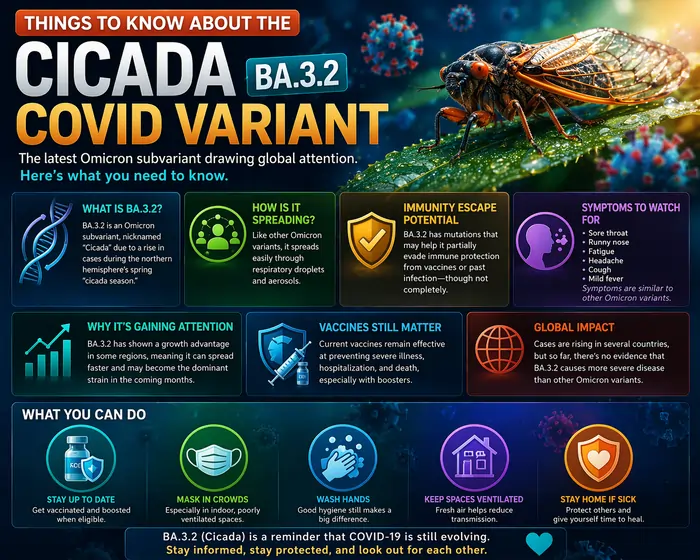
The Cicada COVID Variant BA.3.2 is an Omicron‑related SARS‑CoV‑2 subvariant that has gained attention because of its unusually high number of spike‑protein mutations and its potential to partially escape existing immunity. Sometimes nicknamed the “Cicada” variant in news reports, BA.3.2 is now being monitored by public‑health agencies alongside other circulating lineages. In this guide, we’ll walk through seven key things experts currently know about the Cicada COVID Variant BA.3.2, with links to official and expert resources so you can follow the latest updates yourself.
This article is for general information only and is not a substitute for professional medical advice, diagnosis or treatment. For personal guidance about COVID‑19, always consult a doctor or your local health authority.
1. What Is the Cicada COVID Variant BA.3.2?
The Cicada COVID Variant BA.3.2 is a member of the Omicron family of SARS‑CoV‑2 variants. It is classified as a distinct lineage within the BA.3 branch, but it has accumulated substantially more mutations in its spike protein than the strains on which current vaccines were originally based. Because of these changes, researchers are studying BA.3.2 to understand how it behaves compared with other recent variants.
News and global‑health organisations have adopted the “Cicada” nickname as a way to talk about BA.3.2 in simpler terms. The name refers to how the variant seemed to “emerge” suddenly in surveillance data, drawing a loose comparison to periodical cicadas that surface after long intervals. For a clear, accessible overview, you can see how one vaccine‑alliance site explains the Cicada COVID Variant BA.3.2 here:
Gavi – 8 things you need to know about BA.3.2 “Cicada”
For readers who want more technical detail, a summary of the lineage and its place in the Omicron family is available here:
BA.3.2 – Wikipedia
2. Where and When BA.3.2 Was First Detected
Like other variants, BA.3.2 was initially identified through genomic‑surveillance programmes that routinely sequence positive COVID‑19 samples. It was first picked up in late 2024, with early detections reported in parts of southern Africa before additional cases appeared in several other regions. As more laboratories uploaded sequences, scientists recognised that this particular lineage had a distinctive mutation pattern, prompting closer monitoring.
By early 2026, BA.3.2 had been detected in multiple countries and a growing number of US states. Some news outlets began asking questions such as “What is Cicada COVID, and is it circulating in my city?”, reflecting rising public interest. A plain‑language explainer that discusses where the Cicada COVID Variant BA.3.2 has been found so far is available here:
A new COVID‑19 variant called “Cicada” is spreading – CBS News
For more locally focused coverage that looks at whether BA.3.2 has been reported in particular regions, you can refer to this city‑level explainer:
What is Cicada COVID; is it in Philly? – USA Today
A key scientific reference underpinning many of these articles is a surveillance summary from a national public‑health agency, which describes BA.3.2 as a new, highly divergent lineage under investigation:
CDC – Early Detection and Surveillance of the SARS‑CoV‑2 Variant BA.3.2
3. Why BA.3.2 Is Considered Highly Mutated
One of the main reasons the Cicada COVID Variant BA.3.2 stands out is the number of changes in its spike protein. The spike protein is the part of the virus that binds to human cells and is a primary target of vaccines and neutralising antibodies. BA.3.2 carries dozens of amino‑acid substitutions and deletions across the spike, including in regions critical for receptor binding and antibody recognition.
Technical summaries note that BA.3.2 has many more spike mutations than earlier reference strains, which is why researchers refer to it as “highly divergent”. This does not automatically mean it is more dangerous, but it does mean that laboratory teams are particularly interested in how well antibodies generated by vaccination or past infection recognise this variant.
If you want a deeper dive into the mutation pattern and what it may imply, there is an accessible science‑magazine piece that walks through the details in non‑specialist language:
Scientific American – A new COVID variant is spreading in the U.S.
The surveillance report mentioned earlier also includes a technical description of the spike‑protein changes and how BA.3.2 compares with other monitored variants:
CDC – Early Detection and Surveillance of the SARS‑CoV‑2 Variant BA.3.2
4. Symptoms Reported With the Cicada COVID Variant BA.3.2
So far, the symptom profile linked to the Cicada COVID Variant BA.3.2 appears broadly similar to other recent COVID waves. People described in news and hospital reports commonly mention symptoms such as:
- Fever or chills
- Cough and sore throat
- Nasal congestion or runny nose
- Headache and muscle aches
- Fatigue or general tiredness
- Occasionally, nausea, vomiting or diarrhea
Some coverage notes that loss of taste or smell, which was a hallmark of earlier pandemic waves, seems less frequently highlighted in recent BA.3.2 stories, although individual experiences can vary.
Because these symptoms overlap significantly with those of flu, RSV and other respiratory infections, it is extremely difficult to distinguish BA.3.2 from other illnesses based on symptoms alone. That is why testing and professional assessment remain important if you feel unwell or have been exposed.
For a symptom‑comparison overview that sets Cicada COVID alongside flu and other infections, you can read this guide:
NBC News – Do you have the new Covid variant, flu or other virus?
A hospital‑authored Q&A on the Cicada variant, which discusses symptoms and general considerations in more detail, is available here:
Stony Brook Medicine – New COVID‑19 Cicada Variant: What to Know
Another everyday‑language list of commonly reported symptoms associated with the Cicada COVID Variant BA.3.2 can be found at:
The Mirror – Covid cicada variant: Symptoms of BA.3.2
If you have symptoms, or think you may have been exposed, do not rely on articles alone. Contact a healthcare professional or follow your local health authority’s testing and isolation guidance.
5. Who Appears Most Affected in Early Observations
Early news reports and commentaries have highlighted that, in some data snapshots, infections with the Cicada COVID Variant BA.3.2 seem relatively common in children and younger age groups. In those stories, most described cases are mild to moderate, with symptoms similar to other respiratory infections. It is important to remember that early patterns may not fully represent the longer‑term picture and can change as more data are collected.
At the same time, doctor‑written explainers emphasise that, so far, there is no clear evidence that BA.3.2 causes more severe disease than the variants dominating winter 2025–26. As with previous waves, older adults, people with certain chronic conditions and those with weakened immune systems are generally considered at greater risk of complications, regardless of which lineage is circulating.
For a balanced discussion written by a clinician, including comments on age patterns and severity, see this explainer:
The Conversation – COVID‑19 variant BA.3.2 is spreading quickly across US
A news story that specifically explores how the Cicada COVID Variant BA.3.2 is showing up in children, and what that might mean, is available here:
CNN – Kids may be more likely to get the new ‘Cicada’ variant
Remember that these pieces reflect a snapshot in time based on available data; official risk assessments from national health agencies should be your primary reference.
6. Vaccines, Immunity and the Cicada COVID Variant BA.3.2
Laboratory studies looking at neutralising antibodies have found that BA.3.2 can be less effectively neutralised by antibodies generated against earlier strains or vaccine formulations. This is one of the reasons the Cicada COVID Variant BA.3.2 is described as having strong immune‑escape characteristics. However, experts consistently caution that lower neutralisation in lab tests does not automatically mean that vaccines provide no protection, especially against severe disease, hospitalisation and death.
Analyses referenced in news and health‑policy articles indicate that 2025–26 vaccine formulations were developed against other reference strains, so public‑health agencies are closely watching real‑world outcomes as BA.3.2 circulates. It often takes time to see how well existing vaccines perform against a new variant outside the laboratory.
An accessible summary of what this immune escape may mean in practice, and how experts interpret those findings, is provided here:
Gavi – 8 things you need to know about BA.3.2 “Cicada”
A news feature that discusses the Cicada COVID Variant BA.3.2, immune escape and vaccine questions in lay terms is here:
CBS News – A new COVID‑19 variant called “Cicada” is spreading
The technical report describing neutralisation findings and BA.3.2’s classification as a new lineage can be read at:
CDC – Early Detection and Surveillance of the SARS‑CoV‑2 Variant BA.3.2
For decisions about vaccination, boosters or treatments, it is essential to follow current guidance from your national health agency and speak directly with your healthcare provider, rather than relying on general articles.
7. How to Stay Informed About BA.3.2 Without Panicking
Variant news can feel overwhelming, especially when headlines focus on mutations and immune escape. A more sustainable approach is to focus on a small number of trusted sources that regularly interpret new data and translate it into practical guidance.
Helpful steps include:
- Checking periodic updates from your country’s health authority or national public‑health agency
- Following the World Health Organization’s COVID‑19 pages for global context and broad guidance
- Reading Q&As and updates from reputable hospital systems or academic medical centres that discuss variants such as the Cicada COVID Variant BA.3.2 in everyday language
- Using mainstream outlets that quote recognised experts and link back to original scientific documents when they report on BA.3.2
For example, you can track technical updates and variant classifications here:
CDC – Early Detection and Surveillance of the SARS‑CoV‑2 Variant BA.3.2
You can check a hospital‑authored FAQ on the Cicada variant at:
Stony Brook Medicine – New COVID‑19 Cicada Variant: What to Know
And you can read news‑style summaries of what health agencies are currently saying about the Cicada COVID Variant BA.3.2 here:
Fox5 DC – Cicada COVID Variant BA 3.2: What we know from the CDC
Always prioritise information that comes from, or clearly cites, public‑health institutions and peer‑reviewed data.
Conclusion
The Cicada COVID Variant BA.3.2 is a highly mutated Omicron‑related lineage that has prompted renewed attention to genomic surveillance, vaccine performance and public communication about COVID‑19 variants. While early reports suggest that its symptom profile broadly resembles that of other recent waves, its large number of spike‑protein changes and evidence of immune escape mean that scientists and health agencies are watching it carefully.
For individuals, the most practical response is to stay informed through official channels, follow local health guidance and discuss any concerns about risk, vaccination or treatment with a qualified healthcare professional. By grounding your information in credible sources and avoiding sensationalism, you can keep up with developments around the Cicada COVID Variant BA.3.2 without adding unnecessary worry for yourself or your readers.
If you are interested in broader lifestyle and wellbeing factors that influence resilience and long‑term health, you may also find useful insights in this piece on sleep and public health in Australia Australia’s Sleep Crisis Reveals Key Insights for Better Health.
FAQs About the Cicada COVID Variant BA.3.2
What is the Cicada COVID Variant BA.3.2?
The Cicada COVID Variant BA.3.2 is an Omicron-family SARS-CoV-2 subvariant with a high number of spike-protein mutations that may affect transmissibility and immune recognition.
Why is it called the “Cicada” variant?
The nickname comes from its sudden appearance in surveillance data, similar to how cicadas emerge after long intervals.
Is BA.3.2 more contagious than other variants?
Early data suggests efficient spread, but comparisons remain under study and are not yet conclusive.
Does it cause different symptoms?
Symptoms appear similar to recent COVID waves, including cough, fever, sore throat, congestion, headache, and fatigue.
Can you distinguish it from flu or RSV?
No—symptoms overlap significantly, so testing is required to confirm the cause.
Who is most affected so far?
Cases have been noted in younger populations, but older adults and vulnerable groups remain at higher risk of complications.
Do current vaccines still work?
Studies suggest reduced antibody neutralisation, but vaccines may still provide protection against severe illness.
Should I change my vaccination plans?
Follow official health guidance and consult a medical professional for personalised advice.
How was BA.3.2 discovered?
It was identified through genomic surveillance, detecting a distinct mutation pattern in virus samples.
Is it more severe or deadly?
There is no clear evidence yet that it causes more severe disease, but monitoring continues.
Does prior infection offer protection?
Previous infection may provide some immunity, but effectiveness varies due to mutations.
How can I reduce my risk?
Use layered protection strategies like vaccination, ventilation, masking if advised, and staying home when sick.
How do scientists track this variant?
Through genomic sequencing and epidemiological data analysis to monitor spread and impact.
Where can I find reliable updates?
Check public health agencies, the World Health Organization, and medical research institutions.
What should I do if I think I have it?
Follow testing guidelines, self-isolate if needed, and seek advice from a healthcare professional.