

Introduction
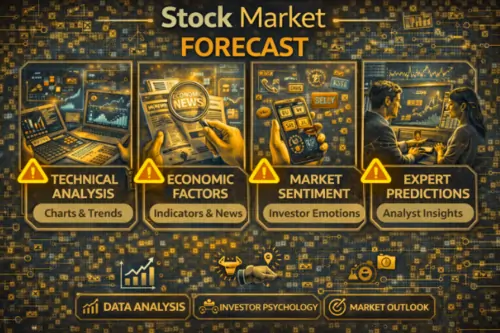
A stock market forecast helps investors understand where markets may be headed based on economic conditions, business performance, interest rates, inflation, and investor sentiment. While no forecast can predict the future with certainty, a well-reasoned market outlook can help readers make better investment decisions and prepare for possible risks.
For beginners, the idea of forecasting the stock market may sound like trying to predict the unpredictable. Markets move for many reasons, and even experienced investors get it wrong at times. Still, understanding the major forces behind market performance can make a big difference. A strong stock market forecast is not about guessing exact price targets. It is about identifying likely trends, possible risks, and the conditions that may affect stocks in the months ahead.
Today’s market environment is shaped by several powerful themes. Investors are watching inflation, central bank policy, corporate earnings, consumer spending, global growth, and the role of new technologies such as artificial intelligence. These forces all influence how investors price stocks and how companies perform over time.
This guide explains the main drivers behind a stock market forecast, the sectors investors are watching, the risks that could affect market performance, and why long-term discipline still matters more than short-term predictions.
What Is a Stock Market Forecast?
A stock market forecast is an estimate of how the stock market may perform over a future period. It can focus on the overall market, a major index, a specific sector, or even individual stocks.
Analysts use many inputs when building a forecast. These often include:
- economic growth
- inflation trends
- interest rate direction
- corporate earnings
- unemployment data
- consumer confidence
- geopolitical developments
- market valuation levels
Some forecasts are short term and focus on the next few weeks or months. Others are long term and look at market direction over several years. Both types can be useful, but they serve different purposes. Short-term forecasts are often more sensitive to news and volatility, while long-term forecasts are more closely tied to economic and business fundamentals.
Why a Stock Market Forecast Matters
A good stock market forecast can help investors stay grounded. Markets often move on emotion in the short term, especially when headlines create fear or excitement. Forecasting does not remove uncertainty, but it gives investors a framework for thinking clearly.
A market outlook can help with:
- setting realistic expectations
- planning asset allocation
- identifying overvalued or undervalued sectors
- managing risk during volatile periods
- maintaining focus on long-term goals
Investors who ignore the bigger picture often react emotionally to market swings. In contrast, those who understand the market environment may be better prepared when prices rise or fall.
Main Factors That Influence a Stock Market Forecast
Economic Growth
Economic growth is one of the most important drivers in any stock market forecast. When the economy expands, businesses often sell more products and services, increase profits, and invest in future growth. Strong economic activity usually supports higher stock prices, especially across broad market indexes.
When growth slows, companies may face weaker demand, lower margins, and reduced confidence from investors. That can weigh on stock performance. For this reason, investors closely follow GDP growth, business activity, and consumer spending trends.
Interest Rates
Interest rates have a major effect on stocks. When central banks raise rates, borrowing becomes more expensive for businesses and consumers. Higher rates can slow economic growth and make stocks less attractive compared with fixed-income investments.
When rates are stable or falling, borrowing becomes easier, which can support business expansion and investor confidence. This is why interest rate expectations often have a powerful influence on a stock market forecast.
Growth stocks, especially in technology, tend to be highly sensitive to interest rates because their valuations often depend on future earnings. Value and dividend stocks may react differently depending on the broader economic backdrop.
Inflation
Inflation affects nearly every part of the market. If prices rise too quickly, consumers may cut back spending and companies may struggle with higher operating costs. This can reduce profits and weaken investor sentiment.
Moderate inflation is not always harmful, but high or unpredictable inflation often increases uncertainty. In a stock market forecast, inflation matters because it influences central bank policy, business margins, and market valuation.
Corporate Earnings
Corporate earnings are one of the clearest indicators of market health. Stock prices may rise when companies show strong sales growth, improving margins, and better-than-expected profits.
If earnings weaken or guidance disappoints, stocks can fall quickly, even in an otherwise healthy market. This is why quarterly earnings seasons often bring strong volatility. Any serious stock market forecast should consider whether businesses are likely to grow profits in the current environment.
Market Valuations
Valuation tells investors how expensive or cheap the market appears relative to earnings, sales, or other metrics. High valuations do not automatically mean the market will fall, but they can limit future upside and increase the risk of sharp corrections.
Low valuations may suggest opportunity, especially if economic and earnings conditions improve. A balanced stock market forecast looks at both growth potential and valuation risk.
Investor Sentiment
Sentiment reflects how optimistic or fearful investors feel. Markets can rise too quickly when enthusiasm becomes excessive, and they can fall too sharply when fear takes over.
Investor psychology matters because stock prices are driven not only by fundamentals but also by expectations. Sentiment indicators can help analysts judge whether markets may be overheated or overly pessimistic.
Stock Market Forecast for the Coming Period
The broad stock market forecast remains mixed but constructive. On one hand, many businesses continue adapting well to a changing economic environment, and long-term innovation remains a powerful driver of growth. On the other hand, markets still face pressure from valuations, global uncertainty, and changing policy expectations.
The most likely scenario for many investors is not a straight move higher or lower, but a market that continues to reward selectivity. In other words, some companies and sectors may outperform while others lag behind.
That matters because modern market performance is often uneven. Indexes can appear strong even when only a limited number of large companies are driving gains. A smart stock market forecast should therefore look beyond the headline numbers and ask whether market strength is broad-based or concentrated.
Key Trends Shaping the Stock Market Forecast
Artificial Intelligence and Technology
Technology remains one of the most important themes in any modern stock market forecast. Artificial intelligence, automation, cloud infrastructure, semiconductors, and data-driven services continue to attract investor attention.
Technology companies often lead market advances because they offer scalability and long-term growth potential. However, they can also trade at high valuations, which increases pressure to deliver strong results.
Investors should not look only at the biggest names. The wider technology ecosystem includes software providers, hardware makers, cybersecurity firms, and infrastructure businesses that may also benefit from digital transformation.
Healthcare and Biotechnology
Healthcare remains a strong long-term sector because demand is supported by demographics, innovation, and ongoing medical needs. Biotech companies, pharmaceutical firms, healthcare equipment makers, and service providers all play a role in the broader market outlook.
In a stock market forecast, healthcare often stands out as a sector with both defensive and growth characteristics. It can perform well during periods of uncertainty while still offering upside through innovation.
Renewable Energy and Infrastructure
Energy transition, infrastructure development, and sustainability remain important structural themes. Governments, businesses, and consumers continue investing in cleaner technologies, power systems, and efficiency improvements.
These trends may create long-term opportunities, though the sector can still face volatility from regulation, commodity prices, and capital spending cycles.
Financials
Banks, insurers, and financial service firms are closely tied to interest rates, credit demand, and the broader economy. A stock market forecast should always monitor financials because they often reflect real-world business conditions.
When the economy is healthy and credit demand is stable, financials can perform well. But if recession fears rise or defaults increase, the sector can come under pressure.
Risks That Could Change the Stock Market Forecast
No market outlook is complete without a realistic discussion of risk. Even a positive stock market forecast can be disrupted by unexpected events.
Recession Risk
If economic growth slows sharply, companies may reduce hiring, delay expansion, and report weaker earnings. That can pull stock prices lower, especially in cyclical sectors.
Sticky Inflation
If inflation remains higher than expected, central banks may keep policy tighter for longer. This could pressure valuations and limit market gains.
Geopolitical Events
Wars, trade disputes, sanctions, and supply chain disruptions can affect investor confidence and company performance. Global markets are deeply interconnected, so geopolitical risks can quickly influence stocks.
Overvaluation
If investors pay too much for growth, even strong companies can see their shares fall when expectations are not met. Overvaluation is one of the most common reasons a bullish stock market forecast can lose momentum.
Policy and Regulatory Changes
Tax changes, regulation, election outcomes, or shifts in government spending can affect sectors in very different ways. Investors should pay attention to how policy changes may alter the outlook for technology, energy, healthcare, and financials.
How Investors Can Respond to a Stock Market Forecast
A stock market forecast is most useful when it supports better decision-making. Investors do not need to predict every move. They need a plan that can handle different conditions.
Here are some practical principles:
Stay Diversified
Diversification helps reduce the impact of weakness in any one sector or asset class. Even when one part of the market struggles, another may hold up better.
Focus on Quality
Companies with strong balance sheets, durable earnings, competitive advantages, and capable leadership often hold up better over time.
Avoid Emotional Decisions
Markets can move sharply on news, but emotional reactions often lead to poor timing. A disciplined strategy usually beats panic-driven decisions.
Keep a Long-Term View
Short-term forecasts can change quickly. Long-term investing is usually more effective because it allows strong businesses time to grow and compound value.
Review Risk Tolerance
Not every investor should respond to a stock market forecast the same way. A younger investor building long-term wealth may take a different approach from someone focused on capital preservation or income.
Is the Stock Market Forecast Always Accurate?
No. A stock market forecast is a tool, not a guarantee. Even the best analysts cannot account for every surprise. Forecasts are based on available data, current conditions, and reasonable assumptions, but markets can change fast.
That does not make forecasting useless. It simply means forecasts should be used with humility. Investors benefit more from using a forecast as a guide than as a promise.
Long-Term Outlook for Investors
The long-term stock market forecast is often more encouraging than the short-term one. Markets go through corrections, bear phases, recoveries, and new highs. Over long periods, strong businesses, economic innovation, and reinvestment have historically helped equities grow.
This does not mean every stock will perform well. It means patient investors who stay diversified and disciplined may be in a stronger position than those who constantly react to short-term noise.
Long-term success is rarely about making perfect predictions. It is more often about consistency, risk management, and staying invested in quality opportunities.
Conclusion
A strong stock market forecast looks at more than headlines. It considers economic growth, inflation, interest rates, earnings, valuation, investor sentiment, and sector trends. Right now, the market outlook appears balanced between opportunity and caution.
There are still reasons for optimism. Innovation continues, many businesses remain resilient, and long-term investing opportunities still exist. At the same time, investors should respect the risks, including volatility, valuation pressure, and unexpected global events.
The best response to any stock market forecast is not blind optimism or fear. It is a disciplined strategy built on diversification, quality, patience, and long-term thinking. Investors who stay informed and measured are often in the best position to navigate changing market conditions.
FAQ
What is a stock market forecast?
A stock market forecast is an estimate of how the stock market may perform in the future based on economic data, interest rates, inflation, earnings, and investor sentiment.
Why is a stock market forecast important?
A stock market forecast helps investors understand trends, manage risk, and make more informed decisions instead of reacting emotionally to market swings.
What factors affect the stock market forecast most?
The biggest factors include economic growth, interest rates, inflation, company earnings, market valuations, and geopolitical developments.
Can anyone accurately predict the stock market?
No one can predict the stock market with complete accuracy. A stock market forecast is a guide based on current information, not a guarantee of future results.
Is a long-term stock market forecast more useful than a short-term one?
For many investors, yes. Long-term forecasts are generally more useful because they are less affected by daily volatility and more tied to business fundamentals.