

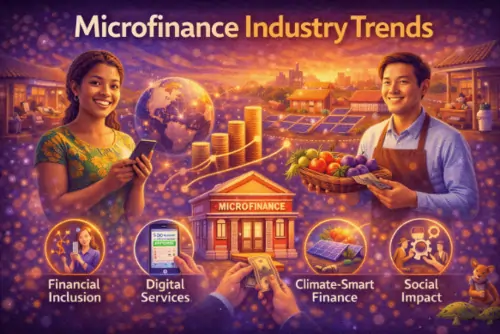
Microfinance helps people who may not qualify for traditional bank loans access small amounts of credit, savings tools, and sometimes insurance—often to support a sari-sari store, tricycle boundary, farm inputs, or emergency needs. In the Philippines, microfinance matters because many households and micro-entrepreneurs need fast, flexible capital and safer ways to manage financial shocks.
Today, the biggest microfinance industry trends are not just about “more loans.” They’re about how credit is delivered (digital), how risk is managed (data and stricter controls), and how borrowers are protected (responsible lending and consumer safeguards). These shifts are happening alongside the country’s broader move toward digital finance, which BSP tracks through its ongoing regulation and payments measurement work.
This guide explains what’s changing, why it’s changing, and what it means for Filipino students, MSME owners, investors, and everyday borrowers.
The biggest forces shaping microfinance today
Microfinance is evolving because of five major forces.
Digital access is growing
Microfinance is increasingly delivered through mobile onboarding, digital disbursement, and digital collections—especially where smartphones and e-wallet habits are already strong. The Philippines’ fintech expansion is widely documented in industry reporting, driven by digital adoption and policy focus on financial inclusion.
Demand is shifting from “business-only” to “life + livelihood”
Working capital is still key, but microfinance is also used for school needs, medical gaps, and disaster recovery—especially as economic uncertainty and climate-related disruptions affect incomes.
Competition is coming from digital lenders
Non-bank digital lending apps and platforms have expanded quickly, changing consumer expectations around speed and convenience. A Philippine digital lending industry report shared by Tala highlights the growing role of digital lending platforms in inclusion and access.
Risk is becoming more complex
As lending goes digital, risks shift away from cash-handling and toward identity fraud, scams, model risk (bad scoring), and operational outages.
Sustainable finance and climate risk are moving into the conversation
Microfinance portfolios are exposed to climate shocks (flooding, drought, typhoons) because borrowers’ incomes can be fragile. UNEP FI’s work on climate-related credit risk shows how financial institutions are increasingly integrating climate considerations into credit risk approaches.
Digital microfinance is becoming the default
One of the most important microfinance industry trends is the move from paper-heavy, in-person processes to mobile-first experiences.
Faster onboarding through e-KYC style checks
Borrowers are increasingly onboarded with digital identity steps and app-based applications. This can reduce friction and travel time, especially in provinces where branch access is limited.
Alternative credit scoring is expanding
Instead of relying only on traditional documents, lenders may use alternative signals such as repayment history, transaction behavior, or business cashflow patterns. The benefit is broader access; the risk is that poor models can approve people who can’t sustain repayments.
Embedded microfinance is growing
Small loans may appear “inside” platforms people already use: e-commerce, wallets, payroll apps, or merchant tools. This makes credit feel simple and instant—helpful for emergencies, but risky if borrowers treat it like free money.
What this means for Filipino borrowers
Digital makes access easier, but also makes it easier to borrow too often. The trend to watch is whether lenders pair speed with strong affordability checks and clear disclosures.
Collections and repayments are becoming more cash-lite
Another major microfinance industry trend is how repayments happen. Traditional microfinance often depended on field collections and in-person group meetings. Now, more repayment flows are moving through digital channels.
Wallet and transfer-based repayments reduce collection friction
When a borrower can repay through an app or a wallet, it saves time and reduces travel costs. It can also create better records for both borrower and lender.
But operational resilience becomes critical
If a payment rail is down, collections can be delayed. That pushes microfinance providers to invest in better system uptime, monitoring, and customer support.
This trend aligns with BSP’s broader regulatory and ecosystem focus on payment systems and financial infrastructure oversight (through its regulations and manuals).
Products are expanding beyond microloans
Microfinance used to be strongly associated with small loans. Now, a clear microfinance industry trend is product bundling.
Micro-savings and goal-based savings tools
Providers increasingly encourage borrowers to build small buffers so one emergency doesn’t trigger new debt.
Micro-insurance bundling
Some programs bundle micro-insurance for health events, disasters, or device protection. This matters in a country where one hospital bill can wipe out monthly income.
Water and sanitation microfinance
Sector initiatives also show microfinance moving into “life improvement” financing. The Microfinance Council of the Philippines (MCPI) posted updates on WaterCredit-related program assessments and sector activities, reflecting how microfinance supports essential household needs beyond business capital.
Portfolio quality and over-borrowing are rising concerns
As credit becomes easier to access, the risk of over-borrowing increases. This is one of the most important microfinance industry trends to watch because it affects both consumers and lenders.
Signs of over-borrowing include
Borrowing from one lender to pay another
Taking a new loan immediately after finishing a loan
Using loans to cover basic daily expenses without a clear repayment plan
Feeling constant stress about due dates
What responsible providers are doing
Tighter loan limits for first-time borrowers
More careful “ability to pay” checks
Better segmentation (different terms for different borrower profiles)
Stronger financial education
MCPI’s sector updates include training activities such as financial education initiatives in collaboration with BSP, signaling continued efforts to strengthen borrower capability and responsible finance practices.
Climate risk is becoming a serious microfinance topic
Climate and disaster exposure is not theoretical in the Philippines. When typhoons and floods disrupt livelihoods, repayment capacity drops.
A major microfinance industry trend is the integration of climate-related risk thinking into credit decisions and portfolio monitoring. UNEP FI’s “Bridging climate and credit risk” report discusses current approaches and emerging trends in how institutions assess climate-related credit risk.
What this can look like in microfinance, in plain terms
Lenders may map which areas are flood-prone and adjust risk policies
Agriculture-linked borrowers may get more flexible schedules aligned with harvest cycles
Providers may develop “resilience loans” for repairs, solar kits, or safer equipment
Insurance bundling may expand for disaster-related coverage
For investors and funders, climate resilience is becoming part of due diligence, not a “nice to have.”
Regulation and ecosystem development remain central
Microfinance is not a free-for-all. Different players fall under different oversight frameworks, and compliance expectations are growing as digital models expand.
In the Philippines, BSP’s regulations hub provides access to manuals and issuances that shape financial supervision and payment system oversight.
At the ecosystem level, MCPI acts as a national network of microfinance practitioners and allied institutions and regularly publishes sector news and program updates.
If you’re tracking microfinance industry trends, these two sources help you separate real signals from social media noise.
What microfinance industry trends mean for different readers
Students
Fast-growing career lanes include credit analytics, product operations, fraud prevention, compliance, and customer education programs—because microfinance is increasingly “finance + data + behavior.”
MSME owners and micro-entrepreneurs
You’ll likely see faster loan offers and more digital repayment options. Choose providers that explain total cost clearly and don’t pressure you into borrowing more than you can repay.
Investors and funders
Watch portfolio quality, repeat borrowing behavior, fraud controls, customer outcomes, and climate resilience strategy. Climate-credit integration is becoming a serious benchmark topic globally.
Everyday borrowers
Speed is useful, but your best protection is discipline. Borrow only with a clear plan: where the money goes, how it earns or saves money, and how you repay without needing another loan.
How to track microfinance industry trends reliably
Use a simple “signal stack”:
Official and sector sources
BSP regulations and published issuances for policy direction and oversight signals.
MCPI news and newsletters for program activity, training, and ecosystem initiatives.
Industry reporting
Digital lending industry reports (when transparent about methodology) can highlight adoption shifts and borrower behavior patterns.
Research-based risk signals
UNEP FI materials on climate-credit risk show where institutional practice is heading.
A practical watchlist of keywords
“digital lending,” “e-KYC,” “responsible lending,” “over-indebtedness,” “micro-insurance,” “financial education,” “climate risk,” “portfolio quality.”
FAQs
What’s the difference between microfinance and payday loans?
Microfinance typically aims to support livelihoods and inclusion with structured repayment and community-based or supervised models. Payday-style loans are usually very short-term and can be expensive. Always check total cost and terms.
Are online lending apps considered microfinance?
Some operate like micro-lenders, but not all follow microfinance best practices. Treat them as credit products and evaluate transparency, fees, and collection behavior.
What are warning signs I’m borrowing too much?
If you borrow to repay another loan, feel constant anxiety about due dates, or can’t explain where the loan will generate repayment capacity, it’s a warning sign.
How do MFIs decide who qualifies?
They typically assess identity, income stability, repayment history, and ability to pay. Digital lenders may use alternative data as part of the assessment.
How can I protect myself from scams and abusive collection practices?
Avoid sharing OTPs, verify lender legitimacy, keep screenshots of terms, and use official customer support channels. If something feels threatening, seek help from appropriate authorities.