

Explore investment banking in 2026: AI impact, salaries, career path, M&A trends, risks, and how to break into the industry.
Investment Banking in 2026: What It Looks Like, Where It’s Headed, and Who Should Care
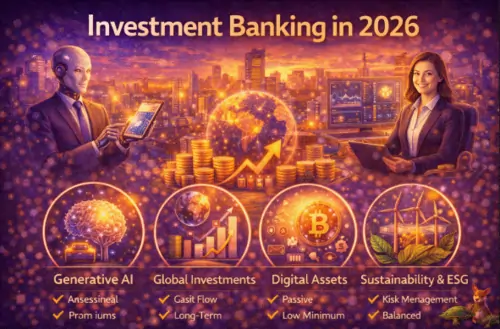
Investment banking in 2026 is being shaped by AI automation, private capital growth, higher interest rate discipline, ESG-driven financing, and more selective deal-making.
While traditional IPO activity is recovering unevenly, M&A and private credit markets remain active. Careers in investment banking still offer high compensation, but demand stronger technical, data, and analytical skills than ever before.
If you’re:
- A student considering finance,
- A professional thinking about switching careers,
- A business owner planning to raise capital,
- Or an investor watching global markets,
This guide breaks it down clearly and realistically.
What Is Investment Banking? (In Simple Terms)
Investment banking is the business of helping companies:
- Raise money (through stocks or bonds)
- Buy or merge with other companies (M&A)
- Restructure debt
- Go public (IPO)
- Navigate complex financial transactions
Investment banks act as financial advisors and capital market intermediaries.
Unlike commercial banks (which handle savings accounts and loans), investment banks focus on large corporate transactions and institutional clients.
In 2026, that core function remains the same. What’s changed is how it’s executed.
The State of Investment Banking in 2026
After volatile global markets between 2023 and 2025, 2026 has become a year of cautious rebuilding.
Interest Rates Still Matter
Higher-for-longer interest rate environments have changed how deals are structured. Companies are:
- More selective about acquisitions
- Focused on profitability over aggressive expansion
- Relying more on private credit markets
Cheap debt is no longer guaranteed. That means smarter underwriting and stricter financial modeling.
M&A Is Strategic, Not Aggressive
Mergers and acquisitions are still happening—but they’re more strategic.
Companies are buying:
- AI and tech capabilities
- Energy transition assets
- Infrastructure and logistics companies
- Healthcare and biotech firms
The “growth at all costs” mindset has shifted toward operational efficiency.
IPO Market: Slow but Stabilizing
The IPO market cooled significantly in earlier years, but 2026 shows signs of selective recovery.
Only companies with:
- Strong balance sheets
- Clear profitability paths
- Realistic valuations
are going public.
Private markets still dominate many funding rounds.
Major Trends Shaping Investment Banking in 2026
1. AI and Automation in Finance
AI is not replacing bankers—but it is reshaping their workflow.
AI now assists in:
- Financial modeling
- Risk assessment
- Due diligence review
- Market analysis
- Data extraction from filings
Junior analysts now need data literacy and AI familiarity. Excel alone is no longer enough.
The most successful bankers combine:
- Technical financial expertise
- Strategic thinking
- AI tool fluency
2. The Rise of Private Capital
Private equity and private credit firms are stronger than ever.
Many companies prefer:
- Private funding
- Flexible debt structures
- Avoiding public market scrutiny
As a result, investment banks increasingly work alongside private capital rather than just public equity markets.
3. ESG and Sustainable Finance
Environmental, Social, and Governance (ESG) factors remain important.
Green bonds, sustainability-linked loans, and climate disclosures are integrated into many transactions.
Investment banks now evaluate:
- Carbon exposure
- Supply chain risks
- Regulatory sustainability requirements
ESG is no longer optional—it’s embedded into deal strategy.
4. Cybersecurity and Digital Risk
As transactions become digital, cybersecurity risk becomes critical.
Investment banks now prioritize:
- Secure digital deal rooms
- Encrypted communications
- Compliance audits
- Data protection measures
One breach can damage reputation and trust instantly.
Investment Banking Careers in 2026
If you’re reading this because you’re considering investment banking as a career, here’s what you need to know.
Is It Still High Paying?
Yes.
Investment banking remains one of the highest-paying entry-level finance careers globally.
However:
- Bonuses are more performance-linked
- Competition is stronger
- Skill expectations are higher
Compensation still rewards long hours and strong deal execution.
Skills That Matter Most in 2026
Beyond traditional finance knowledge, you need:
- Financial modeling expertise
- Valuation skills (DCF, comparables, LBO modeling)
- Data analytics understanding
- AI-assisted workflow familiarity
- Strong communication and presentation skills
- Regulatory awareness
Soft skills matter more than ever because automation handles repetitive tasks.
Work Culture: Is It Changing?
Yes, slowly.
Some shifts include:
- Hybrid work models for non-live deal phases
- More boutique advisory firms competing with bulge bracket banks
- Slightly improved work-life awareness (but still demanding)
Investment banking is still intense. But expectations are evolving.
Risks Facing Investment Banks in 2026
Investment banking is not immune to global risks.
Economic Uncertainty
- Slower global growth
- Political instability
- Trade restrictions
All influence deal volume.
Regulatory Pressure
Governments are tightening regulations around:
- Cross-border transactions
- Antitrust approvals
- Financial transparency
Banks must stay compliant while remaining competitive.
Talent Retention
Top talent increasingly moves into:
- Private equity
- Venture capital
- Tech finance roles
- Fintech startups
Banks must offer competitive compensation and culture to retain professionals.
Investment Banking vs Private Equity in 2026
Many readers ask:
Should I pursue investment banking or private equity?
Investment Banking
- Advisory role
- Fast-paced transactions
- Client-facing
- Strong modeling foundation
- Long hours
Private Equity
- Direct investing role
- Portfolio management
- Ownership decision-making
- Often requires prior banking experience
For many professionals, investment banking remains a stepping stone to private equity.
Who Should Read About Investment Banking in 2026?
This topic matters to:
- Finance students
- MBA candidates
- Career switchers
- Startup founders
- Corporate executives
- Investors tracking capital markets
If you’re building a business or planning major capital moves, understanding how investment banking works helps you make smarter decisions.
How to Prepare for Investment Banking in 2026
If you’re serious about entering the field:
Education
- Finance, economics, or accounting background
- MBA (optional but helpful)
- Certifications like CFA (beneficial but not mandatory)
Technical Skills
- Excel and financial modeling
- Valuation methods
- AI-driven research tools
Networking
- Alumni connections
- LinkedIn outreach
- Internship experience
Breaking into investment banking still requires persistence and strong preparation.
Frequently Asked Questions
Is investment banking growing in 2026?
Yes, but selectively. M&A and private capital activity remain strong, while IPO recovery is gradual.
Is AI replacing investment bankers?
No. AI enhances productivity but does not replace strategic advisory roles.
Is investment banking still worth it?
For high-achieving, driven individuals comfortable with long hours, it remains financially rewarding.
What sectors are most active?
Technology (AI), renewable energy, infrastructure, healthcare, and logistics.
Is it harder to enter investment banking now?
Yes. Technical expectations are higher, and competition remains intense.
Final Thoughts
Investment banking in 2026 is not what it was a decade ago.
It is:
- More data-driven
- More regulated
- More technologically integrated
- More performance-focused
Yet it remains one of the most influential forces in global finance.
For readers who want high-level careers, understand capital markets, or build businesses strategically, learning about investment banking is still highly relevant.