

The current Bank Outage in Australia is disrupting card payments, online banking, and mobile apps, highlighting society’s reliance on real-time digital infrastructure. As banks work to restore services and issue status updates, customers are advised to check official service pages, use outage trackers cautiously, keep backup payment methods ready, and stay alert to scams during IT disruptions.
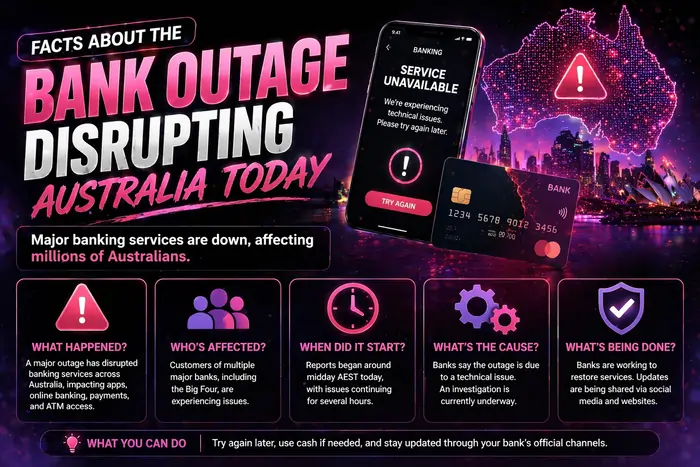
Unexpected banking outages can freeze payments, block ATM withdrawals and disrupt businesses in a matter of minutes. When a major Bank Outage hits Australia, customers may suddenly find that card payments are declined, mobile apps won’t log in and online banking is unreachable. This guide walks through eight key facts to understand during a Bank Outage, from how it happens to what you can do while services are down, with links to official resources and outage trackers you can monitor in real time.
1. What Is a Bank Outage?
A Bank Outage is any period where one or more core banking services stop working as expected. That can mean app logins failing, internet banking timing out, ATMs refusing withdrawals, card transactions being declined or payments (such as Osko and payroll) getting stuck in processing.
In Australia, most banks publish a live “system status” or “service updates” page for customers. For example:
When you notice a Bank Outage, your first step should be to visit your institution’s status page or alerts feed to see whether the issue is known, what services are impacted and whether there’s an estimated fix time.
2. Bank Outages Can Be Planned or Unplanned
Not every Bank Outage is an emergency. Banks routinely schedule maintenance windows to patch systems and upgrade infrastructure, and those windows often cause temporary downtime overnight or on weekends.
For example:
- Bank Australia lists planned maintenance windows where “internet banking, the app and open banking” may be unavailable for several hours.
- Commonwealth Bank similarly posts scheduled work where NetBank or the CommBank app will be limited between specified times.
Before assuming a major Bank Outage, always check whether there’s scheduled work on your bank’s status page, such as the planned maintenance windows listed by Bank Australia or CommBank’s service‑updates page.
3. Third‑Party Providers Often Sit Behind a Bank Outage
Many Australian institutions rely on shared core‑banking platforms, payment gateways and cloud providers. When a vendor fails, multiple banks can go down at once, turning a single technical fault into a nationwide Bank Outage.
Ajust’s Bank Australia outage resource explains that:
- A “major network outage” in February 2024 was caused by a third‑party provider (Data Action), knocking out mobile and online banking across several institutions in one hit.
- Other incidents stemmed from software glitches or external infrastructure issues such as local power failures.
The Australian Banking Association has also had to reassure customers during global tech incidents like the 2024 CrowdStrike crash, noting that while some services were affected, “major disruptions to payments systems… have not occurred and are not anticipated.”
When a third‑party platform fails, it can trigger a multi‑bank Bank Outage that affects customers far beyond a single institution.
4. How to Check If There’s a Bank Outage Right Now
During a suspected Bank Outage, you want to know whether it’s “just me” or a wider issue. In Australia, customers typically combine three checks:
- Official status page
- Bank Australia: System status
- CBA: Service updates
- Other banks have similar “status” or “service updates” pages.
- Outage‑tracking sites
- Independent resources
If you suspect a Bank Outage, check your bank’s status page, then cross‑check with community trackers like Downdetector for Bank Australia or Downdetector for Commonwealth Bank.
5. Bank Outages Range from Minor to Major
Not all outages are equal. Some are narrow, like a specific feature in an app; others are broad, affecting ATMs, EFTPOS, online banking and mobile apps at the same time.
Examples you can reference:
- A nationwide Commonwealth Bank outage in 2025 affected online banking, the mobile app and ATMs, forcing some branches to temporarily shut as the bank worked on a fix.
- Social posts from 2024 describe multiple banks being hit by “major technology breaks” that prevented customers from processing transactions.
- Ajust’s log for Bank Australia lists incidents from international payments failing for a day, to full digital‑banking outages that took hours to resolve.
For customers, a major Bank Outage can feel worse than a power cut, because payments, withdrawals and even in‑store purchases suddenly stop.
6. How Long Does a Bank Outage Usually Last?
There’s no fixed rule, but historic incidents give you a ballpark.
According to Ajust’s roundup of Bank Australia disruptions:
- Minor outages (like Osko hiccups or app login glitches) often clear within 1–3 hours.
- Larger digital‑banking outages are typically fixed within the same day, though they can last several hours.
- External provider failures (core‑banking, data‑centre issues) can take longer but are usually resolved by end of day.
Banks will generally post time‑stamped updates on their status or alerts pages as they work on a Bank Outage, and some publish post‑incident summaries explaining causes.
Helpful links:
Historically, most Australian Bank Outage incidents are fixed within hours, not days, but you should monitor your bank’s status page and independent resources like Ajust’s outage timeline for more accurate estimates.
7. What You Can Do During a Bank Outage
While you can’t personally fix a bank outage, you can take practical steps to reduce stress and protect yourself:
- Check official updates
- Visit your bank’s status or alerts page (e.g. Bank Australia alerts, ABA outage updates).
- Try alternative payment methods
- Use another bank card if you have one, or a different payment app / account that’s still working.
- Keep cash on hand for essentials when you know there’s ongoing instability.
- Avoid risky “quick fixes”
- Document issues and contact your bank
Resources:
- Bank Australia – banking service updates & scam alerts
- Australian Banking Association – technical outage & scam warning
- Ajust – how to report a Bank Australia outage
“During a Bank Outage, be extra cautious about texts or emails claiming to ‘fix’ your account; scammers often exploit confusion around major incidents.”
8. How to Prepare for Future Bank Outages
Finally, the best time to think about a Bank Outage is before it happens. You can’t guarantee perfect continuity, but you can reduce your vulnerability:
- Diversify your banking
- Consider maintaining a secondary account with a different institution for emergencies.
- Store backup payment methods (a second card, or a different bank’s debit card) in a safe place.
- Keep some cash handy
- Even a modest cash buffer can help if EFTPOS and ATMs are temporarily down.
- Know your bank’s contact points
- Save your bank’s status URL and emergency phones (e.g. Bank Australia 132 888, CBA 13 2221).
- Stay scam‑aware
- Follow scam alerts and security advice on your bank’s website.
Example links:
- Bank Australia – support and alerts
- Australian Banking Association – current technical outage & advice
“If you live in Australia, building a small cash buffer, keeping a backup account and bookmarking your bank’s status page can make the next Bank Outage far less stressful.”
Conclusion
A Bank Outage is disruptive, but it doesn’t have to be disastrous. By understanding how outages happen, monitoring official status pages, using independent trackers carefully and keeping basic contingencies in place, you can navigate downtime with more confidence. The key is to treat each Bank Outage as a reminder to diversify your payment options, stay scam‑aware and keep up with the communication channels your bank uses during incidents.
If you’re also interested in how digital infrastructure is reshaping other parts of the Australian economy, this deep‑dive on low‑earth‑orbit internet is a useful companion read: Starlink Australia: Plans, Price and Speed in 2026.
FAQs About the Bank Outage in Australia
What is a Bank Outage?
A Bank Outage is when core banking services like apps, online banking, ATMs, or card payments stop working due to technical or network issues.
Which services are usually affected?
Common issues include login failures, declined card payments, ATM errors, and delayed transfers.
Is it always a cyberattack?
No—many outages are caused by software bugs, system failures, or third-party provider issues, not just hacking.
How can I check if there’s an outage?
Visit your bank’s official status page, then confirm via trusted trackers or news sources.
Why do multiple banks go down at once?
Because many banks share infrastructure, cloud systems, or payment networks, so one failure can impact multiple institutions.
How long do outages last?
They can last from minutes to several hours, depending on the severity of the issue.
What should I do if my card is declined?
Try another payment method, use cash, and wait for official confirmation before retrying large transactions.
Is my money safe?
Yes—outages usually affect access, not account balances, but always follow official updates.
Can payments be delayed?
Yes—scheduled transfers and payments may be queued or delayed until systems recover.
How can I contact my bank?
Use official phone numbers from your card or website, and expect longer wait times.
Are outages announced in advance?
Only planned maintenance is announced; unexpected outages happen without warning.
How can I prepare for future outages?
Keep backup payment options, some cash, and possibly a secondary bank account.
Are outage trackers reliable?
They are useful but unofficial—always verify with bank updates.
What scams should I watch for?
Beware of fake messages about account issues—only trust verified bank communications.
Who decides when services are restored?
The bank and its tech partners confirm when systems are stable and fully operational.