

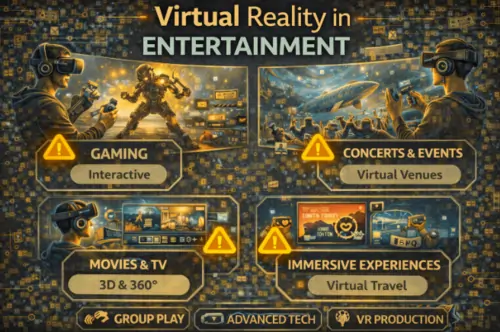
Virtual reality in entertainment means using a VR headset to step inside a digital experience instead of watching it on a flat screen. When it’s done well, it feels like you’re there: you can look around in 360 degrees, move your hands to interact, and share the moment with other people in real time.
In 2026, VR entertainment isn’t only about hardcore gaming anymore. It now includes virtual concerts, immersive films, themed experiences in malls and venues, sports “front-row” simulations, and mixed reality (MR) content that blends digital objects into your real room.
At the same time, the industry is adjusting to reality: high-end headsets can be expensive, comfort still matters, and safety—especially for kids—needs serious attention. Reports about Apple scaling back Vision Pro production due to weak sales show that “amazing tech” doesn’t automatically mean mass adoption.
This guide explains the biggest VR entertainment uses today, what’s changing in 2026, how VR makes money, the risks you should know, and how Filipino audiences can try VR without overspending.
What counts as VR (and what doesn’t)
People often mix up VR, AR, and mixed reality:
- VR (Virtual Reality): You’re inside a fully digital environment. Most of what you see is virtual.
- AR (Augmented Reality): Digital elements appear on top of the real world (often via phone camera or smart glasses).
- Mixed Reality (MR): A deeper blend—virtual objects “sit” in your room and respond to your space.
Many entertainment devices now blur VR and MR. For example, Apple’s updated Vision Pro lineup is positioned around “spatial” experiences and immersive content. And competitors like Pico are reportedly preparing new mixed-reality headsets aimed at that same space.
Where virtual reality in entertainment is actually used today
VR gaming
Gaming is still the strongest category for VR. Why? Because VR is naturally interactive.
What makes Virtual Reality in Entertainment games feel different:
- you aim, swing, grab, and move with your hands
- you feel “presence,” like you’re inside the level
- social VR lets you play and talk with friends in shared spaces
If you’re in the Philippines and want to experience VR without buying a headset, location-based VR (VR arcades and mall attractions) can be your easiest entry point—more on that below.
Virtual concerts and live events
Virtual Reality in Entertainment concerts are not “just watching a video.” The goal is to recreate the feeling of being in a venue—sometimes even with interactive elements like choosing camera angles, moving around the stage, or unlocking digital extras.
Even outside pure VR, entertainment platforms keep proving that immersive music events work when they’re social and interactive. Fortnite-style experiences show how music and interactive worlds can combine into a “destination event,” complete with themed activities and in-game items.
Immersive films and documentaries
Virtual Reality in Entertainment film experiences typically fall into two buckets:
- 360° film: you look around while the story plays (like being inside a scene)
- interactive narrative: you explore the story world and trigger scenes
Virtual Reality in Entertainment documentaries can be powerful because they place you “in the environment,” which can increase empathy and memory compared to normal video.
Theme-park-style attractions and VR arcades
Not everyone wants Virtual Reality at home. This is why location-based VR is growing: you pay per session, use high-quality equipment, and experience content designed for groups.
In the Philippines, mall-based arcades have begun listing VR among their attractions—for example, Timezone locations such as Ayala Malls Manila Bay and SM Aura explicitly include VR experiences.
This matters for PH audiences because:
- you don’t need to invest ₱20,000–₱40,000+ upfront
- it’s a barkada-friendly activity
- it lowers “tech fear” for first-timers
Sports and esports experiences
Virtual Reality in Entertainment can simulate:
- courtside seats
- 360 replays
- training drills and practice simulations
For fans, the big value is presence—feeling closer to the action than a normal stream.
What’s changing in VR entertainment in 2026
1) The industry is leaning toward mixed reality and better comfort
Comfort and practicality are now major battlegrounds. Reports about Apple’s Vision Pro facing adoption challenges point to classic blockers like price, comfort, and app availability.
Meanwhile, new devices and OS updates across the industry keep emphasizing:
- lighter hardware
- sharper displays
- better “work + play” experiences
Wired’s reporting on Pico’s mixed-reality push highlights how competitors are trying to improve usability and openness for developers.
2) Better creation tools are making content easier to produce
Virtual Reality in entertainment used to require specialized cameras and expensive rigs. But more consumer-friendly creation pipelines are emerging—Canon’s 2026 showcase, for example, highlights more accessible VR and 3D capture approaches that lower the barrier for creators.
That’s good news for:
- indie filmmakers experimenting with VR scenes
- event producers offering immersive clips
- creators making “you are there” style content
3) Immersive entertainment is becoming a broader category
Virtual Reality in Entertainment is part of a wider “immersive experience” industry that includes interactive installations, live experiences, and tech-driven storytelling. Gensler’s 2025 immersive industry report reflects how this space is being studied as a serious entertainment category with real audiences and business models.
How VR entertainment makes money
Virtual Reality in entertainment usually follows a few models:
Paid games and in-app purchases
- buy the game once
- spend on expansions, cosmetics, or add-ons
Tickets and time-based access
Common for:
- VR arcades
- short VR films
- pop-up experiences
Subscriptions
Some platforms bundle VR content the way streaming bundles movies.
Brand partnerships and sponsorships
Brands sponsor immersive experiences because VR can create high attention and strong memory.
Location-based VR revenue
Mall and venue experiences monetize via foot traffic, group sessions, and repeat visits.
The real benefits of virtual reality in entertainment
If you’re explaining Virtual Reality in Entertainment to someone who’s never tried it, focus on what’s genuinely different:
Deeper immersion
You’re not just watching—you feel present.
Stronger emotional connection
Being “inside” a story can hit harder than watching a screen.
More social experiences
Many VR spaces are built around shared moments.
New creative formats
Virtual Reality in Entertainment can tell stories in ways film can’t—because the viewer has agency.
Risks and challenges you shouldn’t ignore
Motion sickness and discomfort
Some users feel dizzy or nauseous, especially in experiences with artificial movement. Start slow, take breaks, and choose beginner-friendly content.
Eye and health questions (especially for kids)
The American Academy of Ophthalmology notes that long-term studies are limited, and advises caution—especially for children—while also offering practical safety tips (breaks, stopping if symptoms occur).
The American Academy of Pediatrics also discusses VR use in children and references research on motion sickness and postural stability in younger users.
Child safety in social VR
Social VR spaces can expose minors to inappropriate behavior if safeguards fail. Investigative reporting has raised concerns about child safety issues in Meta’s VR/social ecosystem.
Age limits and parental controls
Meta’s ecosystem has moved toward supervised experiences for younger users (with parent-managed accounts in certain age ranges), and parental control tooling is documented by groups like ESRB and child-safety orgs.
If you’re a parent: treat VR like the internet—great potential, but supervision and settings matter.
Virtual reality in entertainment in the Philippines
The easiest PH entry: VR in malls and arcades
Buying a headset is expensive. Trying VR first in a controlled environment is practical. Timezone’s PH pages show VR offerings at locations like Ayala Malls Manila Bay and SM Aura, which signals that “pay-per-try” VR is part of mainstream mall entertainment now.
Practical PH constraints
- data costs (for downloads and updates)
- device affordability
- internet stability outside major cities
PH opportunities for creators
Filipino creators can explore:
- short VR scenes (tourism, culture, horror, history)
- VR-enhanced events (immersive previews, 360 backstage clips)
- educational entertainment (museum-style VR experiences)
The smartest path is often: start small, test demand, then scale.
Beginner-friendly tips for first-time VR users
- Start with 5–10 minutes only
- Choose “comfort mode” experiences (teleport movement, stable horizon)
- Take breaks immediately if you feel dizzy or strained
- Use a clean, open space (avoid hitting objects)
- If you wear glasses, check headset compatibility
- For kids: follow platform age guidance and enable parental controls
FAQs
What is virtual reality in entertainment?
It’s using VR headsets to experience games, films, concerts, and interactive worlds in a fully immersive way.
Do I need to buy a headset to try VR in the Philippines?
Not necessarily. Mall and venue experiences offer VR sessions (for example, some Timezone PH locations list VR attractions).
Is VR safe for kids?
Health groups note long-term research is limited and recommend caution; parents should follow age guidance, use breaks, and enable parental controls.
Why do some people feel dizzy in VR?
Motion sickness can happen when your eyes sense movement but your body doesn’t. Short sessions and comfort settings help.
What’s the biggest trend in 2026?
More focus on mixed reality, comfort, and practical experiences—not just “VR hype.”