

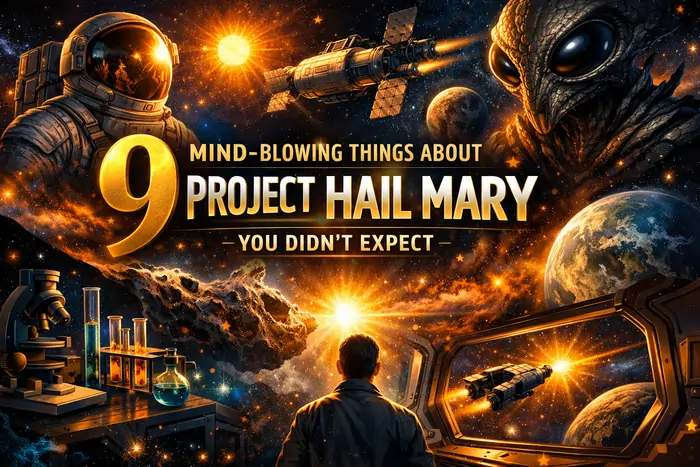
Project Hail Mary by Andy Weir is a science-driven sci-fi story that combines mystery, survival, and interstellar cooperation. The novel follows Ryland Grace, a scientist who wakes up alone on a spaceship with no memory and must uncover his mission to save humanity from a star-killing organism called Astrophage.
What sets the story apart is its blend of realistic science, emotional storytelling, and an unexpected friendship between a human and an alien. With a major 2026 film adaptation starring Ryan Gosling, Project Hail Mary continues to gain popularity for its unique mix of hard science fiction, humor, and deeply human themes.
1. It Starts Like a Mystery Thriller, Not a Space Opera
You might expect a big, glossy prologue about a dying Sun and a desperate mission, but instead you wake up in a small room with a man hooked to tubes who has no idea who he is. The early chapters are structured more like a locked‑room mystery than a traditional space epic, with Ryland Grace slowly discovering that he’s alone on a ship, his crewmates are dead, and he’s far from home.
The official plot summary on the Project Hail Mary Wikipedia page notes that he emerges from a coma with complete amnesia, then gradually uncovers that he’s on an interstellar mission near Tau Ceti. Book reviewers like Reading Ladies emphasize that the opening hook—“a middle school science teacher wakes up alone on a spaceship”—was a big part of why the story grabbed them instantly. SparkNotes‑style guides such as this Project Hail Mary summary underline how the amnesia structure lets the reader solve the mystery alongside Grace.
That structure is a mind‑bender on reread, because you realize how much of the big picture Stratt and Earth already know—and how much you were missing the first time through.
2. The “Monster” Threat Is a Tiny Space Microbe With Terrifying Consequences
You might expect a dying‑Sun story to lean on vague cosmic hand‑waving, but here the culprit is specific, named, and weirdly plausible: Astrophage, a single‑celled organism that eats starlight and uses it as propulsion. Grace discovers in his early flashbacks that this microbe, which forms the mysterious Petrova Line in the sky, is siphoning energy from the Sun at an alarming rate.
The Wikipedia entry for the novel explains that Astrophage breeds by absorbing radiation from the Sun and carbon dioxide from Venus, then migrates between stars, dimming them in the process. In a recent interview with The New York Times, Andy Weir describes how he built Astrophage as a scientifically grounded but fictional organism—“like algae” that can live on a star—by thinking through how it would collect energy, reproduce, and end up in our solar system. You can read his full explanation in “Andy Weir on the Science That Inspired ‘Project Hail Mary’”.
A Nature feature on the upcoming film adaptation notes that Astrophage is imagined as “black matter” that absorbs huge amounts of stellar radiation and re‑emits it as thrust, and praises how the story uses that fictional biology to drive both the plot and the ship’s propulsion system. That combination—tiny organism, planetary threat, and interstellar fuel—is one of the book’s most surprising and satisfying ideas.
3. The Real Heart of the Story Is a Cross‑Species Bromance
You might go in expecting the focus to stay on Grace vs. the mission, but the emotional center of “Project Hail Mary” is the friendship between a human scientist and an alien engineer named Rocky. When Grace finally reaches Tau Ceti, he discovers another ship, the “Blip‑A,” crewed by a lone alien whose star is also under attack by Astrophage.
The plot summary describes Rocky as a being from the Erid star system whose species evolved in an ultra‑dense, super‑hot ammonia atmosphere—no eyes, five legs, chorded speech, and a physiology that would kill any human instantly. A science‑and‑philosophy essay on what “Project Hail Mary” gets right about science notes that Rocky’s body plan (mercury blood, heavy atmosphere, no optical vision) is deliberately alien but built from plausible physics and chemistry.
SparkNotes’ analysis of key themes points out that the novel’s emotional arc hinges on “radical cooperation across difference.” Grace and Rocky build physical tunnels, shared labs, and synchronized clocks to create a literal and metaphorical grammar of trust, culminating in multiple life‑saving sacrifices from each side. That deeply earnest, odd‑couple in space friendship is something many readers did not expect from the author of “The Martian.”
4. The Ethics Are Way Darker Than the Breezy Tone Suggests
At first glance, the book has a light, quippy voice—Grace cracks jokes, solves physics problems with off‑the‑cuff humor, and narrates like a very enthusiastic teacher. But beneath that breezy tone lies a surprisingly dark ethical debate about coercion, sacrifice, and what governments will do when civilization is on the line.
The Wikipedia plot summary makes it clear that Eva Stratt, the Dutch bureaucrat running Project Hail Mary, essentially becomes a world dictator with emergency power to override laws, seize resources, and coerce individuals. She bullies, manipulates, and finally forces Grace onto the mission when the original crew dies, sedating him and using an amnesia drug so he can’t back out.
SparkNotes’ theme analysis calls this a clash between “utilitarian necessity and individual conscience.” Stratt embodies ruthless pragmatism—legal steamrolling, geoengineering experiments, human rights violations—while Grace represents empathy‑driven sacrifice, eventually choosing to give up his own return to save Rocky’s species.
Reviewers like Narfna at Cannonball Read found this unsettling: in their review of Project Hail Mary, they describe Grace as a disgraced scientist essentially “roped into” a suicide mission by a determined bureaucrat. That ethical gray zone is a lot heavier than many readers anticipated from a science puzzle novel.
5. It Treats Science as Gritty Failure Analysis, Not Genius Inspiration
One of the wildest things about “Project Hail Mary” is how it frames science—not as sudden eureka moments, but as a messy process of trying things, breaking things, and narrowing down what’s possible. A review in Science News on surviving a trip to interstellar space notes that the book’s problem‑solving is grounded in real questions about hibernation, radiation, and long‑duration travel.
The Multidisciplinarian essay, “What ‘Project Hail Mary’ Gets Right About Science”, argues that the novel quietly teaches philosophy of science. Grace’s work is framed as failure analysis: something breaks, he runs tests, refines hypotheses, and iterates under pressure. The piece even draws parallels to real puzzles like the neutron lifetime discrepancy, emphasizing that disagreement and discomfort are features, not bugs, of scientific progress.
Bill Gates picks up on a similar vibe in his GatesNotes review of Project Hail Mary, praising how the book makes problem‑solving feel accessible and fun while still respecting the complexity of the underlying science. Instead of glorifying lone genius, the story shows science as a coordination technology between people—and even between species.
6. The Ending Is Both Bleak and Weirdly Hopeful
Given the setup—a one‑way suicide mission, a dying Sun, and an alien civilization on the brink—it’s easy to assume the ending will be either grim sacrifice or miraculous triumph. The reality is more complicated and more bittersweet.
As the Wikipedia synopsis details, once Grace and Rocky discover Taumoeba, the micro‑organism that preys on Astrophage, they figure out how to weaponize it to save both their stars. But a catastrophic leak forces Grace to choose between going home with the data to save Earth or turning back to rescue Rocky, knowing he’ll likely die on Erid because its food is toxic to humans.
He chooses Rocky. He sends the “beetle” pods—with Taumoeba and instructions—to Earth, then deliberately abandons his chance at return to save his friend and an alien civilization he will never see again. Sixteen years later, he’s alive on Erid, teaching young Eridians science in a comfortable habitat they built for him, and Rocky tells him the Sun recovered—meaning his sacrifice worked.
SparkNotes calls this a deliberate rejection of simple utilitarian calculus: Grace’s decision is both altruistic and selfish, rooted in real attachment rather than abstract “humanity.” Many readers found this mix of loss, survival, and unexpected domesticity on an alien world far stranger and more moving than the tidy heroic ending they anticipated.
7. The Film Adaptation Is a Huge Sci‑Fi Event With Serious Talent Attached
If you expected “Project Hail Mary” to remain a cult‑favorite novel, the scale of the film adaptation will probably surprise you. The movie, produced by Amazon MGM Studios, is being directed by Phil Lord and Christopher Miller, with a script by Drew Goddard and Ryan Gosling both starring as Ryland Grace and producing.
The Project Hail Mary (film) Wikipedia page notes that the film premiered in London on March 9, 2026, and is slated for a wide U.S. release on March 20, 2026. Rotten Tomatoes’ preview, “Everything We Know About Project Hail Mary”, highlights the creative team’s pedigree: Lord and Miller’s work on The LEGO Movie and the Spider‑Verse films, and Goddard’s credits on The Martian and The Cabin in the Woods.
Nature’s early look at the movie, “Project Hail Mary film builds dazzling new worlds”, praises its depiction of molecular biology, neutrino physics, and world‑building that respects the novel’s scientific spirit while leaning into visual spectacle. IMDb’s Project Hail Mary news hub notes that the second trailer pushed anticipation even higher, coinciding with a special movie tie‑in edition of the book.
For a book that spends a lot of time inside one person’s head and a cramped ship, the scale and ambition of the film adaptation is itself a bit mind‑blowing.
8. The Science Behind Erid and 40 Eridani Comes From Real Astronomy Questions
Another surprise: Weir didn’t just make up an alien star system from scratch; he built Erid and its environment on top of real astrophysical discussions about exoplanets around 40 Eridani.
In his New York Times interview, he explains that when he was drafting the book, astronomers thought there might be an exoplanet close to the 40 Eridani system, and he needed a plausible way for liquid water to exist there. The solution was to crank up atmospheric pressure (raising water’s boiling point) and choose a heavy atmosphere—he went with ammonia—to keep the planet’s envelope from being stripped away by the star.
The Nature article notes that the film and book both give a nod to how star dimming can be detected in real life, referencing how amateur astronomers spotted the strange dimming of Betelgeuse in 2019. That kind of detail makes the world of “Project Hail Mary” feel surprisingly close to real astronomy: no warp drive, just extreme exploitation of edge‑case physics and biology.
For readers used to more hand‑wavy sci‑fi, the amount of real science underpinning Erid, Tau Ceti, and Astrophage’s behavior is one of the book’s more mind‑blowing elements.
9. It’s Also a Love Letter to Teaching and Everyday Decency
One of the things many readers didn’t expect is how much “Project Hail Mary” cares about teaching—both as a job and as a metaphor. Ryland Grace is not a square‑jawed test pilot but a middle‑school science teacher and disgraced molecular biologist who never meant to be a hero.
Reading Ladies’ book review emphasizes how his teaching background shapes everything: the way he explains physics to himself (and to us), his moral choices, and his eventual decision to spend the rest of his life educating alien kids. GatesNotes’ review of Project Hail Mary calls him a fundamentally decent and likable protagonist you can’t help but root for, precisely because he’s not a hardened astronaut.
SparkNotes notes that the final chapters—Grace teaching a classroom of young Eridians using a digital archive of human knowledge—reframe the mission’s success not as a dramatic homecoming, but as an ongoing act of education and cultural exchange. Narfna’s Cannonball Read review points out that this is a rare sci‑fi story where the ultimate “win” is becoming a teacher again, just on a different world.
In a genre that often celebrates lone geniuses or grim antiheroes, that quiet celebration of teaching and everyday decency is unexpectedly moving—and, for many readers, the most mind‑blowing twist of all.
As both a novel and a film, Project Hail Mary turns what looks like a straightforward save‑the‑world story into something far more surprising—scientifically grounded, emotionally rich, and unexpectedly heartfelt about friendship, teaching, and everyday decency. If you love seeing how different corners of entertainment can suddenly catch fire with audiences, from hard sci‑fi epics to breakout music stars, you might also enjoy 8 Reasons Riley Green Is Trending in Australia Right Now for a look at how a rising country artist is winning over fans on the other side of the world.