

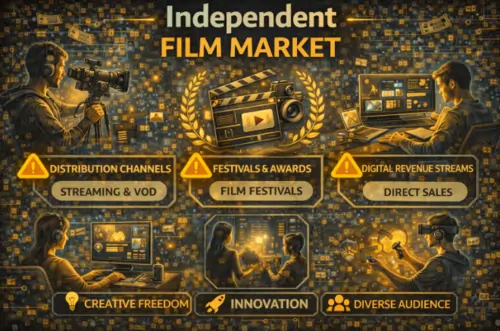
The independent film market is the business side of movies made outside (or mostly outside) the big studio system. It includes how indie films get funded, packaged, sold, and distributed—often through festivals and film markets where producers meet buyers, sales agents, and streaming platforms.
In 2026, the indie market is still alive, but it’s changing fast. Streaming companies are more selective, theatrical runs are often limited, and creators need to plan distribution early. For Filipino filmmakers and film students, this matters because the “old path” (make film → hope a streamer buys it) is no longer reliable. You need a smarter, more realistic playbook.
This guide breaks down how the independent film market works, where money comes from, how films get sold, and what opportunities exist for the Philippines today.
What counts as “independent” film
An independent film typically means:
- the film is produced outside major studio financing and control
- budgets are usually lower (but can still be large)
- creative control is often stronger for filmmakers
- distribution can be more complex (festivals, limited theatrical, streaming, international sales)
Indie doesn’t always mean “small” or “unknown.” Some indie films have big stars and strong budgets—but they still operate through independent financing and sales structures.
How the independent film market works
Think of the indie film market as a chain. Each part affects the next.
Development and packaging
Before money comes in, the film must look “real” on paper:
- script (tight and filmable)
- director vision
- budget range
- lookbook/pitch deck
- proposed cast or “casting targets”
Packaging is a big deal because buyers don’t only buy scripts. They buy the package: concept + team + marketability.
Financing
Indie films usually mix several funding sources, such as:
- private investors
- grants and film funds
- co-productions (two or more countries/companies)
- pre-sales (selling distribution rights before the film is made)
- incentives (rebates/tax benefits depending on location)
- crowdfunding (sometimes as marketing + community building)
For Filipino filmmakers, FDCP funding and incentives can be part of that mix. FDCP has highlighted CreatePHFilms as a flagship local funding program for Filipino filmmakers, with Cycle 1 applications for 2026 running in early February 2026.
FDCP also runs incentives and co-production support through the Film Philippines Office (including Film Location Incentive Program and an International Co-production Fund).
Production
Indie production success is usually about discipline:
- controlling costs
- planning schedules realistically
- managing post-production carefully
- keeping paperwork clean (chain of title, contracts, releases)
A clean legal and financial structure makes distribution easier later.
Distribution and sales
This is where many indie films struggle.
Distribution routes typically include:
- film festivals (premieres + exposure + sales opportunities)
- film markets (where buyers and sales agents do deals)
- limited theatrical releases
- direct-to-streaming licensing
- TV, airline, and international sales
- transactional VOD (rent/buy)
Why film festivals still matter
Festivals are still powerful because they are:
- a launchpad for press and credibility
- a networking hub for sales agents and distributors
- a discovery engine for programmers and curators
For Filipino indie film, festivals like Cinemalaya remain important locally. Cinemalaya continues to position itself as a key platform for Philippine independent films and projects.
Local coverage has also discussed Cinemalaya’s 2026 direction and timelines, including calls and program support.
Internationally, Sundance remains a major indie spotlight. For context, reporting says the 2026 Sundance Film Festival runs January 22 to February 1, 2026 (and 2026 is the last Utah edition before the move to Boulder in 2027).
Film markets that move deals
Festivals show films. Film markets sell films.
A film market is where industry professionals buy and sell rights (territories, platforms, windows). Two major examples:
Marché du Film (Cannes)
The official Marché du Film site lists the 2026 dates as 12–20 May 2026 and describes it as a major global meeting point for industry professionals.
American Film Market (AFM)
AFM’s official site describes it as a marketplace where professionals connect, pitch, finance, and acquire content.
Entertainment trade reporting also notes AFM 2026 dates as Nov. 10–15 in Los Angeles.
Why this matters: if you want distribution, you need to understand where deals happen and how buyers think.
The streaming shift: fewer “big buys,” more strategy
A big 2026 reality: streaming platforms are still important, but many are more selective and more ROI-driven than before.
That changes what “success” looks like. Instead of hoping for one huge global deal, many indie films now aim for:
- targeted licensing (specific territories)
- second-window deals (after an initial release)
- hybrid distribution (festival → limited run → streaming)
- AVOD/FAST opportunities in some cases (depending on film type and territory)
This doesn’t mean streaming is “bad.” It means filmmakers must plan a longer lifecycle and think like a business.
Revenue streams in the independent film market
Indie films can make money from multiple places, often over time:
Box office
Often limited, but can help credibility and press.
Streaming licenses
A platform pays for rights for a period, often by territory.
TV rights
Broadcast and cable deals still exist in some markets.
International distribution
Different territories buy rights separately.
Transactional VOD
Rentals and purchases (depends on audience demand).
Airlines and educational
Smaller, but sometimes meaningful for documentaries or niche films.
A key lesson: indie film revenue is usually stacked (many smaller streams), not one magic payday.
The Philippines angle: where Filipino filmmakers can win
Filipino filmmakers have a major advantage: strong storytelling and global interest in distinct local voices. But the market path is easiest when you build for reality.
Use local support programs as leverage
FDCP’s CreatePHFilms and Film Philippines incentives/co-production support can help strengthen your financing and international credibility.
When you can say, “We have support from a national film body,” it can help negotiations.
Treat festivals as business, not only art
Festivals are not only for awards. They are:
- networking spaces
- proof of audience response
- a reason for press to cover your film
- a door to sales agents and programmers
Build for international co-production
Co-productions can help Filipino films access:
- bigger budgets
- new distribution territories
- stronger festival positioning
FDCP’s International Co-production Fund is one example of how the Philippines is supporting this pathway.
Common challenges indie filmmakers face
Marketing gap
Many indies underestimate marketing. A good film can still disappear without a plan.
Discoverability problem
Streaming libraries are huge. Films need hooks, positioning, and targeted audiences.
Rights and paperwork issues
Messy contracts can kill deals.
Piracy risk
Especially in markets with easy sharing.
Burnout and unrealistic expectations
Indie film is slow. The market rewards planning and persistence.
How to enter the independent film market
Here’s a practical, beginner-friendly route.
Build a film that’s easy to sell
Ask:
- Who is this for?
- Why would they pay attention?
- What makes it different?
- What festival fits it best?
Package your project professionally
You need:
- logline + short synopsis + longer synopsis
- director statement
- mood/look references
- realistic budget
- production plan
- talent strategy
Plan distribution before you shoot
Decide early:
- festival target strategy
- territory priorities (PH first? Asia first? global?)
- possible streaming route
- outreach to sales agents (if appropriate)
Use festivals and markets intentionally
If you’re aiming for Cannes-related business, the Marché du Film is a central global gathering (May 12–20, 2026).
If you’re aiming for U.S. and international rights conversations late in the year, AFM is a major marketplace (Nov. 10–15, 2026).
Build your audience early
Even for serious films, build simple assets:
- teaser stills
- behind-the-scenes posts
- festival journey updates
- press kit
Audience-building is not “selling out.” It’s survival.
FAQs
What is the independent film market?
It’s the ecosystem of financing, festivals, film markets, sales, and distribution for films made outside major studio control.
How do independent films make money?
Usually through stacked revenue: streaming licenses, international sales, limited theatrical runs, TV rights, and rentals.
Are film festivals necessary for indie success?
Not always, but festivals often help with credibility, press, and access to distributors and sales agents.
How can Filipino filmmakers enter the global market?
Use strong packaging, consider co-productions and incentives, aim for the right festivals, and plan distribution early. FDCP programs like CreatePHFilms and Film Philippines incentives can help.
Is streaming good or bad for indie films?
It’s neither. Streaming is a major route, but it’s more selective now—so strategy matters more than hoping for one big deal.Usually through stacked revenue: streaming licenses, international sales, limited theatrical runs, TV rights, and rentals.