

Lindfield Learning Village is a highly innovative K–12 public school that redefines education through its “stage not age” learning model, project-based multidisciplinary approach, and flexible learning environments. Built on a heritage-listed university campus, it combines modern pedagogy, community integration, and inclusive education, making it one of Australia’s most progressive and widely discussed schools.
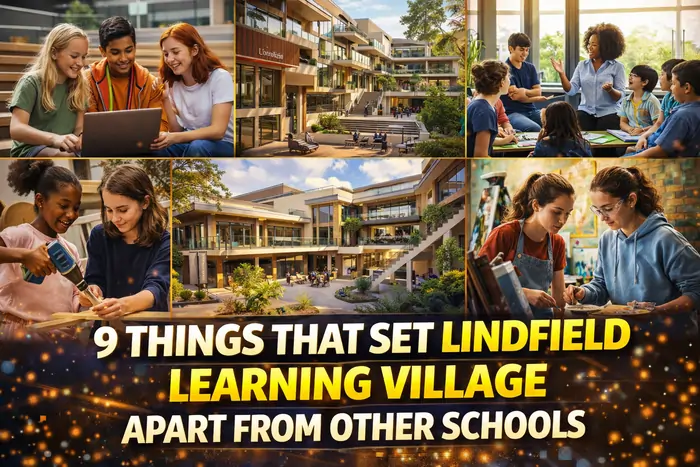
Lindfield Learning Village has become one of the most talked‑about public schools in Australia because it does things very differently—from its architecture and timetable to how students are grouped and assessed.
1. “Stage Not Age”: Progression by readiness, not year level
The most distinctive feature of Lindfield Learning Village is its “stage not age” learning model. Instead of grouping students strictly by chronological age into fixed year levels, the school organises learning around the NSW curriculum “stages,” and students move to more advanced work when they are ready.
According to the NSW School Infrastructure summary and design‑practice descriptions, this model allows students to progress at their own pace, offering:
- Acceleration for students who are ready to move ahead in certain subjects
- Additional time and support for students who need consolidation
- Flexible grouping based on current learning needs rather than a birth‑year cohort
The official educational model summary describes key elements such as “Stage Not Age,” “Project‑based, Multidisciplinary Learning,” and “Student‑directed individualised learning” as core pillars of the school. You can see this outlined clearly in the NSW infrastructure document for Lindfield Learning Village:
Lindfield Learning Village educational model summary (PDF)
Why it sets LLV apart:
Most schools still tie curriculum, assessment and social groupings tightly to age‑based year levels. At Lindfield Learning Village, a Year 7‑aged student might learn maths with older peers but humanities with younger ones, depending on their stage, which changes how teachers plan, how students see themselves as learners, and how progression is communicated.
2. An “all‑through” K–12 school with daily cross‑age contact
Lindfield Learning Village is a proudly public, comprehensive K–12 school on a single campus, which makes it an “all‑through” model rather than separate primary and secondary schools. The official site describes it as a K–12 comprehensive school that serves students “of all ability levels” from Kindergarten to Year 12.
The educational model summary emphasises the benefits of having younger and older learners together:
- Older students act as mentors and role models
- Younger students see directly what more advanced learning looks like and what they can aspire to
- Transitions between primary and secondary phases are smoother, since they occur within one continuous community
A student‑authored reflection on LLV notes that the school is “a progressive new K–12 comprehensive school” with multi‑age groupings (Pods and Beyonds) and learning guides who work with students over time, not just for a single year. You can read that first‑hand account here:
LLV Life (Part 1): A student’s perspective
Why it sets LLV apart:
Most NSW public students change campus (and often culture) at least once—from primary to high school. Lindfield Learning Village instead builds a single identity and learning continuum from age 5 to 18, with daily cross‑age contact baked into its design.
3. Project‑based, multidisciplinary learning instead of siloed subjects
Another defining feature of Lindfield Learning Village is its strong emphasis on project‑based, multidisciplinary learning rather than discrete, subject‑siloed classes. The educational model summary explicitly notes that subjects “will not necessarily be taught discretely but in a cross‑disciplinary approach where students are meeting outcomes across multiple learning areas.”
In practice, this means:
- Students work on extended projects that integrate outcomes from English, maths, science, HSIE and other areas.
- Timetables are flexible, allowing blocks of time for deep work rather than short, bell‑driven “periods.”
- Real‑world problems, community links and multidisciplinary themes anchor units.
An early profile of the school described it as “turning traditional education on its head,” focusing on “collaborative, multidisciplinary projects rather than traditional segregation of classes.” That piece, which introduces the educational model and its aims, can be read here:
A New School Turning Traditional Education on its Head
Why it sets LLV apart:
While some schools run occasional interdisciplinary projects, Lindfield Learning Village embeds project‑based, cross‑disciplinary learning into its core structure. It’s not an add‑on week; it’s how most learning happens.
4. Home bases and “schools‑within‑a‑school”
Because the campus can accommodate up to around 2000–3000 students across K–12, Lindfield Learning Village uses a “schools within a school” model to keep the experience human‑scale. Planning documents and bushfire‑planning reports describe six separate “home bases” or learning communities, each with about 330–350 students, forming a village of smaller schools within the larger site.
These home bases:
- Provide a “home” group where students have consistent relationships with learning guides.
- Give families a smaller, more intimate community inside a large campus.
- Allow specialised spaces and staff expertise to be anchored in each sub‑school.
The NSW infrastructure summary stresses that an “all through” school with structured home bases supports daily connections between older and younger learners and allows pastoral care, wellbeing and academic support to be organised efficiently.
You can see how designers interpreted this “schools within a school” idea in project pages like:
Why it sets LLV apart:
Many large schools struggle with anonymity and fragmentation. Lindfield Learning Village is intentionally structured as multiple overlapping communities—home bases, pods, learning guides—so that students feel known even in a big K–12 environment.
5. Adaptive reuse of a brutalist university campus with heritage protection
Physically, Lindfield Learning Village looks nothing like a typical suburban school. It occupies the former UTS Ku‑ring‑gai campus, a Sulman Award‑winning brutalist complex designed around a “hilltop village” and internal street. This campus has been adapted for schools use and is now listed on the NSW State Heritage Register for its “rare and dramatic Neo‑Brutalist architecture” and strong integration with the surrounding bushland.
Design firms involved describe the project as:
- An “adaptive reuse” of a significant modernist tertiary building into a K–12 school.
- A design that uses the original internal “street” to weave together multiple learning zones and social spaces.
- A campus featuring flexible learning spaces, extensive glazing, indoor–outdoor connections and robust surfaces designed for long‑term student use.
You can explore imagery and architectural commentary via:
Why it sets LLV apart:
Most schools are purpose‑built K–12 complexes or separate primary/secondary campuses. Lindfield Learning Village is a rare example of a public school inhabiting and reimagining a heritage brutalist university site, with all the spatial variety, lecture theatres, and dramatic forms that entails.
6. Flexible, “real‑world” facilities shared with the community
Because it repurposes a former university campus, Lindfield Learning Village has a wide array of facilities atypical for a single public school. Project descriptions highlight:
- An 800‑seat Greenhalgh Theatre used by both school and community
- Lecture theatres, an expansive library, drama and music rooms, and a gymnasium
- A 30‑metre pool, sports grounds, and extensive outdoor play areas
- Spaces designed for distance‑education units and Aurora College (NSW’s virtual selective high school)
Education Snapshots notes that these facilities encourage strong community participation, making the site a “learning precinct” rather than a closed school. MBC Group’s project overview stresses that stage‑two works added specialist technical learning spaces, new bus/kiss‑and‑drop access, a new COLA (Covered Outdoor Learning Area), additional play space, and repurposed lecture theatres into drama and music spaces.
See the detailed facility breakdown here:
Why it sets LLV apart:
Many schools share facilities with the community, but Lindfield Learning Village starts from a civic‑scale campus with performance, lecture and recreational spaces designed for post‑school education and adapts them for K–12 use.
7. A deliberately inclusive, comprehensive ethos with a progressive pedagogy
Despite the innovative architecture and pedagogy, Lindfield Learning Village defines itself as a “comprehensive, inclusive school for students of all ability levels.” Its official “Why choose our school” page emphasises:
- Comprehensive, co‑educational provision K–12
- Structured, explicit teaching reinforced by targeted interventions
- Support for a wide range of learning needs and pathways
Earlier profiles highlight its intent to create “independent, resilient learners” with strong problem‑solving and entrepreneurial dispositions, while embracing students “from all backgrounds and learning abilities.” RBA Group’s project commentary notes that the school aims to “encourag[e] empathy and trust, ensuring that all students from all backgrounds and learning abilities are embraced, valued, and known.”
However, the school has also attracted debate. Some critics argue that highly resourced, innovative “flagship” public schools can create perceived inequities within the broader system. A widely shared social‑media post described LLV as part of a trend toward “special, selectively resourced public schools” that function like “free private schools.” This tension—between innovation and equity—is part of what makes Lindfield Learning Village a focus of policy discussion.
Why it sets LLV apart:
LLV is both radically progressive in pedagogy and proudly public/comprehensive in enrolment philosophy, sitting at an unusual intersection of innovation and system‑level equity debates.
8. Student voice, co‑design, and evolving school identity
From its inception, Lindfield Learning Village has signalled that students will help shape not just what they learn but aspects of how the school itself looks and feels. An early article on the school’s launch reported that students would be involved in designing their own uniform and contributing to the school motto, with the curriculum and school structure “fluid, changing and learning from experiences as they happen.”
A student blog on “LLV Life” reinforces this, describing:
- Learning groups called Pods and Beyonds with learning guides
- Teachers who “are less like stereotypical teachers and more next generation,” seen as guides and co‑learners rather than strict authority figures
- A highly hands‑on, project‑driven environment
You can read that student perspective here:
LLV Life (Part 1): A student’s perspective
Why it sets LLV apart:
While many schools say they value student voice, Lindfield Learning Village structurally embeds it in learning design, school culture, and even visual identity, treating students as co‑designers rather than passive recipients.
9. Deep links with universities, business and external learning networks
Finally, Lindfield Learning Village leverages its location and history to build strong external partnerships. RBA Group’s project overview notes that the school is close to major organisations like Microsoft, CSIRO, and Macquarie Hospital, which enables:
- Real‑life learning experiences and mentoring programs
- Easy access to experts and authentic project briefs
- Community and industry involvement in multidisciplinary learning
The NSW educational model summary also highlights “Community, University and Business links” as a core pillar, indicating that Lindfield Learning Village is designed to be outward‑facing—connecting students with higher education and workplaces long before the end of Year 12.
The relocation of Aurora College, NSW’s selective virtual high school, to the LLV campus further underscores its role as a hybrid physical–virtual learning hub in the state’s wider digital education network.
Why it sets LLV apart:
Plenty of schools run occasional excursions or industry visits; Lindfield Learning Village is structurally positioned as a learning precinct with permanent university and business links and a hosted virtual selective school, making external engagement part of its everyday fabric.
FAQs About Lindfield Learning Village
What is Lindfield Learning Village?
Lindfield Learning Village is a K–12 public, co-educational school on Sydney’s north shore, built on the former UTS Ku-ring-gai campus and designed around a “stage not age” learning model.
Where can I find the school’s official information?
You can visit the school’s official website for enrolment details, philosophy, and updates, including its “Why choose our school” section.
What does “stage not age” mean in practice?
Students progress based on their learning level rather than age, allowing for flexible grouping, acceleration, and targeted support.
Is Lindfield Learning Village a selective school?
No, it is a comprehensive and inclusive public school, though it hosts Aurora College, a virtual selective high school.
How is the campus different from a typical school?
The campus features a heritage-listed university-style design with lecture theatres, an 800-seat theatre, library, pool, and modern open learning spaces.
How big is the school?
It can accommodate around 2000–3000 students (K–12), divided into smaller “schools within a school” for a more personalised experience.
What kind of learning does LLV emphasise?
The school focuses on project-based, multidisciplinary learning, encouraging student-directed work and collaboration.
How does LLV support students with different abilities?
It offers personalised learning pathways based on each student’s stage, with strong pastoral support systems.
Are there criticisms or controversies?
Yes, some critics argue that innovative public schools like LLV may create inequality or “elite” environments within the public system.
What is the student experience like?
Students describe LLV as hands-on and flexible, with teachers acting more as guides than traditional instructors.
How are the learning spaces designed?
Spaces are open, flexible, and connected to outdoor areas, moving away from traditional classroom layouts.
Does LLV have traditional bells and rigid timetables?
No, it uses flexible timetables instead of strict periods, supporting project-based learning.
How does the school engage with the community?
Facilities like theatres and sports areas are shared, and the school maintains strong community and industry partnerships.
Is LLV right for every student?
It suits students who thrive in flexible, innovative environments, but may not fit those who prefer traditional structured schooling.
Where can I learn more about its architecture and heritage?
Architecture firms and case studies provide insights into its design, history, and redevelopment.
Conclusion: Lindfield Learning Village as a living experiment in public education
Lindfield Learning Village stands out because it refuses to tweak one element of traditional schooling; instead, it rethinks many of them at once—how students are grouped, how space is used, how learning is structured, and how a public school connects to its wider community. Its “stage not age” progression, all‑through K–12 model, project‑based learning, and adaptive reuse of a brutalist campus create a distinctive environment that has drawn both admiration and critique within New South Wales’ public system.
For educators and policymakers, LLV offers a real‑world case study in what it looks like to scale progressive pedagogy inside a government‑run school: the opportunities, the trade‑offs, and the questions it raises about equity and system design. For families, it’s a reminder that public education can take many forms—and that finding the right fit means looking beyond test scores to the underlying philosophy of how a school understands learning, community, and the future its students are being prepared for.
If you’re following how Australian schooling is evolving more broadly—beyond a single innovative campus—it’s also important to understand the pressures teachers themselves are under. Industrial action and workload disputes shape what’s possible inside every classroom, progressive or traditional. For a concise snapshot of those dynamics, see 7 Key Things to Know About the Australia Teacher Strike (2026), which breaks down the main issues, demands, and likely impacts on students, parents, and schools nationwide.