

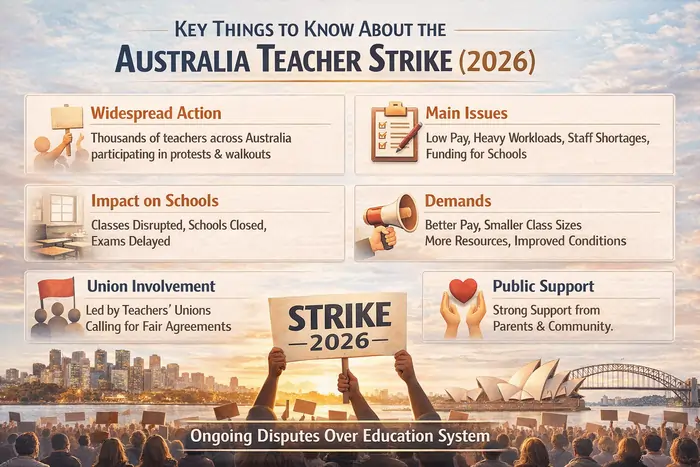
The Australia teacher strike in 2026 is driven by disputes over pay, workload, and education funding, with large-scale walkouts led by the Australian Education Union. The outcome could significantly impact school operations, teacher retention, and government policy across multiple states.
1. The Strike Is Being Led by the Australian Education Union
The central driver of the 2026 teacher strike is the Australian Education Union (AEU), which represents public school teachers, principals and education support staff across multiple states.
In Victoria, AEU members voted overwhelmingly for industrial action after more than eight months of stalled enterprise bargaining with the state government. The union has described the offer on the table as “completely unacceptable,” arguing it fails to address chronic issues with pay, workload and staffing. You can read the AEU’s own framing of the dispute and their industrial campaign on the union’s official update page Public school teachers, principals and education support staff to stop work – AEU Victoria
The AEU is also referencing similar unrest in other states to highlight what it sees as a national crisis in public education, pointing to earlier strikes in Queensland and Tasmania over real wage cuts and workload pressures.
2. The Pay Dispute Is About More Than Just the Percentage
On the surface, the conflict looks like a simple pay dispute – teachers want a bigger pay rise than the government is currently offering. But once you dig into the numbers, it’s clear the argument is also about relativity to other states, inflation and long‑term competitiveness.
According to reports, the Victorian government initially pitched a package that equates to roughly 17–18.5% over four years, including:
- An 8% pay rise for teachers and principals from April 2026.
- A 4% rise for education support staff at the same time.
- Followed by 3% increases in each of the next three years.
This was widely reported by outlets such as the ABC and Yahoo News:
- Victorian teachers reject pay offer as statewide strike looms – ABC News
- Schools to stay open as teachers strike over pay deal – Yahoo News Australia
The AEU, however, is demanding a 35% pay rise over three years, arguing that anything less will leave Victorian teachers behind their counterparts in New South Wales and fail to keep up with the cost of living. Education‑sector outlet EducationHQ summarises this gap clearly in its coverage ‘Completely unacceptable’: teachers set to strike after rejecting pay offer – EducationHQ
Union leaders claim that by late 2026, experienced teachers in NSW will earn more than 13% extra compared with those in Victoria, if no significantly improved deal is reached.
3. Workload, Class Sizes and Staffing Are Core Issues
If you talk to teachers, most will tell you this strike is not just about the money. Over the last decade, workloads have increased sharply, driven by more complex student needs, growing administrative demands and persistent staffing shortages.
The AEU’s log of claims reportedly includes:
- Reduced face‑to‑face teaching hours to free up planning and assessment time.
- Smaller class sizes to make teaching manageable and more effective.
- Increased planning time and properly funded time‑in‑lieu provisions.
- Improved pay and conditions for education support staff, who are among the lowest paid in the sector.
Coverage by independent and alternative media has highlighted how these issues intersect with teacher burnout and attrition. For context on the longer‑term build‑up of frustration, see this 2025 analysis Australia: Growing unrest among teachers amid union-… – World Socialist Web Site
In early childhood and tertiary education, similar disputes over workload and staffing have triggered separate industrial campaigns, such as the statewide strike by early childhood educators in Victoria in March 2026. That action is described in more detail here Australia: Victorian early childhood educators strike for … – WSWS
Taken together, these disputes suggest teachers are using the 2026 strike to force a broader conversation about how Australia funds and values public education.
4. It’s the First Statewide Teacher Strike in Victoria in 13 Years
One reason this industrial action has attracted so much attention is that it marks the first statewide teacher strike in Victoria since Labor returned to government 13 years ago. That historical gap underscores how unusual this escalation is, even in a sector with regular enterprise bargaining.
Yahoo News notes that if the current industrial action proceeds, “it would mark the first statewide strike by teachers in Victoria since the Labor party regained power 13 years ago.” ABC News confirms that tens of thousands of teachers and support staff are preparing to walk off the job, shutting or partially closing hundreds of schools.
Student‑focused outlets such as the University of Melbourne Student Union (UMSU) have framed the event as a major political test for the Victorian government, especially given previous promises about “full and fair funding” for public schools. See UMSU’s explainer here Victorian Teacher Strike on March 24 as Union Rejects Pay Offer – UMSU
Broadcast media have been highlighting the significance of the strike to the broader public. For example, 7NEWS reports that roughly 30,000 Victorian government school teachers and aides are expected to join the action, affecting up to 500 schools statewide Victorian teacher strike over pay dispute | 7NEWS
5. Schools Are Disrupted, but Many Will Stay Open
For parents and students, the most immediate question is: Will my school be open?
The answer varies by state and individual school, but broadly:
- In Victoria, the Fair Work Commission has authorised a one‑day strike, allowing union members to legally stop work for 24 hours.
- The Education Minister has stated that schools will “remain open” where possible, using retired teachers and casual staff, but has conceded that a normal curriculum will not run.
- In practice, many schools will close completely or operate with skeleton staffing, prioritising supervision rather than regular classes.
News coverage from ABC and Yahoo has stressed that this may mean short‑notice updates for families as principals assess staffing levels:
- Victorian teachers reject pay offer as statewide strike looms – ABC
- Schools to stay open as teachers strike over pay deal – Yahoo
Elsewhere, similar action is being taken. In Tasmania, public schools are scheduled to close for a day as teachers strike following the rejection of the latest pay offer Tasmanian public schools to close for a day as teachers go on strike – ABC
For real‑time updates, parents are being encouraged to monitor official school communications and state education department alerts.
6. The Strike Sits Within a Broader Pattern of Education Unrest
The 2026 teacher strike is not an isolated event; it sits within a wider pattern of industrial disputes across Australia’s education sector.
Recent examples include:
- Queensland: Teachers staged strikes in late 2025 during exam week, after rejecting a pay deal that the government said would have made them among the highest paid in the country. Coverage of this dispute is available here Exam week chaos as teachers strike in pay dispute – InDaily QLD
- Tasmania: Public school teachers have rejected the latest salary offer and are proceeding with statewide industrial action in 2026, leading to school closures.
- Early Childhood Sector: Victorian early childhood educators have taken statewide strike action in response to low pay and intense workloads, marching in Melbourne for better conditions.
Longer‑term commentary suggests that years of stagnant real wages, increasing responsibilities, and unresolved class size and workload issues have created a “pressure cooker” environment. Opinion pieces, such as Support the AEU strike and demand funding for public education, argue that the 2026 strike represents a broader pushback against austerity in public education funding.
For a sense of how these disputes intersect and why teachers feel there’s “no option” but to strike, see the WSWS analysis on growing unrest among teachers Australia: Growing unrest among teachers amid union-… – WSWS
7. What Happens Next: Possible Outcomes and Why It Matters
The immediate question now is what the 2026 teacher strike will actually achieve – and what it will mean for Australia’s education system in the long run.
Several scenarios are on the table:
- Improved pay and conditions: The government may return to the bargaining table with a higher pay offer and more concrete commitments on workload, class sizes and support staff, particularly if public sympathy leans towards teachers.
- Extended or rolling strikes: If negotiations stall, the AEU has signalled it is prepared to escalate with further industrial action, potentially targeting exam periods or specific regions to increase pressure.
- Political fallout: The dispute could become a defining issue for state governments, especially where “education state” branding or previous funding promises clash with the reality of industrial conflict.
The AEU’s March 2026 update makes it clear that members are “ready to escalate their industrial action” if the government does not return with an offer that addresses core concerns Public school teachers, principals and education support staff to stop work – AEU Victoria
For parents and students, the outcomes of these negotiations will shape teacher retention, classroom conditions and the overall stability of the school system for years to come. For governments, the dispute is a test of how they balance budget constraints with the need to invest in a workforce that underpins both social and economic outcomes.
Conclusion
The 2026 teacher strike in Australia is about far more than a single day of disruption – it’s a flashpoint in a long‑running debate over how we fund, staff and value public education. Understanding the key drivers – from pay relativity and inflation to workload, class sizes and chronic staffing shortages – helps explain why so many educators feel they have reached a breaking point.
Whether you agree with the tactics or not, the strike is forcing governments, parents and the broader community to confront some uncomfortable questions about the future of schooling and what it will take to keep good teachers in classrooms. To stay informed as the situation evolves, keep an eye on live coverage from outlets like ABC News, updates from the AEU Victoria website, and state‑based reports such as Tasmania’s public school strike alerts
For a closer look at how this teacher strike ties into broader reform efforts, read 9 Major Demands from the AEU That Could Change Australian Schools to see the agenda that could reshape classrooms across Australia.