

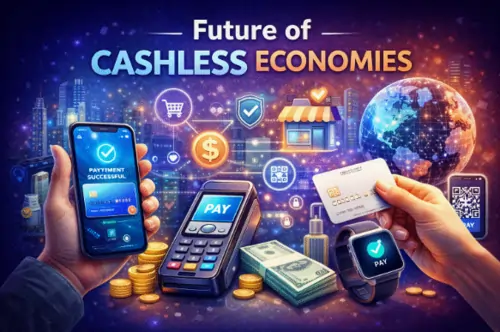
The Future of Cashless Economies
The rise of Cashless Economies is no longer a theory in the Philippines. It’s visible in everyday life—QR codes at sari-sari stores, salary credits sent directly to e-wallets, and bills paid through mobile apps instead of over-the-counter cash.
But the future of Cashless Economies does not mean cash disappears overnight. Instead, it means digital payments become the default choice for most transactions, while cash remains as backup for emergencies, rural areas, and inclusion purposes.
According to the Bangko Sentral ng Pilipinas (BSP), digital retail payments reached 52.8% of total monthly retail transaction volume in 2023, surpassing national targets. In 2024, this grew further to 57.4% by volume and 59% by value, showing measurable progress toward more Cashless Economies.
What Cashless Economies Really Mean
A common misconception is that Cashless Economies mean “no more cash.” In reality, most countries move toward being cash-lite, not fully cash-free.
Cashless Economy are systems where:
- Most transactions are digital (QR, cards, transfers)
- Financial records are electronic
- Instant payments replace manual processing
- Government and business collections move online
Cash remains important for resilience and accessibility, especially in areas with limited connectivity.
Why the Philippines Is Moving Toward Cashless Economies
1. Central bank policy and infrastructure
The BSP’s Digital Payments Transformation Roadmap (DPTR) aimed to convert at least 50% of retail payments into digital form, strengthening the foundation for Cashless Economy.
The development of QR Ph, an interoperable QR system usable across participating banks and non-bank e-money issuers, removed friction between payment providers. Interoperability is essential for sustainable Cashless Economy.
2. Smartphone penetration and mobile internet
Digital wallets like GCash and Maya became popular because they matched Filipino behavior—mobile-first usage.
The growth of smartphones accelerates the transition toward Cashless Economy because devices become digital wallets, payment cards, and banking tools all in one.
3. Merchant adoption
More small businesses now accept QR payments. The more merchants adopt digital payments, the stronger Cashless Economy become.
For micro and small enterprises, digital payments reduce:
- Change-handling problems
- Theft risks
- Manual record errors
What Daily Life Looks Like in Cashless Economies
In growing Cashless Economy like the Philippines:
- Transport fares shift to tap-and-go or QR
- Grocery payments are scan-first
- Remittances arrive instantly
- Bills are paid through apps
- Government fees are processed digitally
The key difference is speed. Cashless Economy reduce friction in daily commerce.
Benefits of Cashless Economies
Convenience
Digital payments are faster and require less physical handling. No waiting for change, fewer ATM withdrawals.
Financial tracking
Payment histories help individuals manage budgets and help businesses monitor cash flow.
Potential financial inclusion
Digital onboarding can make financial services accessible to more Filipinos, supporting broader participation in Cashless Economy.
Risks That Come With Cashless Economies
1. Cybersecurity and fraud
The International Monetary Fund highlights that fintech systems can be vulnerable to cybersecurity risks and broader stability concerns if not properly managed.
As Cashless Economies grow, fraud prevention becomes critical.
2. Inequality risks
Research in Socio-Economic Review notes that removing cash without proper safeguards can aggravate inequality, especially if digital access is uneven.
Cashless Economy must remain inclusive to avoid excluding seniors, rural residents, or low-income communities.
3. System outages
When digital systems fail, fully dependent Cashless Economy can experience disruptions. This is why cash remains an important fallback mechanism.
4. Privacy concerns
Cash transactions are anonymous. Digital payments create data trails. The future of Cashless Economies must balance convenience with consumer data protection.
The Role of Interoperability in Cashless Economies
The success of Cashless Economy depends less on which wallet people use and more on whether systems connect smoothly.
QR Ph allows participating banks and e-money issuers to scan the same QR codes for payments via InstaPay. This shared standard reduces fragmentation.
Interoperability strengthens trust and usability in Cashless Economies.
Will CBDCs Change Cashless Economies?
Central banks worldwide are studying Central Bank Digital Currencies (CBDCs). The Bank for International Settlements reports ongoing CBDC exploration, with many projects focused on wholesale settlement rather than everyday consumer use.
CBDCs may support infrastructure behind Cashless Economy rather than replace private e-wallets immediately.
Source: BIS CBDC Survey Report (bis.org)
What Filipinos Should Watch Next
Rising digital share
BSP data confirms digital transactions already exceed half of retail volume. The next phase of Cashless Economies depends on:
- Safer fraud controls
- Better dispute resolution systems
- More rural access
- Stronger consumer protection
Source: BSP 2024 E-Payments Measurement Report (bsp.gov.ph)
Trust as the foundation
Cashless Economy only succeed when users feel:
- Their money is safe
- Errors can be corrected
- Support is accessible
- Fees are transparent
Without trust, adoption slows.
Practical Tips for Living in Cashless Economies
For individuals
- Enable transaction alerts
- Use strong PINs and authentication
- Never share OTPs
- Keep a small cash backup
For students
Growing Cashless Economies create demand for:
- Cybersecurity professionals
- Compliance specialists
- Fintech developers
- Risk analysts
For investors
Themes aligned with Cashless Economies:
- Fraud detection
- Identity verification
- Merchant enablement tools
- Payment infrastructure and rails
FAQs
Will the Philippines become fully cashless?
Unlikely in the near term. The country is becoming cash-lite, with digital payments dominant but cash still available.
How digital is the Philippines already?
BSP reports 57.4% of retail transactions by volume were digital in 2024.
Are Cashless Economies safer?
They can be convenient but increase exposure to digital fraud, making strong security essential.
Do Cashless Economies exclude some people?
They can, if digital literacy, access, and affordability are not addressed.
Final Takeaway
Cashless Economy are expanding rapidly in the Philippines, supported by policy, infrastructure, and consumer adoption. The future is not about eliminating cash but about making digital payments more secure, inclusive, and reliable.
The success of Cashless Economies will depend on three pillars:
- Security
- Inclusion
- Interoperability
If these are managed well, digital payments can improve efficiency without leaving people behind.