

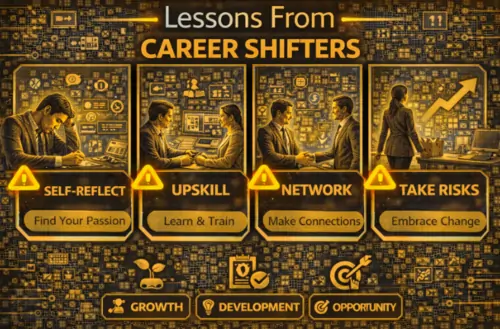
Introduction
Changing careers can feel exciting, risky, confusing, and deeply personal all at once. For many people, a career shift is not simply about switching jobs. It is about rethinking identity, skills, priorities, and long-term goals.
Some people change careers because they feel stuck. Others do it because of layoffs, burnout, family responsibilities, industry decline, or a growing desire for more meaningful work.
The stories and experiences behind these transitions offer valuable insight. The best lessons from career shifters show that changing direction is rarely a sign of failure.
In many cases, it is a sign of self-awareness, courage, and adaptability. A career shift often begins with uncertainty, but it can also lead to stronger confidence, better alignment, and greater long-term satisfaction.
Many professionals who changed paths successfully did not have perfect timing, complete certainty, or a guaranteed outcome. What they had was a willingness to learn, adjust, and keep moving forward. Their experiences can help others understand what makes a successful transition possible.
This article explores the most important lessons from career shifters, including mindset, strategy, skill development, networking, and resilience.
Why More People Are Changing Careers
Career changes are becoming more common across many industries. Work has changed dramatically over the past decade. Technology has transformed entire sectors, remote work has expanded possibilities, and more professionals are rethinking what they want from their jobs.
Some of the most common reasons people shift careers include:
- burnout or chronic stress
- lack of purpose or fulfillment
- better income opportunities
- industry disruption
- family or lifestyle changes
- desire for flexibility
- personal growth and reinvention
These changes mean that a linear career path is no longer the only model of success. One of the most important lessons from career shifters is that careers can evolve more than once, and that evolution can be healthy rather than unstable.
Lesson 1: Clarity Often Comes After Action
A common myth is that people should wait until they are fully certain before making a career move. In reality, many career shifters did not begin with perfect clarity. They discovered direction through action.
This might include:
- taking a course
- freelancing part-time
- talking to people in a new field
- trying a short project
- volunteering
- testing a business idea
One of the strongest lessons from career shifters is that movement creates clarity. Waiting for certainty can lead to long periods of indecision. Small experiments often reveal more than endless thinking.
Lesson 2: Transferable Skills Matter More Than People Think
Many professionals fear that changing careers means starting from zero. In most cases, that is not true. People bring valuable transferable skills from previous roles, even if the industry changes.
Examples include:
- communication
- project management
- leadership
- problem-solving
- sales
- writing
- analysis
- relationship-building
- time management
A teacher moving into corporate training, a journalist moving into content strategy, or a customer service professional moving into operations may all carry strong, relevant skills.
One of the most practical lessons from career shifters is learning how to translate past experience into new value. Success often depends on how clearly a person can explain what they already know and how it applies to the next role.
Lesson 3: Identity Can Be Harder to Change Than the Job
Career transitions are not just professional. They are psychological. Many people become deeply attached to their job title, industry, or sense of expertise. Letting go of an old identity can feel uncomfortable, even when the new direction is better.
This is one of the more emotional lessons from career shifters. The practical side of change may be manageable, but the internal side can be harder. People may wonder:
- Am I too late?
- What if I fail?
- What will others think?
- Am I qualified to begin again?
Career shifters often succeed when they stop seeing change as losing identity and start seeing it as expanding identity.
Lesson 4: Skill Gaps Can Be Closed
A career shift often requires learning something new. That can sound intimidating, but many successful transitions happen because people are willing to learn in focused and practical ways.
This may involve:
- online certifications
- short courses
- portfolio projects
- mentorship
- industry reading
- technical training
- job shadowing
The important point is that not every new path requires another full degree or years of formal education. One of the most empowering lessons from career shifters is that many skill gaps can be reduced through targeted learning and consistent effort.
Lesson 5: Networking Becomes More Important During Transition
When people shift careers, they often cannot rely only on traditional job applications. Relationships become especially important.
Networking during a career change can help with:
- understanding industry expectations
- discovering hidden opportunities
- learning common role requirements
- finding mentors
- gaining referrals
- building confidence
This does not mean asking everyone for a job. It means having thoughtful conversations, asking better questions, and learning from people already doing the work.
A major takeaway from the best lessons from career shifters is that opportunity often comes through connection, not just credentials.
Lesson 6: Starting Smaller Is Often Smarter
Not every career shift needs to happen in one dramatic leap. In fact, many successful transitions happen gradually.
Examples include:
- side projects before full-time change
- part-time study while employed
- consulting in a new niche
- freelance work before a full transition
- hybrid roles that bridge old and new skills
This gradual approach can reduce financial stress and help people build confidence. One of the most useful lessons from career shifters is that a bridge is often better than a jump.
Lesson 7: Rejection Is Part of the Process
Career shifters often face rejection, especially in the early stages. Employers may question their experience. Recruiters may prefer more traditional candidates. Interviews may not lead anywhere at first.
This can feel discouraging, but rejection is often part of repositioning. It does not always mean someone is not capable. It may simply mean they need to present their story more clearly, strengthen a few skills, or target the right role more strategically.
One of the most realistic lessons from career shifters is that persistence matters. Many people who later succeeded faced multiple setbacks before gaining traction.
Lesson 8: Career Satisfaction Often Improves With Alignment
A powerful reason people shift careers is the search for better alignment. That alignment may relate to values, schedule, work style, purpose, creativity, income, or long-term growth.
Many professionals discover that success in the wrong environment still feels wrong. A career shift can improve not only income or title but also energy, motivation, and overall well-being.
This is one of the deeper lessons from career shifters. Work feels more sustainable when it aligns better with who a person has become.
Lesson 9: Confidence Is Built During the Transition
People often assume they need confidence before they make a big move. In reality, confidence usually grows through the process itself.
Confidence builds when people:
- finish a course
- complete a project
- get positive feedback
- have a strong networking conversation
- solve a new problem
- see early signs of progress
One of the most encouraging lessons from career shifters is that confidence is often the result of action, not the requirement for it.
Lesson 10: Career Change Can Lead to Stronger Long-Term Growth
A career shift may feel like a setback in the short term, especially if someone takes a temporary pay cut, starts in a junior position, or rebuilds credibility. But many career shifters later find that the move leads to stronger long-term outcomes.
These may include:
- better job satisfaction
- more flexibility
- stronger income growth over time
- healthier work-life balance
- greater purpose
- better industry fit
The most important lessons from career shifters often appear only in hindsight. What first looked like disruption later becomes the reason a better future was possible.
Common Mistakes Career Shifters Should Avoid
Career transitions can be powerful, but they are easier when common mistakes are avoided.
Some of the biggest mistakes include:
- waiting too long for perfect certainty
- ignoring transferable skills
- changing direction with no financial plan
- applying too broadly without a clear story
- refusing to learn new tools or language
- isolating instead of networking
- expecting instant results
These mistakes do not make transition impossible, but they can slow momentum.
Conclusion
The most valuable lessons from career shifters are about more than jobs. They are about adaptability, courage, self-awareness, and long-term growth. Career changes can be uncomfortable, but they also create space for reinvention and stronger alignment.
People who shift careers successfully are not always the ones with the most perfect plans. Often, they are the ones willing to learn, take action, stay resilient, and keep refining their direction.
A career shift is not necessarily the end of stability. In many cases, it is the beginning of a more meaningful and sustainable future. For professionals who feel ready for change, the experiences of others offer an important reminder: it is possible to start again and still move forward.
FAQ
What are lessons from career shifters?
Lessons from career shifters are practical insights gained from people who changed industries, roles, or professional paths and successfully adapted to new opportunities.
Is changing careers a bad sign?
No. Changing careers is often a sign of growth, self-awareness, and adaptability rather than failure.
What is the hardest part of changing careers?
For many people, the hardest part is uncertainty, especially around identity, income, confidence, and starting over in a new field.
Can transferable skills help in a career shift?
Yes. Transferable skills such as communication, leadership, problem-solving, and project management often make career transitions more realistic.
How can someone start changing careers?
A good starting point is to assess transferable skills, explore new fields, learn relevant skills, and begin having conversations with people already in the target industry.