

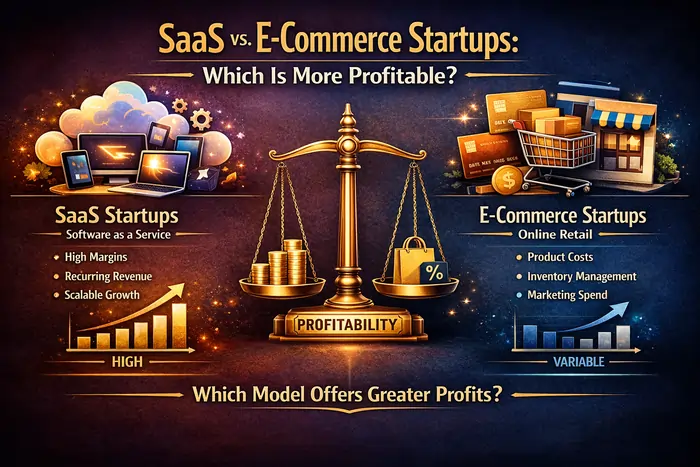
SaaS vs. E-Commerce is a common comparison for entrepreneurs deciding which type of online business to start. Both models offer strong income potential, global reach, and scalability, but they operate in very different ways. SaaS (Software as a Service) focuses on selling digital subscriptions that generate recurring revenue, while e-commerce revolves around selling physical or digital products, often with one-time transactions.
Choosing between SaaS and e-commerce depends on factors like startup costs, technical skills, profit margins, risk level, and long-term growth goals. Understanding how each model makes money, scales, and handles competition can help you determine which path is more profitable—and better suited to your strengths as an entrepreneur.
SaaS and e‑commerce can both be very profitable, but they generate profit in different ways: SaaS usually wins on long‑term margins and predictability, while e‑commerce can produce faster, more transactional cash flow if you execute well on products and operations.
SaaS vs E-Commerce Startups: Which Is More Profitable?
If you’re deciding between launching a SaaS product or an e‑commerce brand, the key question isn’t just “which makes more money?” but “which economic model fits how you want to build and scale a business.” SaaS tends to offer higher gross margins and recurring revenue once it’s working, while e‑commerce often has thinner margins but can spin up revenue quickly with the right products and marketing engine.
Founders in communities and case studies frequently debate SaaS vs. e‑commerce as bootstrapped paths to the first meaningful profit milestone, and the consensus is that SaaS is structurally more profitable long‑term, whereas e‑commerce is often quicker to launch but more sensitive to costs.
How SaaS Startups Make and Keep Profit
SaaS (software‑as‑a‑service) businesses sell access to software via subscriptions—usually monthly or annually—rather than one‑off licenses. Their economics revolve around recurring revenue and relatively low marginal cost once the product is built.
Recurring revenue and operating leverage
The economics of SaaS are built on recurring revenues that stack up over time. Once you’ve invested in building and hosting the product, serving each additional customer costs relatively little. Analyses like CLF’s breakdown of the economics of SaaS explain that most SaaS costs are fixed—engineering, infrastructure, support—while revenue can keep growing with each new subscription.
Industry benchmarks and finance guides often cite:
- Typical SaaS gross margins in the 70–85% range for healthy, mature SaaS businesses.
- Very low marginal cost per extra user (bandwidth, storage, incremental support).
Stripe’s explainer on SaaS gross margin and Chargebee’s glossary on SaaS gross margin both highlight how these high margins create strong operating leverage once you’ve covered fixed costs.
Unit economics and growth
SaaS profitability hinges on unit economics—how much value you get from each customer over time vs. what it costs to acquire and serve them. Key levers include:
- Customer acquisition cost (CAC).
- Customer lifetime value (LTV).
- Churn rate and net revenue retention.
- Expansion revenue via upsells, seat increases, and pricing tiers.
Guides on gross margin ratios and recurring profit in SaaS emphasize that healthy SaaS grows LTV over time through retention and expansion, allowing you to spend more on acquiring customers while still remaining profitable. If CAC is too high or churn is high, the model can look good on the surface but fail to generate real profit.
Time to profitability and investor appeal
SaaS usually requires more upfront investment: you have to build a working product, often over months, before you can charge meaningful subscription fees. That means many SaaS businesses burn cash early as they invest in development and customer acquisition.
The payoff is that, once you hit product‑market fit and get churn under control, profit can scale quickly with relatively modest incremental cost. That’s also why investors love SaaS: high margins, predictable revenue, and strong lifetime value when things go right.
To get there, you typically start with a focused MVP and iterate based on conversion and retention data. Frameworks similar to those described in guides on how to build an MVP that actually converts help you go from prototype to a subscription product that people actually pay for and stick with—critical prerequisites before you talk seriously about long‑term SaaS profitability.
How E‑Commerce Startups Make and Keep Profit
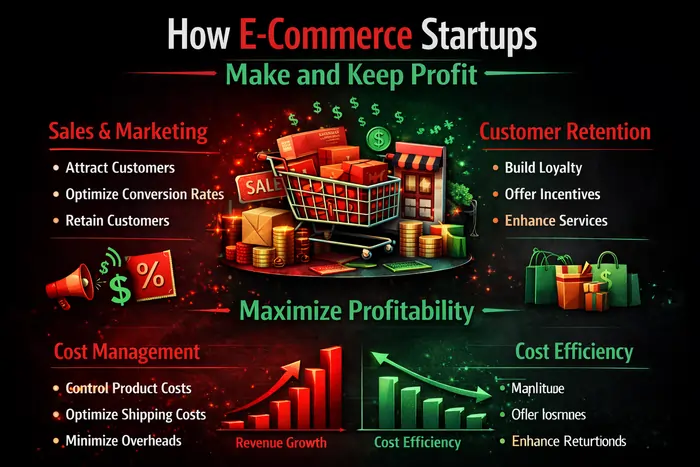
E‑commerce startups sell physical or digital products online, usually through their own store or marketplaces. Unlike SaaS, most e‑commerce revenue is transactional—you get paid for each order—unless you deliberately add subscriptions or memberships.
Margin structure and cost of goods sold
E‑commerce profitability depends heavily on gross margin, which is your selling price minus cost of goods sold (COGS), including the product itself, packaging, and sometimes fulfillment fees.
Resources like E‑Commerce Profit Margins: 6 Proven Strategies for Success and Understanding E‑Commerce Profit Margins outline some common patterns:
- Gross margins often fall in the 40–60% range, depending on category and positioning.
- Net profit margins are commonly around 5–15% after marketing, operations, and overhead, with 10% often viewed as healthy.
K38 Consulting’s Revenue vs Profit Margin: Essential Guide for E‑commerce shows how small changes in COGS, discount rates, or shipping costs can dramatically affect net margin.
Volume, marketing, and logistics
E‑commerce can generate revenue quickly because you don’t have to build complex software; you can launch with off‑the‑shelf platforms and an initial product line. But you pay for that speed through:
- Ongoing ad spend (search, social, affiliates, influencers).
- Shipping and fulfillment costs.
- Returns and refunds.
- Inventory risks and cash tied up in stock.
Profit often depends on balancing volume with acquisition cost and operations. When your ads are efficient, your logistics are tight, and your product mix has good margins, e‑commerce can be very profitable. If ad costs spike or competition pushes discounting, your margins can shrink quickly.
Head‑to‑Head: SaaS vs. E‑Commerce Margins
If you compare the two purely on typical margin profiles and scalability, SaaS tends to look more profitable per unit of revenue, especially once it reaches scale.
| Aspect | SaaS (Typical) | E‑Commerce (Typical) |
|---|---|---|
| Revenue model | Recurring subscriptions | One‑off purchases (unless subscription e‑com) |
| Gross margin | Often 70–85% for mature SaaS | Often 40–60% depending on category |
| Net margin potential | Can become very high after scale | Commonly 5–15% net with strong execution |
| Marginal cost per sale | Very low (hosting, support) | Higher (COGS, shipping, returns, payment fees) |
| Upfront build cost | High (product development, infrastructure) | Lower (inventory, store setup), but stock ties up capital |
| Revenue predictability | Higher with strong retention | Lower; depends on ad performance and repeat purchases |
| Sensitivity to ad costs | Medium (more LTV cushion) | High (ad spikes can erase profit) |
This is why finance and investor‑focused content often describes SaaS as structurally superior on profitability, while many founders argue that e‑commerce can be a quicker path to early cash flow if you find a strong product‑market fit and keep operations lean.
Where SaaS Profitability Breaks Down
SaaS doesn’t automatically mean profit. The same recurring model that can be powerful at scale can also hide poor economics early on.
SaaS often struggles when:
- It takes too long or costs too much to build the product, delaying revenue.
- Customer acquisition cost is high because of crowded niches or expensive channels.
- Churn is high, so you’re constantly replacing lost customers.
- Pricing doesn’t reflect the value delivered (underpricing or weak packaging).
Guides on recurring revenues and SaaS economics and gross margin ratios show how high churn and low LTV can make growth unprofitable even if top‑line revenue looks impressive.
Where E‑Commerce Profitability Breaks Down
E‑commerce profit is sensitive to many variables that can move quickly: ad auctions, shipping rates, marketplace rules, and consumer tastes.
E‑commerce often struggles when:
- Paid acquisition becomes more expensive, driving CAC higher than gross profit.
- Returns and refunds eat into margins, especially in apparel and similar categories.
- Inventory is mismanaged, leading to overstock, stockouts, or dead stock.
- Discounts and promotions train customers to buy only on sale.
Articles like Understanding E‑Commerce Profit Margins and Revenue vs Profit Margin for E‑commerce underline how fragile net margins can be if you don’t keep a close eye on COGS, shipping, and ad efficiency.
SaaS vs. E‑Commerce: Marketing, LTV, and SEO Dynamics
Marketing economics amplify the differences between SaaS and e‑commerce.
- In SaaS, you’re usually willing to spend more to acquire a customer because revenue recurs over time. You focus on sign‑ups, activation, retention, and expansion. Content marketing, product‑led growth, and long‑tail SEO are common strategies, as discussed in pieces like SaaS vs E‑Commerce SEO & Retargeting That Converts.
- In e‑commerce, you often have less LTV cushion per customer, so you must tightly control CAC. You optimize for conversion rate, average order value, and repeat purchases, using things like email flows, loyalty programs, and subscription boxes.
This difference in lifetime value vs. acquisition cost is a big reason SaaS can support higher marketing spend while still being profitable in the long run, whereas e‑commerce has to be more surgical with performance marketing to protect thin margins.
Cash Flow, Burn Rate, and Runway
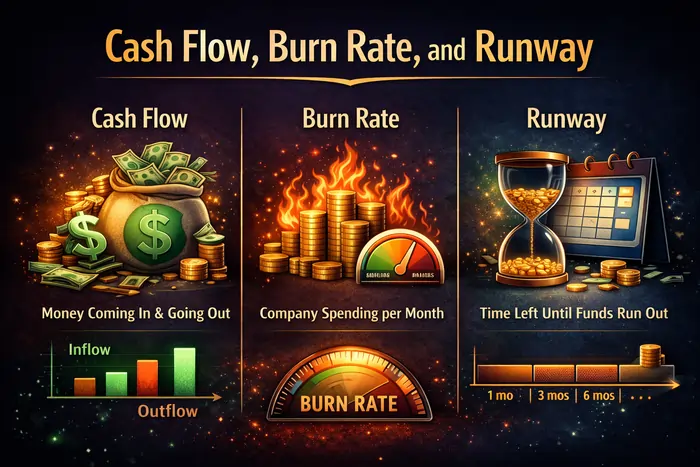
Profitability on paper isn’t enough if you run out of cash. For both SaaS and e‑commerce, managing burn rate and runway is critical, but the patterns differ.
- SaaS often runs negative cash flow for longer while you invest in product and sales. You need a handle on burn and runway using frameworks similar to those described in guides on how to calculate and reduce burn rate and managing cash runway.
- E‑commerce may reach operating profitability faster, but large inventory buys, seasonality, and ad swings can create cash crunches even when you’re technically profitable.
Real‑world burn‑rate guides stress that understanding your monthly net burn and runway is essential regardless of model; SaaS founders often track MRR vs expenses, while e‑commerce founders track inventory cycles, payables, and advertising ROI.
SaaS vs. E‑Commerce: Hybrid and Platform Plays
The line between SaaS and e‑commerce isn’t always sharp:
- Some e‑commerce founders move into SaaS by building tools for other merchants, as seen in “from e‑commerce to SaaS” success stories shared by brokers and marketplaces.
- Many SaaS e‑commerce platforms charge subscriptions to power e‑commerce stores, effectively combining SaaS economics with e‑commerce demand. Articles like Top Advantages of SaaS Ecommerce Platforms for Growth argue that these platforms can capture value from both sides.
There are also PaaS and on‑prem variants, but for profitability, the key questions remain similar: margin structure, recurring vs transactional revenue, and cost to acquire and serve customers.
Funding and Story: Turning Profitability into a Pitch
Whichever model you pursue, you’ll likely need to articulate its profit potential to investors at some point. That means translating your unit economics and path to profit into a coherent story.
If you’re building SaaS, that story often runs from pain point → MVP → product‑market fit → scalable recurring revenue. Frameworks similar to those in guides on how to build an MVP that actually converts help you show that you can turn an idea into a product people pay for repeatedly, which is exactly what investors want to see before backing SaaS.
If you’re building e‑commerce, you’ll emphasize high‑margin products, predictable acquisition channels, and disciplined operations. In both cases, learning how to pitch investors like a pro—for example, drawing on structures and tips similar to those in How to Pitch Investors Like a Pro—helps you frame your chosen model as a credible, profitable opportunity rather than just a concept.
SaaS vs. E‑Commerce: So, Which Is More Profitable?
From a structural standpoint, SaaS usually has the edge on profitability: higher gross margins, recurring revenue, strong operating leverage, and the ability to support higher CAC because of strong LTV. However, it often requires more upfront capital, technical capability, and patience before those advantages materialize.
E‑commerce can be more immediately accessible and faster to launch, and can certainly be very profitable in the right niche with disciplined operations—but margins are thinner and more exposed to external shocks like ad platform changes, shipping cost increases, and shifting consumer behavior.
In practice:
- Choose SaaS if you’re comfortable with a longer build phase, have or can access strong product/engineering talent, and want high‑margin recurring revenue with compounding growth.
- Choose e‑commerce if you’re strong in branding, marketing, and operations, enjoy working with physical or digital products, and are prepared to manage tighter margins, inventory, and logistics.
The “more profitable” option for you is the one where your skills, capital, and risk tolerance let you actually execute the model well—and where you can eventually tell a clear story to customers and investors about how your startup turns revenue into durable profit.