

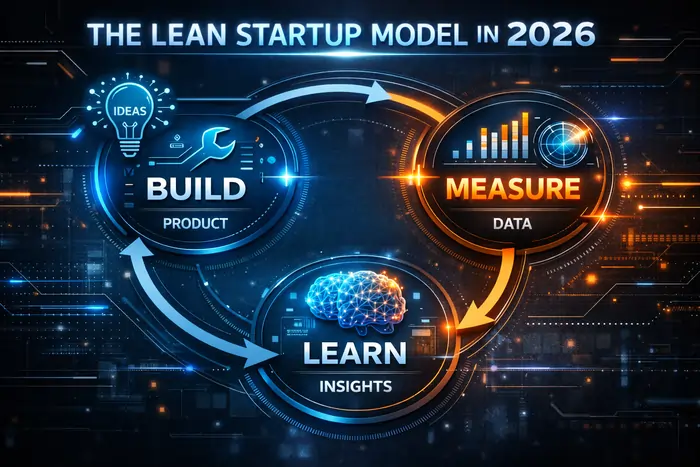
The Lean Startup Model reshaped how founders build products and companies, but in 2026 many entrepreneurs are asking if it still works in a world of AI, no‑code, and answer engines. Rather than being obsolete, Lean has shifted from a rigid playbook to a flexible mindset that you must adapt to today’s tools, markets, and AI‑driven discovery channels.
Introduction
When Eric Ries popularized the Lean Startup methodology, his message was simple: stop guessing, start learning, and use rapid experiments to build products customers actually want. The approach promised to replace thick business plans and long waterfall projects with quick cycles of testing, feedback, and iteration.
Fast‑forward to 2026, and the environment has changed dramatically; AI coding assistants, no‑code platforms, and global distribution channels compress the time it takes to ship an MVP from months to days. This speed has triggered a debate about whether the Lean Startup Model is outdated or still essential for founders trying to survive brutal competition and noisy markets.
In this article, you’ll see what the Lean Startup Model really is, how the landscape has evolved, where Lean still shines, where it fails, and how to adapt it while also optimizing your content for SEO, GEO, AEO, and NLP in 2026.
What Is the Lean Startup Model?
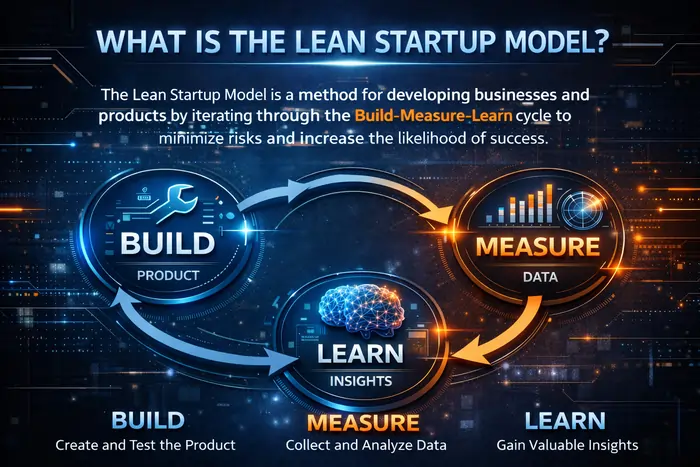
At its core, the Lean Startup Model is a systematic way to build new products under conditions of extreme uncertainty. Instead of relying on intuition or heavy upfront planning, you move through the build‑measure‑learn feedback loop, treating every product change as an experiment.
The official Lean Startup methodology emphasizes two big ideas: validated learning and actionable metrics, which together keep you honest about what is working and what is not.
A central tool in this approach is the Minimum Viable Product (MVP), the simplest version of a product that lets you start learning from customers quickly. As explained in this in‑depth guide to the build‑measure‑learn cycle, you first build an MVP that tests a core hypothesis, then measure how users respond, and finally learn whether to pivot, iterate, or persevere.
Articles like Viima’s overview of what the Lean Startup methodology is show how this loop underpins a culture of continuous experimentation across the whole startup.
How the Startup Landscape Has Changed by 2026
When Lean Startup first emerged, building software was slower and more expensive and required larger teams than it does today.
In 2026, AI‑assisted coding, design tools, and no‑code platforms mean solo founders can ship polished prototypes with a fraction of the resources older startups needed. This shift changes both the pace of experimentation and the expectations investors and customers have for early‑stage products.
At the same time, global markets have become more crowded and unforgiving; new ideas can be copied quickly, while distribution is increasingly mediated by AI‑driven feeds, recommendation engines, and answer engines.
Founders are now judged not just on whether they experiment, but on how fast they learn and how clearly they align experiments with a differentiated strategy. Critics who claim that “The Lean Startup is outdated” usually point to this new context, arguing that the original playbook was tailored to a post‑dot‑com world, not to today’s AI era.
Does the Lean Startup Model Still Work Today?
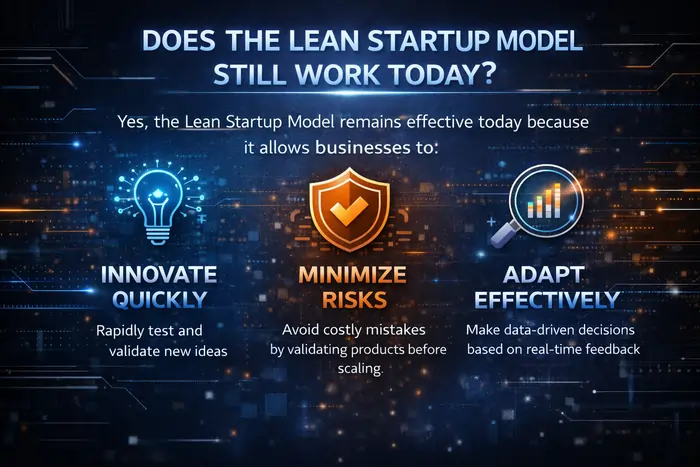
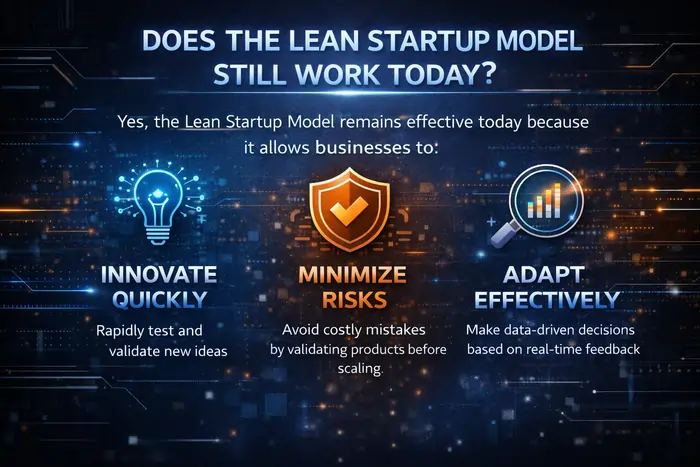
Despite the criticism, the evidence suggests the Lean Startup Model still works in 2026, but mainly as a set of principles rather than a frozen list of tactics. A 2025 Founder Review asking, “Is The Lean Startup a good book?” concludes that the core ideas—MVPs, experiments, and validated learning—remain useful, especially for first‑time entrepreneurs, provided they compress cycles with AI and adapt the approach in regulated sectors.
Thought leaders who argue that Lean is “dead” often clarify that what should die is lazy, cargo‑cult implementation, not the underlying mindset; they talk about a “third wave” where Lean principles are blended with innovation strategy, portfolio thinking, and corporate entrepreneurship.
The Substack essay “The Lean Startup at 2025: Is the MVP Dead?” notes that while crude MVPs are less acceptable now, the spirit of learning efficiently from real users is more relevant than ever. The real question in 2026 is not whether Lean works, but whether you’re applying it deeply enough to keep up with the new economics of experimentation.
When You Should Use Lean Startup (And When Not To)
Lean Startup is most effective in environments where you can iterate quickly, gather feedback cheaply, and manage the risk of failed experiments. A 2026 comparison of Lean Startup vs traditional business planning points out that Lean is ideal when you are building a tech product, the market is uncertain, capital is limited, and you can validate with real users. This aligns with typical SaaS, consumer apps, and many B2B tools where short cycles and constant iteration are possible.
By contrast, Lean can be dangerous if you treat it as an excuse to cut corners in domains where safety, compliance, or infrastructure stability matter more than speed. The same founder review that endorses Lean for many startups also advises some teams—particularly in heavily regulated or capital‑intensive industries—to skip the classic MVP playbook or heavily augment it with risk analysis and regulatory planning.
Articles such as “Lean Startup Is Wrong… or You Are” argue that many failures blamed on Lean actually stem from misuse, poor metrics, or lack of strategic clarity rather than from the methodology itself.
Updating the Lean Startup Model for 2026
To make Lean Startup work in 2026, you must update how you execute the familiar steps, using AI and modern product practices as force multipliers. The build‑measure‑learn loop is still the backbone, but the “build” phase now often means generating high‑fidelity prototypes with AI, integrating off‑the‑shelf components, and orchestrating systems rather than coding everything from scratch.
Measurement has also evolved beyond simple vanity metrics toward cohort analysis, retention curves, and experimentation platforms that explore multiple variations simultaneously.
Strategists like Tendayi Viki, in “Lean Startup Is Dead? Long Live Lean Startup!”, argue that the next wave of Lean is about integrating it with innovation accounting, portfolio management, and corporate governance.
Others, including Peter Fisk in “Beyond ‘Lean’… How next‑generation start‑ups are reinventing the future”, suggest that founders should blend Lean with robust strategic design to avoid getting lost in local optimizations. In practice, this means using design thinking for discovery, Lean for testing, and frameworks like OKRs to ensure your experiments line up with longer‑term goals.
Practical Steps to Apply Lean Startup in 2026
A practical way to apply Lean in 2026 is to treat every new feature and positioning move as a hypothesis about customer behavior and value. Start by writing explicit hypotheses, e.g., “If we launch an AI‑driven dashboard for small agencies in Southeast Asia, at least 20% of beta users will adopt it weekly within 30 days,” and then design the smallest test that can validate or falsify that claim.
Use AI and no‑code tools to assemble a realistic MVP, then push it to carefully chosen early adopters and watch their behavior rather than relying solely on survey feedback.
Resources like the Shopify guide on the Lean Startup model outline how to tie MVPs to specific business questions instead of treating them as half‑finished products. A detailed masterclass on the build‑measure‑learn cycle highlights the importance of choosing meaningful metrics and iterating through the loop multiple times.
Complement these with structured experimentation platforms and analytics to track retention, activation, and unit economics so that your pivot‑or‑persevere decisions are grounded in real data.
Case Studies / Mini Examples
Imagine a SaaS founder targeting service businesses in Southeast Asia; by using AI tools and no‑code platforms, they can build an MVP scheduling app in days and deploy it in a single city like Cagayan de Oro to test adoption and willingness to pay.
Applying Lean Startup here lets the team quickly discover whether their value proposition resonates, which features matter most, and what pricing bands are realistic before expanding to other markets. Articles like “Lean Startups 2026: Why Founders Are Choosing Profit From Day One show that many modern “lean” teams now combine fast experimentation with a strong focus on early profitability instead of growth at all costs.
Contrast that with a startup working on AI‑driven diagnostics for healthcare; regulations and ethical concerns mean you cannot just ship a rough MVP to hospitals and learn from failures.
In these cases, founders still use Lean principles—hypotheses, experiments, validated learning—but run many of their tests in simulation, lab environments, or tightly controlled pilots with partners. They might rely on guidance like “Lean Startup Is Dead? Long Live Lean Startup!” to adapt the model for corporate and regulated settings where experimentation must be more deliberate and risk‑aware.