

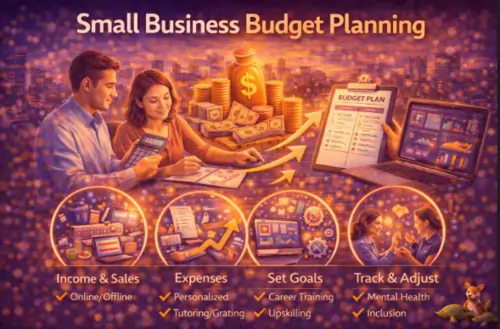
Small Business Budget Planning is not just about writing numbers in a notebook. It is about controlling your cash, protecting your business during slow months, and making smart decisions before problems happen.
In the Philippines, many small businesses close not because they lack customers—but because they run out of cash. Whether you run a sari-sari store, online shop, freelance service, café, or small agency, proper Small Business Budget Planning gives you stability.
What Is Small Business Budget Planning?
Small Business Budget Planning means creating a monthly financial plan that estimates:
- How much money will come in
- How much money will go out
- How much you can keep or reinvest
Let’s simplify three important terms:
Revenue
Total money you earn from sales.
Expenses
Money you spend to operate.
Profit
What remains after expenses.
But here’s something many business owners misunderstand:
Profit is not the same as cash.
You can show profit on paper but still struggle to pay suppliers if cash timing is wrong. That is why Small Business Budget Planning focuses heavily on cash flow.
Step 1: Know Your Fixed and Variable Costs
Before planning income, list your expenses clearly.
Fixed Costs (stay the same monthly)
- Rent
- Internet
- Salaries
- Subscriptions
- Loan payments
These costs determine your survival level.
Variable Costs (change based on sales)
- Inventory
- Delivery fees
- Platform commissions
- Advertising
- Utilities (sometimes)
Irregular Costs (often forgotten)
- Permit renewals
- Repairs
- Equipment replacement
- Annual subscriptions
Small Business Budget Planning requires you to divide expenses correctly. Many Filipino entrepreneurs underestimate irregular costs and then panic when renewals come.
Step 2: Estimate Realistic Revenue
Now estimate income.
Use past data if available:
- Last 3 months average
- Last year’s same month (for seasonal businesses)
Important rule:
Be conservative.
Overestimating revenue is one of the biggest Small Business Budget Planning mistakes. It creates fake confidence and leads to overspending.
If December sales are high, don’t assume January will match them.
Step 3: Calculate Your Break-Even Point
Break-even point means:
How much you must earn to cover all expenses.
Example:
If your total monthly expenses are ₱80,000, your sales must exceed ₱80,000 to start earning profit.
This number is powerful. It removes guessing.
Small Business Budget Planning becomes easier when you know your break-even target.
Step 4: Focus on Cash Flow Timing
This is where many small businesses fail.
Imagine:
You sold ₱200,000 worth of goods on credit.
But your supplier requires payment next week.
Your customers will pay after 30 days.
You are profitable—but broke.
Small Business Budget Planning must track:
- When money comes in
- When money goes out
Create a simple calendar view of payment schedules.
Also aim to build a buffer fund of at least 3 months of basic expenses if possible.
Step 5: Allocate Your Budget Smartly
There is no perfect percentage for all businesses, but a simple example structure:
- 40–50% Operations
- 20–30% Inventory/Cost of Goods
- 10–15% Marketing
- 5–10% Emergency Savings
- 5–10% Growth Fund
- Taxes allocation (set aside monthly)
Adjust depending on industry.
Small Business Budget Planning works best when categories are clear and consistent.
Budgeting for Growth vs Survival
There are two modes:
Survival Mode
Focus on covering fixed costs and maintaining steady cash.
Growth Mode
Reinvest in marketing, staff, expansion, new products.
Before expanding, ask:
- Is cash flow stable for 3–6 months?
- Do I have a safety buffer?
- Is demand proven?
Small Business Budget Planning prevents emotional expansion decisions.
Common Budgeting Mistakes Filipino SMEs Make
Mixing personal and business money
Always separate accounts.
Ignoring small expenses
Subscriptions and small daily costs add up.
Not setting aside taxes
When tax deadlines arrive, panic starts.
Buying too much inventory
Dead stock kills cash flow.
Not reviewing monthly
Small Business Budget Planning only works if reviewed regularly.
Tools for Small Business Budget Planning
You don’t need complicated software.
Simple options:
- Google Sheets
- Excel
- Basic accounting apps
- Notebook (if consistent)
What matters is discipline.
Set a weekly 30-minute money check.
Every month, compare projected vs actual results.
Budget Planning by Business Type
Online Sellers
Track:
- Ad spend
- Platform fees
- Inventory turnover
- Refunds/returns
Profit margins must cover advertising costs.
Service-Based Businesses
Time is your inventory.
Track:
- Billable hours
- Client payment delays
- Recurring vs one-time clients
Small Business Budget Planning in service businesses must focus on steady client pipelines.
Physical Retail
Monitor:
- Utility fluctuations
- Seasonal foot traffic
- Inventory shrinkage
- Supplier credit terms
Retail businesses need tighter inventory control.
Monthly Review Checklist
Every month, ask:
- Did I reach projected sales?
- Where did I overspend?
- What expense can I reduce next month?
- Did I set aside tax and savings?
- What is my current cash reserve?
This review keeps Small Business Budget Planning realistic.
Crisis Budget Planning
If sales suddenly drop:
- Cut non-essential expenses immediately
- Delay expansion plans
- Negotiate payment terms
- Improve cash collection
- Offer bundles or promotions
Small Business Budget Planning helps you respond calmly instead of emotionally.
Philippine Tax Awareness (High-Level)
Even small businesses must plan for taxes.
Set aside a percentage monthly so you are not surprised during filing season.
Budget also for:
- Business permit renewal
- Barangay clearance
- Government contributions if you have employees
Planning ahead prevents penalties.
Simple Budget Template Structure
Income Section
Total Sales
Other Income
Expense Section
Fixed Costs
Variable Costs
Irregular Costs
Net Profit
Income – Total Expenses
Cash Reserve Tracker
Current buffer
Target buffer
Growth Fund Allocation
Keep it simple. Complexity reduces consistency.
Why Small Business Budget Planning Is About Control
Budgeting is not about restriction.
It is about clarity.
When you know:
- Your break-even point
- Your cash schedule
- Your spending patterns
You make decisions confidently.
Small Business Budget Planning turns uncertainty into structure.
And structure builds survival.
FAQs
How much should a small business save monthly?
Aim for at least 5–10% toward emergency funds until you build 3 months of basic expenses.
What’s the difference between profit and cash flow?
Profit is income minus expenses on paper. Cash flow is the actual timing of money entering and leaving.
How often should I review my budget?
Weekly quick checks, monthly detailed reviews.
Should I pay myself a salary?
Yes. Treat yourself as part of fixed costs to avoid mixing personal and business money.
What if my sales are unpredictable?
Use conservative projections and build a larger emergency buffer.