

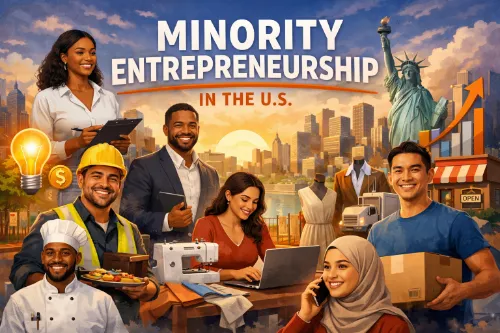
Minority entrepreneur has become an increasingly important part of the United States economy. Entrepreneurs from diverse racial, ethnic, and cultural backgrounds are launching innovative businesses, creating jobs, and contributing to economic growth across multiple industries. Over the past few decades, minority‑owned businesses have expanded rapidly, playing a critical role in strengthening local communities and promoting economic inclusion.
In the United States, minority entrepreneurs include business owners from groups such as African American, Hispanic or Latino, Asian American, Native American, and other underrepresented communities. These entrepreneurs are active in sectors ranging from technology and healthcare to retail, manufacturing, and professional services.
This article explores the growth of minority entrepreneurship in the U.S., examining its economic impact, challenges faced by minority business owners, available support programs, and future opportunities.
The Growth of Minority‑Owned Businesses
Minority‑owned businesses have experienced significant growth in the United States. According to the U.S. Census Bureau’s Annual Business Survey (ABS), minority entrepreneurs now represent a substantial portion of new business formation. The ABS reports that about 21% of all employer firms are minority‑owned, reflecting rapid expansion over the past decade.
Several factors have contributed to this growth:
- Increased access to education and professional training
- Expansion of digital platforms and e‑commerce
- Growing support networks, incubators and accelerators
- Government programs designed to promote inclusive economic development
Many minority entrepreneurs are launching startups in high‑growth industries, including technology, digital marketing, finance and healthcare. You can explore detailed data by race, ethnicity, industry and state through the ABS and tools such as Social Explorer’s ABS interface.
Economic Impact of Minority Entrepreneurship
Minority‑owned businesses contribute significantly to the U.S. economy by generating employment and fostering innovation.
Job Creation
Small businesses are among the largest job creators in the United States, and minority‑owned firms account for millions of jobs across industries. Pew Research Center’s “A look at Black-owned businesses in the U.S.” finds that Black‑owned employer firms increased their share of all U.S. businesses and boosted revenues by about 66% between 2017 and 2022, underscoring their growing economic role.
Community Development
Minority entrepreneurs often invest in their own neighborhoods by opening restaurants, retail stores, service firms and tech startups. An analysis from the American Edge Project, “Tech’s Role In Supporting A Vibrant Small Business Ecosystem”, highlights how digital tools help many minority‑owned small businesses reach new markets and strengthen local economies.
Innovation and Market Diversity
Minority entrepreneurs bring distinct cultural perspectives and experiences that often lead to innovative products and services targeted at underserved markets. This diversity of viewpoints increases competition and choice for consumers.
Economic data on small businesses and their contributions to GDP, employment and incomes can be explored via the U.S. Small Business Administration (SBA) and the Bureau of Economic Analysis (BEA):
- SBA overview (via USAFacts): What does the Small Business Administration (SBA) do?
- BEA main site: https://www.bea.gov
Key Industries for Minority Entrepreneurs
Minority‑owned businesses operate across nearly every sector, but some industries are especially attractive due to lower startup costs or high growth potential.
Technology and Digital Services
Technology is one of the fastest‑growing spaces for minority entrepreneurs, supported by lower infrastructure costs and cloud‑based tools. Examples include:
- Software development and IT services
- Digital marketing agencies
- Mobile‑app startups
- AI and data‑analytics solutions
Many of these firms are clustered in emerging tech hubs like Atlanta, New York, Miami and the Bay Area, aided by local accelerators and innovation programs.
Retail and E‑Commerce
Online retail platforms have removed many traditional barriers to entry, enabling minority entrepreneurs to launch e‑commerce brands without large physical storefronts. Platforms such as Shopify and Amazon Marketplace allow these businesses to serve customers nationwide and globally.
Food and Hospitality
Restaurants, food trucks and catering services are popular ventures among minority founders, often showcasing cultural cuisines and unique dining concepts that enrich local communities and tourism.
Professional and Business Services
Many minority entrepreneurs operate consulting firms, accounting practices, marketing agencies and legal or compliance services. These professional‑services businesses support other companies, including those in corporate and government supply chains.
Guides like the Library of Congress’ Business and Economic Surveys overview can help you locate detailed sector data on minority‑owned firms.
Challenges Facing Minority Entrepreneurs
Despite rapid growth, minority entrepreneurs still face structural hurdles that can limit business formation and scale.
Access to Capital
Limited access to capital is consistently cited as a primary challenge. Minority founders often struggle to obtain traditional bank loans or attract venture capital at the same rates as their non‑minority peers.
Networking and Mentorship
Professional networks, warm introductions and mentorship are crucial for raising capital and securing major contracts. Some minority entrepreneurs have fewer connections within established investment and corporate networks, which can slow their growth trajectory.
The article “10 Resources to Help Minority-owned Businesses Flourish” outlines practical ways founders can plug into mentorship, capital and advisory resources tailored to minority‑owned firms.
Market Barriers
Minority‑owned firms may face barriers related to:
- Accessing supply chains and procurement opportunities
- Navigating complex regulations without in‑house counsel
- Competing against larger, well‑capitalized corporations
Policymakers and advocacy groups emphasize targeted support programs and inclusive procurement policies as key tools to address these issues.
Government Programs Supporting Minority Businesses
The U.S. government operates several programs designed specifically to support minority entrepreneurship.
Minority Business Development Agency (MBDA)
The Minority Business Development Agency (MBDA) is the only federal agency solely dedicated to the growth and global competitiveness of minority‑owned businesses.
According to the MBDA’s mission overview on Wikipedia, the agency helps minority business enterprises access capital, contracts and markets. It runs a network of MBDA Business Centers and specialized initiatives that provide consulting, deal structuring and export assistance:
- MBDA programs and center network: https://www.mbda.gov/mbda-programs/
- MBDA main site: https://www.mbda.gov
In recent years, MBDA‑assisted clients have secured billions of dollars in financing and contracts and created or retained tens of thousands of jobs.
SBA 8(a) Business Development Program
The SBA 8(a) Business Development program is a nine‑year business‑development and federal‑contracting program for socially and economically disadvantaged small businesses, including many minority‑owned firms.
Participants in the 8(a) program can receive:
- Access to set‑aside and sole‑source federal contracts
- One‑on‑one business‑development assistance
- Entry into the SBA Mentor‑Protégé Program
- Training and support to build long‑term competitiveness
Full details and eligibility criteria are provided on the SBA’s 8(a) program page:
A Congressional Research Service report, “SBA’s 8(a) Business Development Program: Structure and Current Issues”, explains how the program works, including size and revenue limits, sole‑source thresholds, and graduation requirements. Consulting firms like CBH also provide SBA 8(a) Business Development Program consulting services to help firms apply and comply.
Community Development Financial Institutions (CDFIs)
Community Development Financial Institutions (CDFIs) provide capital and financial services to underserved communities, including many minority business owners. CDFIs typically offer:
- Small‑business loans and microloans
- Flexible underwriting criteria
- Technical assistance and financial education
You can learn more and search for certified CDFIs via the U.S. Treasury’s CDFI Fund:
These institutions play a key role in filling funding gaps where traditional banks may be less active.
The Role of Minority Business Organizations
Nonprofit organizations and advocacy groups are vital in providing training, certification and connections to minority entrepreneurs.
Examples include:
- National Minority Supplier Development Council (NMSDC)
- U.S. Hispanic Chamber of Commerce
- National Black Chamber of Commerce
- Asian American Chamber of Commerce
The National Minority Supplier Development Council helps minority‑owned firms secure corporate and government contracts by providing MBE certification, supplier‑diversity networking opportunities and business‑development programs:
- NMSDC main site: https://nmsdc.org
Academic resource pages like UCF’s Government Resources: Minority Business Development Agency summarize key federal and nonprofit organizations that minority founders can tap for support.
Success Stories of Minority Entrepreneurs
Numerous minority entrepreneurs have built influential companies in technology, media, financial services and consumer goods, demonstrating the potential of diverse leadership.
Brookings’ analysis “Driving prosperity: How Black-owned businesses fueled recent economic growth” shows that Black‑owned businesses significantly increased revenues and payroll in recent years, contributing to local prosperity in several metropolitan areas. Pew’s look at Black-owned businesses in the U.S. also highlights growth in firm counts and revenue across multiple sectors.
MBDA, NMSDC and SBA regularly publish case studies featuring founders who have leveraged government contracts, corporate supplier‑diversity programs and export opportunities to scale from microenterprises to multi‑million‑dollar businesses.
The Future of Minority Entrepreneurship
The future of minority entrepreneurship in the United States looks promising, with several trends supporting continued growth.
- Expansion of digital entrepreneurship: Remote work tools, online marketplaces and low‑cost software enable entrepreneurs to build businesses with minimal physical infrastructure.
- Increased venture‑capital focus on diverse founders: As Forbes notes in “The VC Landscape In 2025: Key Trends That Shaped The Year”, investors are launching more funds focused on underrepresented founders, particularly in AI and tech.
- Government and corporate support: Supplier‑diversity initiatives, 8(a) contracting, MBDA services and corporate DEI programs are creating new pathways for minority‑owned firms to participate in large value chains.
- Growth of community‑based innovation ecosystems: Programs spotlighted by the SBA Innovation Ecosystem – America’s Seed Fund and the SBA’s Innovation Ecosystem Summit are strengthening local support systems in cities nationwide.
With sustained effort to close capital, network and knowledge gaps, minority‑owned businesses are positioned to play an even larger role in future economic growth.
Strategies for Minority Entrepreneurs to Succeed
Minority entrepreneurs can increase their chances of success by focusing on several key strategies.
- Building strong networks: Engage with mentors, peer founders, local chambers and organizations such as NMSDC and MBDA Business Centers to access introductions, contracts and investment opportunities.
- Leveraging technology: Use digital marketing, e‑commerce platforms and cloud tools to scale faster and reach wider markets.
- Continuous learning: Take advantage of training offered by SBA resource partners, MBDA centers and local small‑business development centers to strengthen financial, legal and marketing skills.
- Accessing available resources: Explore SBIR/STTR grants via SBIR.gov, CDFI financing via cdfifund.gov, and 8(a) and MBE certifications to unlock government and corporate opportunities.
The article “10 Resources to Help Minority-owned Businesses Flourish” is a useful starting checklist of programs and organizations.
Conclusion
Minority entrepreneurship is a powerful driver of economic growth and innovation in the United States. With minority‑owned firms now representing around one in five employer businesses, their contributions to job creation, community development and market diversity are increasingly visible.
Although challenges such as access to capital and market barriers remain, expanding support from government programs (SBA, MBDA, CDFIs), private investors and minority business organizations (like NMSDC and national chambers) is helping more minority entrepreneurs succeed.
By leveraging technology, building strong networks and tapping into available resources—including the Annual Business Survey (census.gov/programs-surveys/abs.html), SBA (sba.gov), MBDA (mbda.gov), and the CDFI Fund (cdfifund.gov)—minority entrepreneurs will continue to shape the future of American business and innovation.