

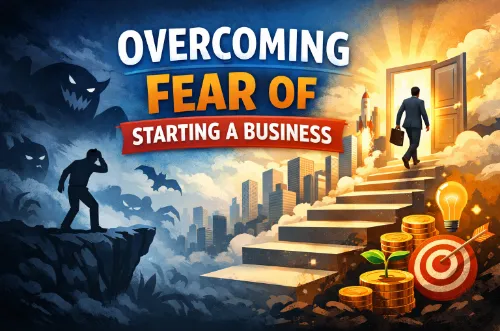
Entrepreneurial Fear is one of the biggest reasons people never start a business, even when they have solid ideas and skills. You don’t need to eliminate fear completely—you need to understand it, reduce the real risks, and learn to act even when you feel uncomfortable.
Why We Have Entrepreneurial Fear?
Typical fears before launching a business include:
- Fear of failure (losing money, “looking stupid,” or disappointing family).
- Fear of not being good enough or not knowing enough.
- Fear of rejection from customers, partners, or investors.
- Fear of uncertainty and leaving a stable job or routine.
13 Reasons People Don’t Start Businesses (and How to Overcome Them) – LivePlan shows how common these fears are, from financial worry to fear of imperfection. Academic work on fear of failure in entrepreneurship also finds that anticipated emotional pain and social judgment often matter as much as financial risk.
Step 1: Name Your Specific Fears
Fear feels bigger when it’s vague. Naming it makes it manageable.
Practical exercise:
- Write down the exact thoughts in your head (for example, “I’ll go broke,” “People will laugh,” “I don’t have what it takes”).
- For each one, ask: “What’s the worst that could realistically happen?” and “What can I do to reduce that risk?”.
- Separate facts (like current savings) from assumptions (like “nobody will buy”).
How to Overcome Fear and Start Your Own Business – AIContentfy recommends listing fears and challenging them with evidence and small action steps. How to Overcome the Fear of Starting Your Own Business – Quality Company Formations similarly begins with identifying specific worries instead of letting them stay as a general anxiety.
Step 2: Reduce Risk with Knowledge and Planning
A lot of fear comes from “I don’t know what I’m doing.” The more you understand your idea and numbers, the less scary it feels.
Ways to reduce risk:
- Research your market: talk to potential customers, study competitors, and validate that the problem is real.
- Create a simple, one‑page business plan or lean canvas to clarify your offer, pricing, and costs.
- Build a financial buffer (savings, part‑time work, or keeping your day job initially) to reduce money stress.
Overcoming Fear and Anxiety in Business – Enterprise Nation explains how information and planning directly calm anxiety. Overcoming Mental Barriers to Starting a Small Business – RISBDC stresses that fear is often a signal to prepare better—through research, planning, and realistic timelines.
Step 3: Start Small and Test Your Idea
You do not need to quit your job or invest everything on day one. Starting tiny is one of the most powerful ways to shrink fear.
Concrete steps:
- Treat your idea as a side hustle first and test it evenings/weekends.
- Pre‑sell a service, run a small pilot, or launch a simple landing page to gauge interest.
- Set a first micro‑goal (for example, “get 3 paying customers”) instead of fixating on a full‑time business immediately.
In 3 Ways To Overcome the Fear of Starting a Business – LinkedIn, Greg Bouhl emphasizes “start small, reduce risk, and test your idea” as a core strategy to move past paralysis. LivePlan also highlights starting part‑time and validating assumptions as key ways to ease into entrepreneurship.
Step 4: Reframe Failure and Build a Resilient Mindset
If you see failure as a final verdict on you, you’ll stay stuck. If you see it as feedback, you can keep going.
Mindset shifts:
- Expect small failures and mistakes; they are normal feedback, not proof you’re not “meant” for business.
- After something goes wrong, ask: “What did this teach me?” and “What’s my next best step?” instead of “What’s wrong with me?”.
- Replace perfectionism with “progress over perfection”; your first offer only needs to be good enough to test.
Unshakable: The Psychology Behind Fearless Entrepreneurship explains how cognitive reframing, self‑compassion, and gradual exposure to risk help entrepreneurs act despite fear. [How to overcome fear as an entrepreneur – Elite Business Magazine] (not in your list but consistent with these ideas) also focuses on reframing failure and building an “experiment” mindset.
Step 5: Build a Support System Around You
Trying to handle everything alone amplifies fear; sharing the journey reduces it.
Ways to build support:
- Join communities of founders (local meetups, Facebook groups, Reddit communities, or online programs).
- Find at least one mentor, coach, or experienced founder to discuss your plans with.
- Share your goals with supportive friends or family who will encourage you and keep you accountable.
6 Common Business Owner Fears (and How to Overcome Them) – GoDaddy recommends surrounding yourself with people who understand the entrepreneurial journey and can normalize your fears. The RISBDC article emphasizes using mentors and advisors to “right‑size” obstacles that feel overwhelming in your head.
Step 6: Use Simple Tools to Calm Anxiety
Sometimes fear is less about business facts and more about nervous system overload.
Helpful techniques:
- Breathing exercises (slow, deep exhales) when you feel overwhelmed.
- Journaling or brain‑dumping your worries to get them out of your head.
- Setting a 10–15‑minute timer to do just one tiny task instead of thinking about the whole business.
How to Overcome Fear and Start Your Own Business – AIContentfy suggests pairing mindset work with simple routines like journaling, movement, and micro‑tasks to gradually build courage. Enterprise Nation likewise highlights practical self‑care and anxiety tools as part of overcoming fear in business.
Step 7: Take the First Small Step (Then the Next)
Fear shrinks when you move. You rarely feel 100% ready; confidence grows from action, not the other way around.
Possible first steps:
- Talk to one potential customer this week and ask about their problems.
- Publish a very simple landing page describing your offer and share it with your network.
- Register a domain, secure social handles, or draft your first service/package outline.
LivePlan and LinkedIn both emphasize that “doing something small now” is the most reliable way to build momentum. AIContentfy encourages celebrating each small step as evidence that you’re becoming the kind of person who acts despite fear.