

The DJI Osmo Pocket 4 is a pocket‑sized 3‑axis gimbal camera built around a 1‑inch sensor, designed to deliver stabilized 4K video with higher dynamic range, better low‑light performance, and powerful slow‑motion options than typical smartphones. It offers high‑frame‑rate 4K recording, a 10‑bit log‑style color profile for flexible grading, advanced subject tracking for solo shooters, generous internal storage, and strong battery life in a device that weighs under 200 g. This makes it especially attractive to vloggers, travelers, educators, and social media creators who want cinematic footage in a grab‑and‑go form factor without the complexity of a full interchangeable‑lens camera system.
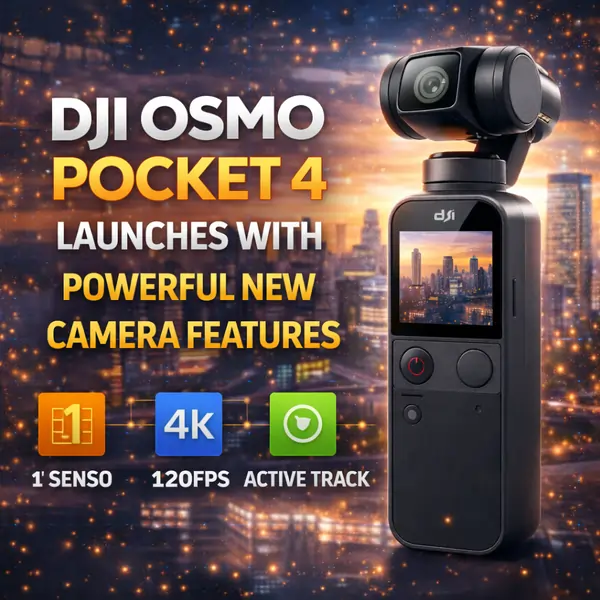
The DJI Osmo Pocket 4 has officially launched, bringing serious upgrades to DJI’s iconic pocket‑sized gimbal camera line. It’s designed for creators who want stabilized, cinematic‑looking video without carrying a full camera rig or learning complex systems.
If you’re a vlogger, travel creator, educator, or anyone who simply wants better video than a smartphone can produce, the DJI Osmo Pocket 4 aims to be your always‑with‑you camera. This in‑depth guide walks you through its new camera features, real‑world benefits, who it’s best for, and how to get the most from it.
What’s New in the DJI Osmo Pocket 4
The DJI Osmo Pocket 4 continues the concept of a tiny handheld camera mounted on a 3‑axis gimbal, but it pushes the hardware and software much further than previous generations.
Key themes for this model:
- Higher‑end image quality in a truly pocket‑able form
- More powerful slow‑motion and video options
- Smarter, more reliable subject tracking
- Longer battery life and improved usability
Where older pocket cameras felt like compromises, the Pocket 4 aims to be a serious tool that just happens to be extremely small.
DJI Osmo Pocket 4 Key Specs at a Glance
Below is a concise spec snapshot you can reuse in product descriptions or comparison sections.
| Feature | DJI Osmo Pocket 4 (Core Specs) |
|---|---|
| Sensor | 1‑inch CMOS |
| Lens | ~20 mm equivalent, wide‑angle, fast |
| Max Video Resolution | Up to 4K with high frame‑rate options |
| Slow Motion | High‑frame‑rate 4K slow motion |
| Color / Profiles | 10‑bit log profile + standard profiles |
| Dynamic Range | High (designed for more highlight detail) |
| Stills Resolution | High‑resolution photo capture |
| Stabilization | 3‑axis mechanical gimbal |
| Tracking | Advanced subject/face tracking system |
| Display | Bright color touchscreen |
| Storage | Large internal storage, fast offload |
| Connectivity | USB‑C, wireless connectivity |
| Battery Life | Several hours of video in optimal modes |
| Weight | Under 200 g (pocket‑friendly) |
Exact numbers (like bitrates or capacity) can vary by region and firmware, but the overall positioning is clear: this is a compact gimbal camera meant to rival or beat smartphone video in most conditions.
Image Quality: Sensor, Resolution, and Dynamic Range
A larger sensor in a tiny body
At the heart of the DJI Osmo Pocket 4 is a 1‑inch sensor—significantly larger than typical smartphone sensors and many action cameras in the same size class. A larger sensor matters because it usually brings:
- Better low‑light performance
- Cleaner shadows and less noise
- More natural highlight roll‑off
- Greater flexibility when editing
For creators, that means evening city scenes, indoor vlogs, and sunrise/sunset shots will look cleaner and more cinematic compared to footage from many phones.
Sharp video and detailed stills
The DJI Osmo Pocket 4 outputs detailed 4K video plus high‑resolution still photos. This lets you:
- Capture vlogs and talking‑head content with a “real camera” look
- Pull still frames from video for thumbnails or social posts
- Use a single device for both quick photos and polished video
In practice, you can walk through a market, record everything in 4K, then later pull frame‑grabs for your blog or Instagram.
Dynamic range and log profile
Dynamic range describes how well a camera can capture detail in both very bright and very dark areas of the same scene. The Pocket 4 is built to provide high dynamic range, which helps preserve:
- Clouds and sky detail instead of pure white
- Shadow detail in faces and foreground objects
- More flexible footage for color grading
On top of that, it offers a 10‑bit log‑style profile (DJI’s version of D‑Log or a flat profile). Shooting in log:
- Captures more tonal detail
- Gives you more headroom to correct exposure and color
- Reduces banding in gradients like skies and sunsets
If you’re not into heavy editing, you can use standard color profiles out of the box. But if you want your footage to match other cameras in a multi‑cam setup, the log profile is a major advantage.
Video Performance: 4K Slow Motion, Bitrates, and Codecs
High‑frame‑rate 4K slow motion
One of the standout upgrades of the DJI Osmo Pocket 4 is its high‑frame‑rate 4K recording. This lets you record 4K video at higher frame rates than typical consumer gear, then slow it down in post for smooth, cinematic slow motion.
In practical terms, this helps you:
- Turn simple actions (waves, hair flips, traffic, pouring coffee) into visually engaging B‑roll
- Capture sports, dance, or fast action with extra clarity
- Add dramatic cutaways to travel or documentary‑style edits
You can record your main narrative at a normal frame rate (24–30 fps), then use the Pocket 4’s slow‑mo capabilities to elevate your transitions and scene changes.
High bitrates and creator‑friendly formats
The DJI Osmo Pocket 4 records at solid bitrates with modern codecs, which matters more than many beginners realize. Higher bitrate video:
- Preserves fine detail (hair, foliage, textures)
- Survives heavy YouTube/TikTok/Instagram compression better
- Gives you more slack when color grading or adding effects
If you’d like to understand the fundamentals of how bitrates and compression affect image quality, you can explore foundational resources from standards bodies like the National Institute of Standards and Technology (NIST), which often publish accessible explanations of digital media and encoding concepts.
Stabilization and Advanced Tracking
Mechanical 3‑axis gimbal stabilization
Software‑only stabilization has improved on phones, but a physical 3‑axis gimbal still offers a more natural, controlled look—especially when you are moving. The DJI Osmo Pocket 4 mounts its camera on a mini gimbal that actively compensates for:
- Walking and running motion
- Hand shake
- Panning and tilting
This leads to:
- Smoother walking vlogs
- Less warping and “jello” compared to purely digital stabilization
- Graceful movement even in busy environments
You can power it up and immediately walk and talk, with the camera gliding along instead of bouncing with every step.
Advanced subject tracking for solo creators
A big reason creators love this series is its subject tracking. The DJI Osmo Pocket 4 continues with an advanced face and subject tracking system (often referred to in marketing as ActiveTrack). It can:
- Lock on to a face and keep it centered as you move
- Follow you as you walk around a room or outdoor space
- Recover from brief occlusions (someone walking between you and the camera, etc.)
For solo creators, this means you can set the Pocket 4 on a mini tripod, tap to focus on yourself, and then move naturally while the camera keeps you framed. It’s like having a mini camera operator in your pocket.
Design, Controls, and Everyday Usability
Compact, one‑handed form factor
The DJI Osmo Pocket 4 keeps the vertical, hand‑friendly design of earlier models. It’s:
- Small enough to slip into a jacket or small bag
- Light enough to hold for extended vlogs
- Easy to use one‑handed while walking
For travelers and daily vloggers, that matters more than it might seem; you’re far more likely to capture spontaneous moments if your camera setup doesn’t feel like a burden.
Bright touchscreen and improved controls
The Pocket 4 includes a bright color touchscreen, making it easier to:
- Compose shots even in daylight
- Swipe between modes quickly
- Adjust key settings (resolution, frame rate, tracking, exposure) without diving through cryptic menus
Physical buttons handle core actions like record, mode switching, and gimbal recentering so you can operate by feel when needed.
Storage, Connectivity, and Battery Life
Large internal storage (and what it means for you)
Instead of relying solely on microSD cards, the DJI Osmo Pocket 4 offers generous internal storage with fast data speeds. This design has pros and cons:
Advantages:
- You can start recording even if you forgot to bring or buy a memory card.
- High‑bitrate 4K and slow motion is less likely to be bottlenecked by a slow SD card.
- Offloading footage over USB‑C can be very fast.
Considerations:
- You’ll need a habit of regularly offloading footage to your laptop, external SSD, or cloud.
- If you fill the internal storage on a full‑day shoot, you must make space before continuing.
For most creators, the convenience of always‑ready internal storage outweighs the limitations, as long as you have a simple workflow for offloading.
Wired and wireless connectivity
The Pocket 4 supports modern connectivity options, typically including USB‑C for wired transfer and charging and wireless connectivity (e.g., Wi‑Fi) for remote control, previews, and quick sharing. This lets you:
- Offload footage quickly to your editing machine
- Use your phone as a larger monitor in tight or tricky angles
- Control recording remotely (useful for talking‑head setups)
Battery life built for real‑world shooting
Battery performance will vary depending on frame rate, resolution, screen usage, and wireless connectivity, but the DJI Osmo Pocket 4 is designed to offer several hours of recording under efficient settings. Many creators can comfortably shoot:
- Multiple vlogs in a single day
- A full afternoon of B‑roll and travel footage
- Events, tours, or educational content sessions with strategic breaks
Fast charging via USB‑C power delivery also means you can top up between locations—very useful for travel and event work.
DJI Osmo Pocket 4 vs Previous Pocket Models
If you’ve used earlier Pocket models, you’re probably wondering how big the jump really is. While specifics vary by generation, the DJI Osmo Pocket 4 generally brings:
- A more capable 1‑inch sensor for cleaner, more cinematic footage
- Higher frame rates at 4K for dramatic slow motion
- Improved dynamic range and a richer log profile for grading
- More robust subject tracking for solo shooters
- Larger, faster internal storage instead of relying entirely on microSD
- Improved battery life and responsiveness
Quick comparison summary
| Aspect | Older Pocket Models | DJI Osmo Pocket 4 |
|---|---|---|
| Sensor size | Smaller sensors | 1‑inch sensor |
| Max 4K frame rate | Lower slow‑mo options | High‑frame‑rate 4K slow motion |
| Dynamic range | Good for casual use | Higher, better for grading |
| Color depth | 8‑bit / limited log options | 10‑bit log‑style profile available |
| Storage | microSD only | Large internal storage (no card needed) |
| Tracking | Early tracking versions | More advanced face/subject tracking |
| Battery / charging | Shorter runtime | Longer runtime, faster charging |
If you mostly shoot simple clips for social media and already have a recent model, upgrading may be optional. But if you want better low‑light, higher‑end slow motion, and more flexibility in editing, the Pocket 4 is a substantial upgrade.
Who the DJI Osmo Pocket 4 Is Best For
The DJI Osmo Pocket 4 is versatile, but it shines most in certain scenarios.
Vloggers and YouTubers
- Stabilized walking and talking shots with minimal fuss
- Better image quality than most phones, especially in low light
- Easy framing of yourself via tracking when you’re shooting solo
Travel and adventure creators
- Ultra‑portable setup that still delivers high‑end 4K footage
- Slow‑motion capabilities that make everyday scenes look cinematic
- No need to carry heavy gimbals or lenses
Educators, coaches, and online course creators
- Perfect for stand‑up explainer videos and classroom walk‑throughs
- Tracking makes it possible to walk around a whiteboard or workshop area while staying framed
- Easy to set up quickly, so you focus on teaching instead of gear
Social media creators (Reels, Shorts, TikTok)
- Crisp, stabilized vertical or horizontal footage
- Slow‑motion clips that stand out from standard phone content
- Footage that holds up better after multiple platform compressions
Professionals needing a B‑camera
- Great as a discreet B‑roll or behind‑the‑scenes camera
- Easy to mount in tight spaces for unique angles
- Log profile and dynamic range make it easier to match with larger cameras in post
Pro Tips & Expert Insights for Creators
1. Use high‑frame‑rate modes selectively
High‑frame‑rate 4K is incredible for certain shots but unnecessary for everything. To manage storage and editing workloads:
- Use standard frame rates (24/25/30 fps) for talking‑head and narrative segments.
- Reserve high‑frame‑rate slow motion for key B‑roll moments (water, sports, fast action, transitions).
2. Shoot in log when you need flexibility
If you know you’ll be editing on a computer and want a cinematic look:
- Enable the log profile for high‑contrast scenes (bright sun, mixed lighting).
- Slightly protect highlights (don’t overexpose the sky).
- Apply a LUT or basic grading in your NLE to bring back contrast and saturation.
For “shoot, edit on phone, and upload today” workflows, a standard color profile is usually easier.
3. Build a simple offload habit
Because the Osmo Pocket 4 leans on internal storage:
- Offload at the end of each shooting day to a laptop or external SSD.
- Keep a dedicated folder structure per project or trip.
- Consider backing up important shoots to a second drive or cloud.
This keeps your camera ready to go at all times and reduces the risk of running out of space mid‑shoot.
4. Exploit tracking for one‑person productions
When filming yourself:
- Place the Pocket 4 on a small tripod at about chest or head height.
- Enable face/subject tracking and confirm it’s locked on.
- Walk, gesture, and teach as if a camera operator is following you.
This is especially powerful for educators, fitness coaches, and presenters who need to move while demonstrating.
5. Invest in audio early
Video quality is important, but audio quality often matters more to viewers. If you plan to publish regularly:
- Consider a small wireless mic or external audio solution compatible with your setup.
- Monitor levels when possible and record in relatively quiet spaces.
You can find general guidance on media and technology fundamentals through educational resources like MIT OpenCourseWare, which hosts free university‑level courses that help you better understand sound, image, and storytelling.
6. Think about safety and digital security
As you share more content and carry gear in public, it’s wise to understand online safety and device security. Government resources such as StaySafeOnline.gov provide practical advice on protecting your accounts, devices, and personal information—a crucial layer when your camera and content become central to your work.
Frequently Asked Questions (FAQ)
What is the DJI Osmo Pocket 4?
It’s a compact handheld camera with a built-in 3-axis gimbal, designed to deliver stabilized 4K video and high-quality audio in a pocket-sized body.
What’s the main advantage of the 1-inch sensor?
A 1-inch sensor provides better low-light performance, improved detail, and greater dynamic range compared to smaller sensors found in smartphones and action cameras.
Does the DJI Osmo Pocket 4 shoot 4K slow motion?
Yes, it supports high-frame-rate 4K recording, allowing smooth and cinematic slow-motion footage.
Is the DJI Osmo Pocket 4 good for vlogging?
Yes. With strong stabilization, face tracking, a wide lens, and good low-light capability, it’s ideal for solo vloggers.
Can I use the DJI Osmo Pocket 4 for professional work?
Yes, it’s suitable for YouTube, social media, event B-roll, and educational content—especially when using log profiles and good audio setups.
Do I need to know color grading to use the log profile?
Basic knowledge helps, but you can use LUTs in software like DaVinci Resolve or Adobe Premiere Pro to simplify the process.
Does the DJI Osmo Pocket 4 replace a smartphone camera?
Not entirely, but for stabilized video and low-light shooting, it often outperforms many smartphones.
Is the Osmo Pocket 4 easy for beginners?
Yes. You can start with automatic settings and gradually explore manual controls and advanced features.
How long can I record on a single charge?
You can typically record for several hours under normal settings, though high-frame-rate 4K and wireless features reduce battery life.
Does the DJI Osmo Pocket 4 support external microphones?
Yes, depending on accessories, you can connect wireless microphones or compatible audio gear.
Is there a microSD card slot?
The device focuses on internal storage, meaning you’ll rely on built-in memory and regular file transfers.
Can I live stream with the DJI Osmo Pocket 4?
Yes, live streaming is possible through DJI’s app and wireless connectivity, depending on firmware support.
Is the DJI Osmo Pocket 4 waterproof?
No, it’s not fully waterproof. Use protective housing if filming in wet or underwater environments.
Can I use the DJI Osmo Pocket 4 as a webcam?
Some models support webcam functionality via USB-C, depending on firmware and system compatibility.
Is the DJI Osmo Pocket 4 good for travel?
Yes. Its compact size, light weight, and stabilized video make it an excellent travel camera.
How does it compare to an action camera?
Action cameras are more rugged and often waterproof, while the Pocket 4 offers a mechanical gimbal and larger sensor for more cinematic footage.
Is the DJI Osmo Pocket 4 suitable for filmmaking students?
Yes, it’s a great learning tool for composition, movement, and storytelling. Resources like MIT OpenCourseWare can help build skills.
What editing software works best with Pocket 4 footage?
Editors like DaVinci Resolve, Adobe Premiere Pro, and Final Cut Pro support its formats and log workflows.
Do I need a gimbal if I have the Pocket 4?
No, it already includes a built-in mechanical gimbal for stabilization.
Is the DJI Osmo Pocket 4 a good first “real camera”?
Yes. It’s beginner-friendly yet powerful enough to produce professional-looking video, making it a great entry point into dedicated cameras.
Conclusion
The DJI Osmo Pocket 4 takes the “tiny camera, big results” idea and pushes it further with a larger sensor, high‑frame‑rate 4K slow motion, advanced tracking, and a creator‑friendly design. It offers a clear step up from smartphone video, especially when stability, low‑light performance, and dynamic range matter for modern content creation.
If you’re serious about elevating your content but don’t want the complexity of interchangeable‑lens cameras, the Osmo Pocket 4 is an excellent candidate for your primary or secondary camera. Your next move: clarify how you plan to use it—vlogging, travel, courses, social, or client work—then choose the bundle (basic or creator‑style kit) that delivers the accessories you’ll actually use. Once you have it, start with auto modes, learn basic framing and movement, and gradually explore log profiles and advanced tracking to unlock everything the DJI Osmo Pocket 4 can do for your content.
For creators who also want to stay ahead of how AI is reshaping the creative workflow—from ideation and scripting to editing and automation—it’s worth reading Claude AI and the Rise of Creative Agents in the Digital Age, which explores how next‑generation AI tools are changing the way digital storytellers plan, produce, and scale their work online.