

The Geelong Oil Refinery, operated by Viva Energy in Corio, Victoria, is one of only two remaining oil refineries in Australia and supplies a large share of Victoria’s petrol, diesel and jet fuel. In 2026, major fire incidents at the site disrupted petrol and LPG production and highlighted how dependent Australia has become on a small number of domestic refineries and imported fuel.
At the same time, Viva Energy is investing heavily in upgrades such as an ultra‑low sulphur gasoline (ULSG) plant and the broader Geelong Energy Hub to deliver cleaner fuels and strengthen long‑term fuel security. For motorists, businesses and policymakers, these developments mean heightened short‑term price and supply risk, but also a clearer pathway toward a more resilient and lower‑emissions transport fuel system.
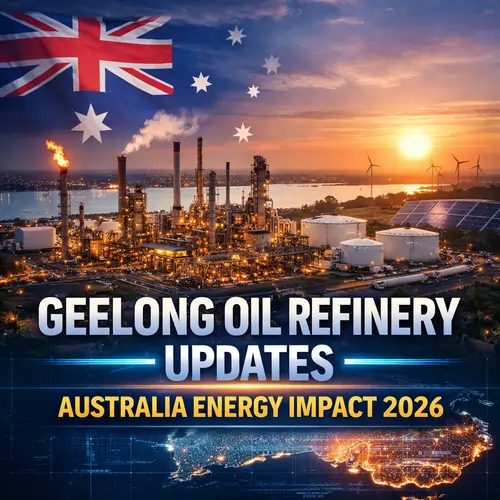
The Geelong Oil Refinery is at the centre of Australia’s energy story in 2026, with recent fires, major upgrades, and fuel security worries converging on a single critical asset. As one of only two remaining oil refineries in the country, any operational shock at Geelong quickly ripples through petrol prices, diesel supply, and national energy policy.
This long‑form guide walks through the latest Geelong Oil Refinery updates, explains how the plant fits into Australia’s fuel system, and unpacks what the current disruptions and investments mean for households, businesses, and policymakers in 2026. You’ll also see how Geelong’s evolution into a modern energy hub connects to Australia’s broader shift toward cleaner fuels and electrification.
Why the Geelong Oil Refinery Matters in 2026
The Geelong Oil Refinery is a major petroleum refinery based at Corio near Geelong in Victoria and operated by Viva Energy. It is one of just two oil refineries left in Australia as of 2026 and plays a pivotal role in domestic fuel production, supplying a large share of Victoria’s petrol, diesel, jet fuel and other refined products, and contributing a significant portion of national fuel demand.
Because Australia has steadily shifted from local refining to imported refined products, the relative importance of Geelong has grown. When this single refinery encounters problems—whether from fire, mechanical fault, or planned maintenance—the effects can be felt quickly through tighter supply, higher price volatility, and renewed concerns around energy security and resilience.
Key reasons the Geelong Oil Refinery is strategically important include:
- It supplies a large share of Victoria’s road transport fuel.
- It contributes a meaningful amount of Australia’s overall refined fuel.
- It produces a wide range of fuels and feedstocks, from petrol and diesel to jet fuel, LPG and industrial inputs.
- It anchors hundreds of direct jobs and many more across the wider supply chain.
In short, when you read about the “Geelong Oil Refinery” in 2026, you are not just reading about one industrial site—you are looking at one of the critical pillars of Australia’s fuel system.
Key 2026 Updates: Fires, Upgrades, and Production
Major fire incidents and operational disruption
In April 2026, a major fire broke out at the Geelong Oil Refinery, with flames reportedly reaching tens of metres into the air and dozens of firefighters deployed to bring the blaze under control. According to detailed coverage from ABC News, the fire affected units involved in LPG and low‑aromatic gasoline production, prompting safety cordons, air‑quality monitoring, and temporary shutdowns of connected systems.
Key immediate impacts included:
- Sharp disruption to petrol‑related production capacity.
- Continued but constrained output of diesel and jet fuel from unaffected units.
- Local safety advisories and emergency responses across the Geelong area.
International outlets, including the BBC’s report on the Geelong fire, noted that the incident hit one of only two remaining Australian refineries, amplifying concerns over national fuel supplies. The federal energy minister publicly warned that the fire was likely to have a larger impact on petrol than on diesel or jet fuel, reinforcing the view that Australia remains highly exposed to refinery‑level shocks.
Market response, trading halts, and margins
Following an earlier 2026 blaze, Viva Energy temporarily halted trading of its shares while it assessed damage and prepared an update for investors on expected impacts to refinery runs and earnings. Market commentary highlighted uncertainty around:
- The duration of any outages.
- Changes to refinery utilisation rates.
- Forward expectations for refining margins once key units resume operation.
Despite the immediate disruption, the company has also signalled expectations of stronger performance later in 2026, once major maintenance and upgrades are fully commissioned and refinery runs can increase under more favourable margin conditions.
Ongoing upgrade program and energy‑hub vision
Alongside fire‑related disruptions, Viva Energy has been executing a substantial upgrade program at Geelong aimed at modernising the plant and aligning it with future fuel quality standards. The centrepiece is the ultra‑low sulphur gasoline (ULSG) upgrade, which allows the refinery to produce cleaner petrol that meets tighter environmental rules; Viva details the project in its “New plant delivers cleaner fuel” update on the ULSG project.
This program sits within a broader Geelong Energy Hub concept that includes:
- New ULSG processing units and modules.
- Enhancements to aromatics and related fuel properties.
- Additional infrastructure for storage, import/export, and future alternative energy projects.
Combined, these investments are part of a multi‑year capital program totalling around A$1 billion to upgrade and diversify the Geelong site.
How the Geelong Oil Refinery Works
Core processing and capacity
According to Viva’s official overview of our Geelong Refinery, the facility processes up to around 120,000 barrels of crude oil per day under normal operating conditions. This crude is imported and then separated and upgraded into various refined products through distillation columns, crackers, reformers, and hydrotreaters.
From this crude input, Geelong produces:
- Petrol (gasoline) for cars and light vehicles.
- Diesel for freight, agriculture, mining and some passenger vehicles.
- Jet fuel and avgas for aviation.
- LPG for households, industry and transport.
- Marine fuel oil for shipping.
- Low‑aromatic gasoline for specific social and health programs.
- Chemical feedstocks used in plastics and polymer banknotes.
Because distinct processing units handle different parts of this product slate, a fire or outage in one area can have a disproportionate impact on specific fuels while leaving others relatively less affected.
Integration into Australia’s fuel network
Geelong sits within a national energy system that includes the country’s only other operating refinery, multiple import terminals, and long‑distance distribution networks by pipeline, road, and rail. With several historic refineries having closed or converted to import terminals, Australia now relies heavily on overseas refining capacity and shipping, while the remaining refineries provide important—but limited—domestic production buffers.
Policy frameworks like the Australian Government’s Fuel Security Package, outlined by the Department of Climate Change, Energy, the Environment and Water (DCCEEW), are designed to underpin this system by improving stockholding and supporting critical refining assets. Readers can explore the government’s fuel security measures via the official energy and fuel security pages on energy.gov.au or related DCCEEW resources.
Fuel Supply: Victoria and National Impact
Short‑term effects on petrol, diesel and jet fuel
ABC’s explainer on what we know about the Viva Energy refinery fire notes that petrol production is likely to bear the brunt, while diesel and jet fuel output can continue in some capacity from unaffected parts of the plant. Market commentary compiled by outlets like MarketWatch also emphasises that gasoline and LPG supply are particularly exposed, whereas diesel and jet fuel appear more resilient.
In practical terms, the short‑term impacts include:
- Reduced domestic petrol output from Geelong until damaged units are repaired.
- Some constraints on LPG and low‑aromatic gasoline supplies.
- Increased reliance on imported refined products, especially petrol.
Existing inventories at the refinery, at independent terminals and within distribution networks provide a buffer, but if the outage is prolonged or coincides with tight global markets, pressure on imports and storage rises.
Price dynamics at the pump
Fuel prices in Australia are shaped by international refined product benchmarks (such as the Singapore price), the Australian dollar, taxes, distribution costs, and retail competition. Incidents like the Geelong fire add another layer by influencing local supply–demand balances.
The federal government and ACCC monitoring typically focus on ensuring that price movements reflect genuine cost pressures rather than opportunistic gouging. SBS reporting on the incident captures the government’s line that the blaze is a “setback” but that efforts are underway to secure alternative supplies and manage impacts. Over time, the degree to which prices rise or stabilise will depend on how long the refinery is constrained and how quickly importers can respond.
Broader national fuel security implications
Australia’s reliance on imports and a small number of domestic refineries has long been flagged as a vulnerability by independent analysts and commentators, including energy experts writing for The Conversation. The Geelong incident brings these concerns back to the forefront by showing how quickly a fire at a single site can force governments to discuss fuel reserves, stockholding obligations, and strategic diversification.
Key risks highlighted include:
- Concentration risk from only two refineries.
- Geopolitical risk affecting global fuel flows.
- Limited redundancy in domestic refining and storage infrastructure.
This is precisely why policy initiatives such as the Fuel Security Package and government co‑funding for critical refinery upgrades have been introduced in recent years.
Environmental and Ultra‑Low Sulphur Fuel Upgrades
Why ultra‑low sulphur petrol matters
Viva Energy’s ULSG project at Geelong, described in its “New plant delivers cleaner fuel” feature, enables the refinery to produce petrol with much lower sulphur content than older specifications. Ultra‑low sulphur fuels significantly reduce emissions of sulphur oxides and fine particulates and are necessary to support the latest vehicle emissions‑reduction technologies.
The project includes:
- A new hydrotreater and associated units to strip sulphur from gasoline streams.
- Modifications to aromatics handling to meet stricter fuel quality parameters.
- A combined investment of around A$350 million for ULSG and related upgrades, with around A$150 million contributed by the Commonwealth government.
By producing ultra‑low sulphur petrol domestically, Geelong aligns with tighter national fuel standards and helps reduce reliance on imported compliant fuels.
Geelong Energy Hub: looking beyond traditional refining
The Geelong Energy Hub concept positions the refinery as part of a broader integrated energy precinct rather than a standalone fuel plant. Viva Energy has proposed or commenced projects including:
- Modernised refining operations centred on cleaner fuels like ULSG.
- Expanded storage and import/export capacity to strengthen fuel security.
- The groundwork for future lower‑carbon energy projects on or near the site.
For policymakers, this aligns with the dual objectives reflected in federal strategies: improving fuel security in the near term while steering the energy system toward lower emissions over time.
Energy Security Risks Revealed in 2026
Single‑point‑of‑failure risk
The Geelong Oil Refinery fire is a live example of what happens when a system has limited redundancy. With only one other refinery operating nationally, any prolonged Geelong outage forces Australia to lean heavily on imported fuel and on a single remaining domestic plant.
Analyses in outlets such as The Conversation argue that this makes Australia “too exposed to energy shocks”, especially during periods of international instability. The lesson is clear: while imported fuel will remain a big part of the mix, onshore infrastructure and stockholding are critical risk‑management tools.
Balancing resilience and transition
Australia’s long‑term climate and energy goals, set out across various federal planning documents and DCCEEW frameworks, call for rapid decarbonisation of transport, industry, and electricity. Yet the country will depend on liquid fuels for many years, particularly in heavy transport, aviation, agriculture, and mining.
The Geelong experience underlines the need to:
- Preserve and modernise critical fuel infrastructure while it remains needed.
- Build strategic reserves and diversify supply chains.
- Accelerate investments in EVs, public transport, and alternative fuels to gradually reduce exposure.
Policy directions to watch
Public statements following the Geelong incident, including those captured by SBS and ABC, suggest that future policy tweaks may focus on:
- Reviewing minimum fuel stockholding requirements.
- Calibrating support for refineries that undertake key security‑aligned upgrades (like ULSG).
- Integrating fuel security planning with EV rollout, hydrogen strategy, and sustainable aviation fuel initiatives.
For current and prospective investors, government signals around refining support, emissions standards, and decarbonisation targets will shape the risk–return profile of assets like Geelong.
What It Means for Consumers and Businesses
Households and individual motorists
For everyday drivers, events at the Geelong Oil Refinery are most visible through pump prices and media reports about potential shortages. While governments and companies aim to avoid actual outages, temporary or regional tightness can occur, especially if incidents overlap with high global prices.
Practical steps for motorists include:
- Following accurate updates from ABC, SBS and government channels rather than social media rumours.
- Avoiding panic buying and “just in case” hoarding, which can worsen local supply stress.
- Considering future vehicle choices with fuel efficiency and EV options in mind as budgets allow.
Businesses, transport and logistics
Transport, logistics and aviation are among the most exposed sectors because fuel is a core input cost. Coverage in Australian Aviation, for example, notes that the Geelong fire could have a larger impact on avgas than jet fuel, with implications for general aviation operators.
- Diversifying fuel suppliers and terminal access rather than relying solely on Geelong‑linked supply chains.
- Building fuel price and availability scenarios into financial planning.
- Investing in fuel‑efficiency measures, telematics and route optimisation to cut consumption.
- Assessing where EVs or alternative fuels are viable in the medium term.
Impact on the Geelong region and workforce
Locally, the refinery is a major employer and a cornerstone of Geelong’s industrial base. Viva Energy’s Geelong operations page highlights its role in supporting around 700 direct jobs plus many more indirectly. Fire incidents create understandable concerns around safety and environmental impacts, but ongoing modernisation and the Energy Hub vision also signal long‑term commitment and potential new opportunities.
As projects progress, the site may host:
- New technical roles in advanced process engineering and energy systems.
- Partnerships with training providers and universities.
- Ancillary work across construction, maintenance and technology.
Pro Tips and Expert Insights
For informed citizens and motorists
- Follow authoritative sources first. Rely on outlets like ABC News and SBS for clear, evidence‑based updates on the Geelong fire and fuel supply rather than unverified social media posts.
- Avoid panic buying. The ACCC and energy officials consistently warn that panic buying can create artificial shortages and rarely leads to meaningful savings.
- Plan ahead for efficiency. Use this moment to benchmark your fuel use and plan future upgrades to more efficient or electric vehicles as market options and infrastructure improve.
For businesses and fleet operators
- Diversify your risk. Where possible, secure contracts that allow sourcing from multiple terminals and suppliers, not just those tied directly to Geelong.
- Scenario‑test your fuel exposure. Model what happens if prices spike for three to six months or if certain fuels become constrained, and bake these outcomes into budgets and pricing strategies.
- Invest ahead of the curve. Fuel‑efficient fleet upgrades, driver training, telematics and early EV pilots can pay off in both cost savings and reduced exposure to future supply shocks.
For policymakers and energy professionals
Communicate clearly. Transparent communication about incidents, risks and responses, through government portals such as energy.gov.au, helps maintain public trust and avoids counterproductive behaviour.
Treat Geelong as both risk and opportunity. Its current vulnerabilities underline the importance of redundancy and stockholding, but its upgrades and hub concept show how legacy assets can support a cleaner, more resilient system.
Align fuel security with transition policy. Tie Fuel Security Package measures and refinery support to clear decarbonisation milestones so that investments advance both reliability and emissions goals.
Frequently Asked Questions (FAQ)
What is the Geelong Oil Refinery?
The Geelong Oil Refinery is a major petroleum refinery located in Corio, near Geelong in Victoria. It processes imported crude oil into petrol, diesel, jet fuel, LPG, and other products that supply a large share of Victoria’s fuel demand.
Who owns and operates the Geelong Oil Refinery?
Viva Energy owns and operates the refinery, along with associated terminals and retail networks across Australia.
What happened at the Geelong Oil Refinery in 2026?
In 2026, the refinery experienced significant fires affecting key production units, including LPG and low-aromatic gasoline facilities, leading to emergency responses and temporary shutdowns.
Is the refinery still operating after the fire?
Yes, some units remain operational. Diesel and jet fuel production continue at reduced capacity while repairs and safety assessments are ongoing.
Will the Geelong Oil Refinery fire increase petrol prices?
The incident may contribute to short-term price increases or volatility, but global oil markets and import costs remain the main drivers of fuel pricing.
How much fuel does the refinery normally produce?
The refinery has a crude processing capacity of around 120,000 barrels per day under normal conditions.
What kinds of fuel are produced at Geelong?
It produces petrol, diesel, jet fuel, avgas, LPG, marine fuel, low-aromatic gasoline, and feedstocks for plastics and polymer banknotes.
How many oil refineries does Australia have?
As of 2026, Australia has only two operating oil refineries, increasing reliance on imported refined fuel.
What is ultra-low sulphur petrol?
Ultra-low sulphur petrol contains reduced sulphur levels, helping lower emissions and improve air quality.
Why is Geelong being upgraded to produce ultra-low sulphur petrol?
The upgrade aligns with stricter environmental regulations and supports cleaner fuel standards across Australia.
How does the Geelong Oil Refinery affect Australia’s energy security?
It plays a critical role as one of only two refineries, meaning disruptions can directly impact national fuel supply and stability.
What is low-aromatic gasoline and why does it matter?
Low-aromatic gasoline is used in remote communities to help reduce petrol sniffing, linking refinery output to public health initiatives.
Are there environmental risks from the refinery fire?
Yes, fires can release smoke and pollutants, but authorities manage risks through monitoring and environmental controls.
What is the Geelong Energy Hub?
It is a long-term project by Viva Energy to transform the site into a broader energy precinct with storage, refining, and potential low-carbon initiatives.
How does the refinery connect to the energy transition?
While still fossil fuel-based, upgrades aim to reduce emissions and support future cleaner energy technologies.
What does this mean for everyday drivers?
Drivers may experience fuel price fluctuations and are encouraged to consider fuel efficiency and alternative vehicle options.
How should businesses respond to refinery-related uncertainty?
Businesses should diversify fuel sources, review supply contracts, and invest in efficiency to manage potential disruptions.
Where can I find official information about the refinery?
Official updates are available through Viva Energy and government energy websites.
Are more refinery closures likely in Australia?
Future closures depend on market conditions, government policy, and the pace of the energy transition.
Will the Geelong Oil Refinery remain important in the future?
Yes, due to its scale and upgrades, it will likely remain a key part of Australia’s fuel infrastructure for years to come.
Conclusion
The Geelong Oil Refinery in 2026 represents both a vulnerability and an opportunity for Australia’s energy landscape. Fires and outages reveal how exposed the system is when so much capacity is concentrated in a small number of assets, while major investments in ultra‑low sulphur fuels and the Geelong Energy Hub show how legacy infrastructure can be retooled to serve a cleaner, more resilient future.
The story of Geelong also sits within a broader picture of wealth, power and resource influence in Australia, from refinery operators to mining magnates who shape policy and investment settings. If you want to explore how individual fortunes intersect with strategic assets and national debates, “10 Shocking Facts About Gina Rinehart’s Wealth and Influence” offers a timely look at the country’s richest mining figure and the scale of her economic and political reach.
For households, this is a prompt to think about fuel use and future vehicle choices. For businesses, it is a call to strengthen fuel procurement strategies, hedge exposure, and invest in efficiency and alternative technologies. For policymakers, the Geelong experience underscores the importance of combining robust fuel security settings with an accelerated but orderly transition away from emissions‑intensive transport.
If you plan to publish or update content on the Geelong Oil Refinery, consider regularly checking Viva Energy’s Media Centre, ABC News, and relevant Australian Government energy pages such as energy.gov.au to keep your article current and authoritative.