

Gina Rinehart is Australia’s richest person, chairing Hancock Prospecting and amassing a multibillion‑dollar fortune from iron ore in Western Australia.
Her influence now spans mining, critical minerals, agriculture and politics, making her one of the most powerful private figures in Australia’s economy and public debate.
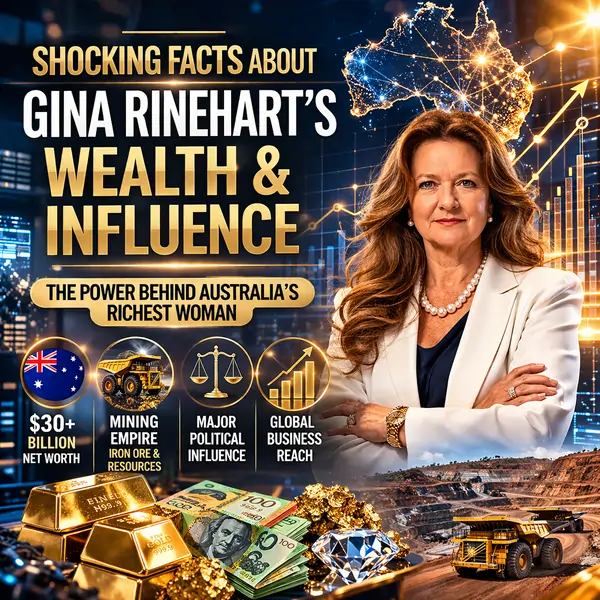
Gina Rinehart is not just Australia’s richest citizen – she is one of the most powerful private individuals in the global resources industry, with a level of influence that reaches from remote iron ore pits to boardrooms, media newsrooms, and even political debate.
For anyone trying to understand how wealth translates into real-world power, Gina Rinehart’s story is a rare, almost textbook case study.
In this deep dive, you’ll discover 10 shocking facts about Gina Rinehart’s net worth, her diversified empire, and the ways she has shaped business, politics, and media in Australia – plus what her dominance means for the future of resources, climate policy, and economic power.
Who Is Gina Rinehart?
Gina Rinehart (Georgina Hope Rinehart) is an Australian mining magnate and the executive chairman of Hancock Prospecting, the private company built on the iron ore discoveries of her father, Lang Hancock.
After taking control of Hancock Prospecting in the early 1990s, she drove a massive expansion in iron ore projects that transformed the business into Australia’s largest private mining company.
Today, Gina Rinehart is consistently ranked as Australia’s wealthiest person and occupies a prominent spot on the global billionaire lists, with a fortune measured in tens of billions of US dollars.
Her power extends far beyond mining, thanks to her stakes in agriculture, critical minerals, media, and active involvement in political and policy debates.
Fact 1: Australia’s Richest Citizen – By a Wide Margin
As of 2026, Gina Rinehart holds the title of Australia’s richest citizen, with an estimated net worth that places her firmly at the top of the national rich lists.
A 2026 report on Australia’s wealthiest individuals ranks Gina Rinehart number one with a fortune of around 38 billion Australian dollars, despite recent volatility in iron ore prices.
Forbes’ 2026 ranking of Australia’s 50 richest people similarly shows Rinehart maintaining the top spot, even though her net worth fell to about 24.6 billion US dollars due to declining iron ore prices and regulatory pressures.
In other words, even a double-digit percentage drop in her fortune was not enough to push her off the number-one position.
Snapshot of Gina Rinehart’s Recent Wealth Rankings
| Year | Source | Estimated Net Worth | Rank in Australia |
|---|---|---|---|
| 2023 | Financial Review Rich List | > A$37 billion | 1st |
| 2024 | Forbes | US$30.8 billion | Wealthiest Australian |
| 2026 | Forbes | US$24.6 billion | 1st |
| 2026 | Esquire Australia | A$38.11 billion | 1st |
These figures highlight how concentrated Australian wealth is around a small number of resource magnates – and how dominant Gina Rinehart is within that elite group.
Fact 2: A Fortune That Once Rivalled the World’s Richest
Gina Rinehart’s current wealth is enormous, but one of the most shocking moments in her financial story came in the early 2010s, when she briefly approached the level of the world’s richest individuals.
In 2012, the Australian business magazine BRW estimated her fortune at about 29 billion Australian dollars and described her as the world’s richest woman, surpassing American Walmart heiress Christy Walton.
Analysts at Citigroup even suggested at the time that, if iron ore prices and project valuations continued to rise, Rinehart’s assets could eventually exceed 100 billion US dollars.
Although that projection never materialised, it illustrates how leveraged her wealth is to commodity prices and major project valuations.
Her net worth has fluctuated significantly, rising with iron ore booms and falling when prices soften or projects face delays, but she has remained near the top tier of global billionaires.
Fact 3: Her Wealth Is Built on One Giant Iron Ore Bet
Gina Rinehart’s fortune is overwhelmingly linked to iron ore, especially the development of the Roy Hill mine and other iron ore assets in Western Australia.
Hancock Prospecting’s big breakthrough came when Rinehart aggressively pursued the Roy Hill project, securing financing and partners for a multi-billion-dollar mine, rail, and port operation.
Roy Hill is a massive single-pit iron ore mine in the Pilbara region, and its success turned Hancock Prospecting from a company with valuable tenements into a high-cash-flow mining powerhouse.
The project’s value was a major driver of estimates that pushed her wealth into the tens of billions of dollars around 2012 and beyond.
Because the company is privately owned, Hancock Prospecting’s financials are not fully public, but estimates from rich lists and industry reports consistently tie Rinehart’s net worth to iron ore output and prices.
Fact 4: She Turned a Struggling Family Company into a Resource Giant
When Gina Rinehart took over Hancock Prospecting after her father’s death in 1992, the company was far from being the iron ore juggernaut it is today.
Lang Hancock had discovered massive iron ore deposits decades earlier, but the business was still heavily dependent on royalties and joint venture agreements rather than standalone mega-projects.
Over the following decades, Rinehart renegotiated agreements, asserted control over key assets, and spearheaded new projects that transformed Hancock Prospecting into Australia’s largest private mining company.
This included pushing ahead with Roy Hill, expanding other iron ore interests, and building a sophisticated corporate structure capable of handling multi-billion-dollar deals.
Her trajectory from heir to empire-builder is often cited as a case study in how succession combined with aggressive expansion can multiply inherited wealth.
Fact 5: From Iron Ore to Lithium and Rare Earths
Another shocking – and strategically important – aspect of Gina Rinehart’s wealth is how aggressively she has pivoted into critical minerals like lithium and rare earths.
Through Hancock Prospecting, Rinehart has taken major positions in companies involved in lithium, rare earth elements, copper, potash, and natural gas, positioning herself in the global energy transition supply chain.
For example, she has invested in Australian lithium developers such as Azure Minerals and Liontown Resources, as well as taking a substantial stake in MP Materials, a major US-based rare earths producer.
By 2025, she was described as a “formidable force” in global mining due to the breadth of these strategic investments across future-facing commodities.
These moves mean Gina Rinehart’s influence is no longer confined to traditional fossil-fuel-linked iron ore exports, but now extends into minerals that are critical for electric vehicles, batteries, and clean energy technologies.
Fact 6: A Cattle and Land Empire Measured in Millions of Hectares
Beyond mining, Gina Rinehart has quietly built one of Australia’s largest private agricultural and landholding empires.
Through Hancock Prospecting and associated entities, she has acquired extensive cattle stations and pastoral land across multiple Australian states and territories.
One of the most high-profile deals was the purchase of S. Kidman & Co, an iconic pastoral company with nearly 4 million hectares of land, in a 386.5 million Australian dollar transaction alongside Chinese partner Shanghai CRED.
That acquisition more than doubled the number of cattle stations associated with Hancock Prospecting, from around 10 to 21, effectively giving Rinehart a presence across millions of hectares.
She later sold off about 2.4 million hectares for roughly 200 million dollars, highlighting a highly active buy-and-sell strategy in agricultural real estate rather than pure buy-and-hold.
Estimates suggest that her real estate holdings, counting both luxury mansions and agricultural properties, total well over half a billion dollars in value.
Fact 7: Media Stakes and Attempts to Shape Public Debate
Another shocking element of Gina Rinehart’s influence is her willingness to buy into media companies, a move that raised concerns about the concentration of media ownership and potential editorial influence.
In the 2010s, Rinehart took sizeable stakes in major Australian media businesses, including Ten Network Holdings and publisher Fairfax Media.
Her attempt to increase her influence at Fairfax, the publisher of The Sydney Morning Herald and The Age, sparked a national debate about whether a mining magnate with strong political views should have a major say in the direction of news outlets.
Although she ultimately sold her Fairfax stake in 2015, the episode illustrated how she is prepared to use capital to shape media narratives, particularly around topics like mining taxes and regulation.
This sits alongside her funding or support of various think tanks, campaigns, and advocacy efforts aligned with pro-business, low-tax, and resource-friendly policy positions.
Fact 8: Political Influence and Policy Advocacy
Gina Rinehart is known not just as a business figure, but as a vocal advocate for specific public policies, especially those relating to taxation, regulation, and labor.
She has spoken out repeatedly against higher mining taxes and regulatory burdens, arguing that they threaten investment, jobs, and Australia’s competitiveness.
Her speeches and public commentary often call for lower taxes, reduced government spending, and industrial relations reforms, and she has been associated with campaigns against resource taxes and certain climate-related regulations.
Because of her financial resources and the economic importance of her projects, these positions tend to carry more weight than those of an average business owner.
Analysts and journalists frequently point to Rinehart as an example of how ultra-wealthy individuals can influence the political agenda, not only through direct political donations but also via media, advertising, and industry lobbying.
For detailed background on Australia’s tax and mining policy debates, you can refer to resources from the Australian Parliament and the Australian Taxation Office, which explain how resource taxation works and why it is so contentious:
Fact 9: Legal Battles, Family Feuds, and Control of the Fortune
Gina Rinehart’s wealth and family relationships have been the subject of intense legal and public scrutiny.
Several of her children have been involved in legal disputes with her over the management of family trusts and the timing of their access to assets tied to Hancock Prospecting.
These disputes have raised questions about succession, governance, and how control over vast private wealth is exercised and transferred across generations.
While many details of settlements and arrangements remain confidential, the repeated litigation underscores the immense stakes involved in controlling the Rinehart fortune.
Case studies and legal analyses of these disputes are often used in law and business schools to illustrate the complexities of family trusts and governance in ultra-wealthy families.
Fact 10: Criticism, Controversy, and the Cost of Her Wealth
Gina Rinehart’s rise has attracted strong criticism alongside admiration, especially from environmental groups, unions, and social justice advocates.
Critics argue that her business model relies heavily on carbon-intensive industries, that her positions on climate policy and regulation conflict with environmental goals, and that her political interventions tilt debate in favour of resource corporations.
At various points, she has been accused of downplaying the social and environmental costs of large-scale mining and pastoral operations, although she argues that her projects create jobs and fund public services through taxes and royalties.
This tension between economic development and environmental and social impacts is at the heart of many public debates about her influence.
From a broader perspective, Gina Rinehart’s story is often cited in academic and policy discussions about wealth inequality, resource governance, and the role of billionaire influence in democracies.
Pro Tips: What Gina Rinehart’s Story Teaches About Power and Money
Gina Rinehart’s career offers several powerful lessons for anyone studying wealth, business strategy, or political influence.
1. Commodity Cycles Can Make or Break Fortunes
Her net worth has risen and fallen dramatically with iron ore prices, showing how exposed resource-based fortunes are to global demand and market cycles.
2. Concentration of Ownership Equals Concentration of Power
Because Hancock Prospecting is privately held and tightly controlled, decisions about massive investments and political advocacy come from a very small group centered around Rinehart herself.
3. Diversification Extends Influence
By moving into lithium, rare earths, and pastoral land, Rinehart has diversified not just her portfolio but her influence in sectors linked to both old and new economies.
4. Media and Policy Engagement Multiply Impact
Her media investments and public advocacy illustrate how ultra-wealthy individuals can shape narratives and policy debates far beyond their home industries.
5. Governance and Succession Matter as Much as Growth
The legal disputes around family trusts highlight that building a fortune is one challenge; preserving and fairly managing it across generations is another.
For readers interested in deeper analysis of economic power, wealth concentration, and policy influence, academic resources from universities and public policy institutes can provide further context and case studies.
Good starting points include open-access research from major universities such as the University of Melbourne and Australian National University, which often publish work on mining, inequality, and political economy.
FAQs About Gina Rinehart
Who is Gina Rinehart?
Gina Rinehart is an Australian mining magnate and executive chairman of Hancock Prospecting, best known for building a vast iron ore and agricultural empire.
How did Gina Rinehart make her money?
She inherited control of Hancock Prospecting from her father, Lang Hancock, and then massively expanded the company’s iron ore operations and other investments, particularly the Roy Hill mine in Western Australia.
What is Gina Rinehart’s net worth?
Estimates vary by year and source, but recent rich lists put her fortune in the range of 24–31 billion US dollars and over 38 billion Australian dollars, keeping her at the top of Australia’s rich lists.
Is Gina Rinehart the richest person in Australia?
Yes, Gina Rinehart has consistently been ranked as Australia’s richest person in recent years by sources such as Forbes, the Australian Financial Review, and other rich lists.
What companies does Gina Rinehart control?
She controls Hancock Prospecting, a private company with major interests in iron ore (including Roy Hill), as well as stakes in agricultural businesses and various mining and energy investments.
What is Hancock Prospecting?
Hancock Prospecting is the mining and investment vehicle founded by Lang Hancock and later developed by Gina Rinehart into Australia’s largest private mining company.
Does Gina Rinehart invest in lithium and rare earths?
Yes, she has invested in lithium producers such as Azure Minerals and Liontown Resources, and holds a significant stake in US-based rare earths company MP Materials, among other critical mineral ventures.
How much land does Gina Rinehart own?
Through pastoral companies and partnerships, she has controlled millions of hectares of land across Australia, including the acquisition of S. Kidman & Co, which alone held nearly 4 million hectares before partial sell-downs.
Does Gina Rinehart own cattle stations?
Yes, she is one of Australia’s largest private cattle producers, with multiple cattle stations across several states and territories.
Has Gina Rinehart invested in media?
She has previously held significant stakes in media companies such as Ten Network Holdings and Fairfax Media, although she later divested her Fairfax interest.
Why is Gina Rinehart controversial?
She is controversial due to her positions on taxation, climate and environmental policy, labor issues, her media investments, and the enormous concentration of wealth and influence she represents.
What are Gina Rinehart’s political views?
Rinehart advocates for lower taxes, reduced regulation, and pro-business policies, particularly opposing higher mining taxes and certain regulatory measures she argues harm investment and jobs.
Has Gina Rinehart been involved in legal disputes?
Yes, she has been involved in high-profile legal disputes with some of her children over the management of family trusts and control of assets linked to Hancock Prospecting.
What impact does Gina Rinehart have on Australia’s economy?
Her mining and agricultural operations contribute significantly to exports, employment, and regional economic activity, particularly through iron ore production and associated infrastructure.
How does Gina Rinehart influence public policy?
She influences policy through public advocacy, funding of campaigns and organisations that support her positions, and, historically, through media investments that amplified pro-business viewpoints.
Is Gina Rinehart involved in philanthropy?
Public reports describe her support for various causes, but details of her philanthropic giving are less prominent than her business and political activities, partly because much of her empire is privately held.
How has Gina Rinehart’s wealth changed over time?
Her wealth has grown dramatically since the early 2000s, with notable peaks during iron ore booms and fluctuations driven by commodity prices, project valuations, and currency movements.
Where can I learn more about Gina Rinehart?
Authoritative background information can be found in detailed biographies and profiles, including those published by business reference sites and encyclopedias, as well as major news outlets.
Conclusion: Why Gina Rinehart’s Power Still Matters
Gina Rinehart is more than just a headline net-worth figure: she is a case study in how resource discoveries, aggressive business expansion, and strategic diversification can create private empires that rival the economic power of small countries.
Her influence spans iron ore, critical minerals, agriculture, media, and politics, shaping debates about climate policy, taxation, and the future of Australia’s resource-dependent economy.
As the world transitions toward cleaner energy and new geopolitical rivalries over critical minerals, Gina Rinehart’s investments in lithium and rare earths suggest her influence is likely to remain significant – and perhaps even grow in strategic importance.
Understanding how she built and wields her wealth gives you a clearer window into the broader forces reshaping both Australia and the global economy.
If you’re interested in how major infrastructure and transport disruptions can also affect Australia’s business landscape and travel plans, you can explore the latest coverage on Sydney Airport flights cancelled, delays, causes and live updates here: Sydney Airport Flights Cancelled: Delays, Causes and Latest Updates.