

If you are asking yourself when should you outsource your accounting, this guide walks through the clearest warning signs that it is time to bring in professional help. You will see how missed deadlines, messy books, growth pressure, and constant money stress point to the need for outsourced support instead of DIY spreadsheets.
This guide also explains how a startup‑focused firm like Accountalent can step in as your remote finance team, and links to deeper resources on outsourced accounting, how to choose the right provider, and the signs your business needs an accountant.
What Does When Should You Outsource Your Accounting Really Mean?
The real question behind “when should you outsource your accounting” is simple: at what point does doing it yourself (or keeping everything in‑house) cost more than it saves. In the early days, it is common for founders or office managers to handle bookkeeping and basic reporting on their own.
As the business grows, the number of transactions, tax rules, and compliance tasks grows too—until finances start slowing you down instead of supporting you. Recognizing that turning point early helps you avoid penalties, bad decisions, and expensive clean‑up projects later.
If you want a broader look at what outsourced support actually includes, you can start here: Outsourced Accounting Services in California (Complete 2026 Guide)
Sign 1: Your Books Are Always Behind
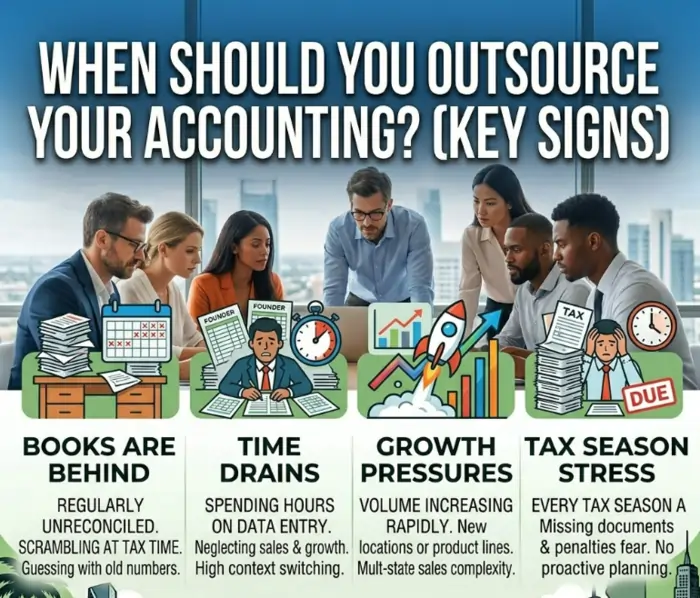
One of the clearest signs that it is time to outsource is when your books are never fully up to date. If you regularly put off reconciliations, leave invoices unrecorded, or scramble at tax time to find receipts, your current system is not working.
Late books mean late reports—and that means you are making decisions based on guesses instead of real numbers.
An outsourced accounting partner can:
- Keep your books current on a monthly or even weekly schedule
- Reconcile accounts so your balances actually match your bank
- Prepare standard reports so you can see how the business is performing
If this sounds familiar, you might also relate to the patterns described in: 7 Signs Your Business Needs an Accountant
Sign 2: You Spend Too Much Time on Accounting Tasks
When should you outsource your accounting instead of doing it yourself? A strong indicator is when you, as the owner or leader, are spending hours every week on bookkeeping, invoices, and basic financial admin.
Every hour you spend fixing spreadsheets or chasing receipts is an hour you are not spending on sales, product, or customer relationships.
Outsourcing allows you to:
- Hand off routine tasks like reconciliation and data entry
- Focus on higher‑value activities that grow the business
- Reduce context switching between finance and your core role
If your calendar is packed and finances are stealing your focus, outsourcing can give you that time back.
Sign 3: You Are Not Confident in Your Numbers
If you do not fully trust your own reports, it is time to reconsider who handles your accounting. Common red flags include:
- Numbers that never seem to match between systems
- Reports that are hard to interpret or obviously inconsistent
- Surprises at tax time that suggest something was missed
Accurate numbers are essential for pricing, hiring, inventory, and cash‑flow decisions. Outsourced accounting firms are built around process and review, which dramatically improves reliability.
Sign 4: Tax Season Is Stressful Every Single Year
When should you outsource your accounting to reduce tax stress? If every tax season feels like a crisis—missing documents, last‑minute scrambling, and fear of penalties—it is a clear sign that your approach needs an upgrade.
An outsourced partner can:
- Keep your books ready for tax all year long
- Coordinate with your tax preparer or handle tax directly
- Help you plan ahead for liabilities instead of reacting late
Over time, you move from “We hope this is right” to “We already know where we stand.”
Sign 5: Your Business Is Growing or Becoming More Complex
Growth is good—but it makes accounting harder. New locations, more employees, additional product lines, and multi‑state sales all add complexity to your books.
You should consider outsourcing when:
- Your transaction volume has increased significantly
- You are selling in multiple states or through several channels
- You are planning to raise money or approach lenders
At this point, you need reliable monthly financial statements and guidance, not just basic bookkeeping.
If you are also deciding which kind of outsourced partner to choose, this guide helps: How to Choose an Outsourced Accounting Service in California
Sign 6: You Are Seeing More Mistakes and Corrections
Frequent mistakes—duplicate entries, misclassified expenses, missing invoices—are a sign that your current setup is stretched beyond its limits. Small errors add up: they distort your financial picture and can lead to mispriced jobs, incorrect margins, or under‑reported income.
Outsourced accounting firms use checklists, review processes, and software tools to reduce these mistakes.
The goal is not perfection overnight, but a system that becomes more accurate and dependable every month.
Sign 7: You Do Not Have a Clear View of Cash Flow
Cash flow is what keeps your business alive day to day. If you are unsure how much you can safely spend, when to invest, or whether you can afford a new hire, your accounting system is not giving you what you need.
A good outsourced partner will:
- Track cash coming in and going out
- Help you understand timing differences between profit and cash
- Provide reports that show upcoming obligations and expected receipts
When you can see cash clearly, decisions feel less risky and more intentional.
How Accountalent Fits Into the Picture
Accountalent is an example of an outsourced accounting firm built specifically for startups and growing small businesses. Instead of patching together a part‑time bookkeeper and occasional tax help, you can work with one team that understands fast‑moving companies and modern accounting tools.
With Accountalent, you can:
- Hand off bookkeeping so your books stay accurate and up to date
- Get startup‑savvy tax preparation and planning
- Access clear monthly financials without building an in‑house team
- Scale your support over time as your business grows
If you recognize several of the signs in this guide, working with a provider like Accountalent can be the practical next step.
When Should You Outsource vs Hire In‑House?
There is a second question behind “when should you outsource your accounting”: should you hire an internal accountant instead. In most small and mid‑sized businesses, outsourced accounting is the first upgrade after DIY because it is more affordable and easier to scale.
An in‑house hire usually makes sense later, when internal processes, volume, and coordination needs justify a full‑time role.
Until that point, outsourcing gives you:
- Access to multiple people and skill sets in one engagement
- Less risk if someone leaves or gets sick
- A more predictable monthly or annual cost structure
If you want a more detailed comparison of models, a full outsourced‑services guide is helpful: Outsourced Accounting Services in California (Complete 2026 Guide)
Final Take: Listening to the Signs
The answer to “when should you outsource your accounting” is rarely one single moment. Instead, it is a combination of signals: late books, constant stress, growth, and a nagging sense that your numbers are not as strong as your ambition.
When several of those signs show up at the same time, it is usually cheaper—and safer—to bring in an outsourced partner than to keep struggling alone. For many founders and small‑business owners, a provider like Accountalent offers a practical way to move from reactive, DIY accounting to a more professional, proactive financial system.
FAQs
1. What is the clearest sign that it is time to outsource accounting?
A major sign is when your books are consistently behind and you cannot get accurate, up‑to‑date financial reports without a lot of manual effort.
2. How does growth affect when you should outsource your accounting?
Growth increases transaction volume and complexity, making it harder for non‑specialists to keep books accurate and timely.
3. Is it okay to wait until tax season to outsource?
Waiting until tax season often leads to rushed clean‑up work and higher costs; outsourcing earlier keeps you prepared year‑round.
4. Should a startup outsource accounting from day one?
Many startups benefit from outsourcing early, especially if the founders lack accounting experience and want investor‑ready numbers.
5. What if I only have a small number of transactions?
You may be able to manage internally at first, but once bookkeeping starts feeling like a burden, outsourcing is worth considering.
6. Can messy books be fixed before outsourcing?
Yes. Many outsourced firms offer clean‑up and catch‑up services to organize your books before moving into ongoing support.
7. How do I know if errors in my books are serious?
Frequent corrections, unexplained balances, or mismatches between bank statements and reports indicate issues that should be addressed.
8. Does outsourcing mean I lose control over my finances?
No. You still make decisions and approve key actions; outsourcing simply means professionals handle the day‑to‑day work.
9. When is it better to hire in‑house instead of outsourcing?
Hiring in‑house makes more sense when your company is large enough that you need someone on site daily for internal coordination.
10. Can an outsourced accounting firm work with my existing CPA?
Yes. Many firms collaborate with your CPA, handling books and monthly reports while the CPA focuses on specialized tax matters.
11. How does outsourced accounting reduce tax‑season stress?
By keeping books clean all year, outsourced teams ensure your data is ready for tax filing long before deadlines.
12. What role does cash‑flow visibility play in deciding to outsource?
If you do not understand your cash position, outsourcing can help by providing regular reports and better forecasting.
13. How do I choose the right outsourced accounting service after deciding to outsource?
You can follow a structured selection process like the one in: How to Choose an Outsourced Accounting Service in California
14. Are there signs that I waited too long to outsource?
Signs include repeated penalties, emergency tax fixes, and difficulty explaining your numbers to lenders or investors.
15. Does outsourcing help if I already use accounting software?
Yes. Software is just a tool; outsourcing brings the expertise needed to use that tool correctly and consistently.
16. How quickly can an outsourced accounting firm start helping?
Timelines vary, but many providers can begin with onboarding and clean‑up within weeks, then move into regular monthly cycles.
17. What should I prepare before talking to an outsourced firm?
Basic financial records, bank statements, tax returns, and any existing reports will help them understand your situation.
18. Will outsourcing help me if I plan to raise investment?
Yes. Clean, reliable financials are crucial for investor conversations, due diligence, and ongoing reporting.
19. What if I am unsure whether my situation justifies outsourcing?
If you see several signs from this guide, reviewing: 7 Signs Your Business Needs an Accountant can help clarify.
20. Where can I find a startup‑friendly outsourced accounting provider?
You can evaluate firms like Accountalent, which focuses on outsourced accounting and tax services for startups and small‑business owners.