

Competitive advantage is the edge that allows a business to win more customers, charge better prices, or earn higher profits than its rivals. It’s the reason some companies consistently outperform others in the same market, even when they sell similar products or services.
In this comprehensive guide, you’ll learn what competitive advantage is, the main types and sources, how to identify your own edge, and how to build and sustain it over time. Along the way, you’ll find helpful internal resources and authoritative external links so readers can dive deeper into specific topics.
What Is Competitive Advantage?
In business, a competitive advantage is anything that gives a company an edge over its competitors by helping it attract more customers and grow its market share. It could come from lower costs, superior quality, a better customer experience, a stronger brand, or more innovative products and services.
A simple way to put it: if customers repeatedly choose you over other options—and you can serve them profitably—you likely have a competitive advantage. For a deeper, technical explanation, you can refer to this detailed definition of competitive advantage.
If you’re launching something new, frameworks like the lean startup model help you test ideas quickly so you can discover and refine your true competitive edge before burning too much time and capital.
Competitive Advantage vs. Parity vs. Disadvantage
Understanding competitive advantage is easier when you compare it to two other states.
- Competitive parity
You’re similar to your competitors on key dimensions like price, quality, and features, so customers see you as interchangeable. You can survive, but there’s no compelling reason for buyers to pick you. - Competitive disadvantage
You’re clearly worse on things that matter—maybe higher prices, lower quality, or weaker service—so you lose deals or must discount heavily to stay in the game. - Competitive advantage
You create more value at the same cost, similar value at a lower cost, or much higher perceived value that justifies a premium price. This is where strong, enduring businesses live.
For founders, especially those operating in resource‑constrained environments or pursuing low cost business ideas, getting clear on which of these three states you’re in is critical.
Key Types of Competitive Advantage
One of the most influential frameworks for thinking about how companies compete is Michael Porter’s generic competitive strategies. According to Porter, firms can win using three main strategy types: cost leadership, differentiation, and focus.
If you’d like a visual breakdown, you can explore a concise guide to Porter’s competitive strategies.
Cost Leadership: Winning on Cost
Cost leadership means becoming the lowest‑cost producer in your industry while still maintaining acceptable quality. This doesn’t always mean being “cheap,” but your cost structure is so efficient that you can profitably charge prices rivals struggle to match.
Common drivers of cost leadership include:
- Economies of scale and bulk purchasing.
- Streamlined processes and automation.
- Tight control of overhead and operating expenses.
- Efficient logistics and supply chain management.
Large retailers and discount airlines are classic examples, but small firms can also build a cost edge by staying lean and choosing efficient low cost business ideas that don’t require heavy capital.
For more on how price and competition interact, you can look at this overview of competitive pricing strategy.
Differentiation: Winning on Uniqueness
Differentiation focuses on being meaningfully different in ways customers value. Instead of being the cheapest, you offer something distinctive that makes your product or service more desirable.
You might differentiate on:
- Superior features or performance.
- Higher quality or reliability.
- Exceptional customer service.
- Design, branding, or emotional appeal.
- A mission or set of values (e.g., sustainability).
When differentiation works, it boosts brand loyalty and allows you to charge higher prices without losing customers. You can learn more about how product differentiation supports loyalty and competitive advantage here: how product differentiation boosts brand loyalty.
Focus / Niche Strategies
A focus strategy means concentrating on a narrow segment and serving it better than anyone else. Rather than trying to win the entire market, you carve out a niche where your understanding and execution are unmatched.
Within focus strategies you can pursue:
- Cost focus – Be the lowest‑cost provider in a specific segment.
- Differentiation focus – Offer a specialized, premium solution tailored to a clearly defined group.
For many new founders, especially those with the right entrepreneur traits, focus is the most realistic way to build an advantage fast. You can go much deeper into Porter’s framework in this article on Porter’s generic strategies.
Core Sources of Competitive Advantage
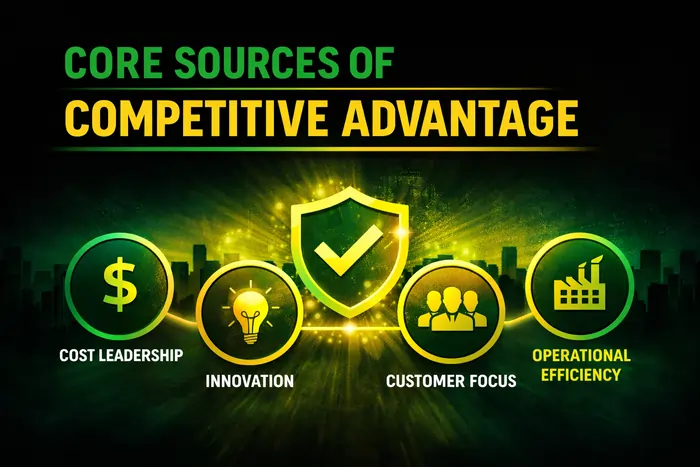
The strategy types above describe how you compete; now we’ll look at the underlying sources that fuel your advantage. Knowing these helps you decide what to build, protect, and invest in.
Resources and Capabilities
Your resources and capabilities are the internal building blocks of your edge. These include:
- Human capital (skills, expertise, leadership, culture).
- Physical assets (equipment, locations, infrastructure).
- Intangible assets (brand, IP, data, relationships).
- Organizational capabilities (innovation, execution, adaptability).
A sustainable competitive advantage often comes from resources that are valuable, rare, hard to imitate, and supported by your organization. For a modern, practical overview, see this Coursera article on what competitive advantage is and how to find yours.
Brand, Loyalty, and Reputation
Your brand is what customers think and feel when they encounter your business, while reputation and loyalty are the results of delivering consistently on your promises. A strong brand can:
- Justify premium pricing.
- Increase conversion rates.
- Reduce churn and boost referrals.
- Attract better partners and talent.
These “soft” assets form a powerful moat around your business, especially in crowded markets where features are easy to copy. If you’re curious about how investors think about such moats, see this explanation of economic moat and competitive advantage.
Economies of Scale and Operational Efficiency
Economies of scale occur when your average cost per unit falls as you increase production volume. Paired with operational efficiency—doing more with less waste—this becomes a powerful source of cost advantage.
You achieve this through:
- Bulk purchasing and supplier relationships.
- Standardized processes and automation.
- Efficient logistics and inventory management.
- Smart use of technology in operations.
Even small businesses can build operational advantages by designing lean processes from day one, especially when aligned with low cost business ideas and disciplined financial management.
Innovation and Technology
Innovation and technology drive competitive advantage by enabling new value for customers or new ways to deliver existing value more efficiently. Examples include:
- New features that solve previously unmet needs.
- New business models (subscription, platforms, marketplaces).
- Data‑driven personalization and smarter decision‑making.
- Automation that cuts costs and improves consistency.
In fast‑moving markets, a culture of experimentation and learning—key components also emphasized in lean startup model thinking—can itself become a core competitive capability.
How to Identify Your Competitive Advantage
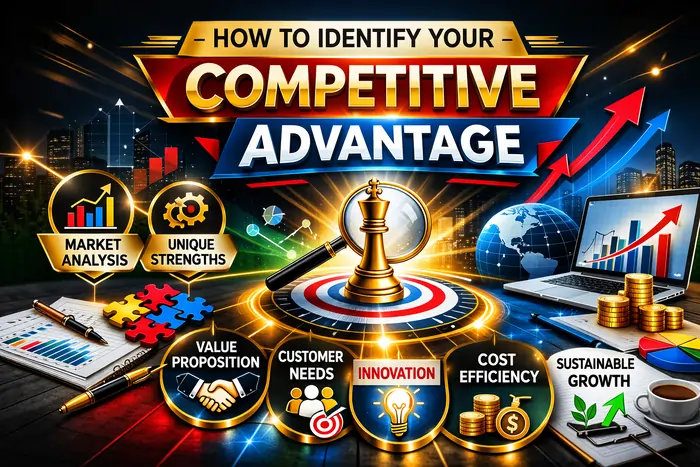
Many founders assume they know what their advantage is, but struggle to articulate it or prove it. A more systematic process helps you move from guesswork to clarity.
Analyze Your Market and Competitors
Start with a structured look at your competitive landscape:
- List your top 3–5 direct competitors.
- Compare prices, features, positioning, and target segments.
- Study reviews, testimonials, and social media to see what customers like or dislike.
- Identify patterns: where are competitors weak, generic, or slow to react?
This scan shows the baseline customers have come to expect and reveals where there may be room to stand out. For a step‑by‑step approach, you can consult this guide on discovering and strengthening your company’s competitive advantage.
Use Strategy Tools: SWOT and Value Chain
Two widely used tools can clarify where your strengths really lie:
- SWOT analysis
SWOT (Strengths, Weaknesses, Opportunities, Threats) helps you see the big picture of your strategic position.- Strengths and weaknesses are internal (capabilities, resources, brand).
- Opportunities and threats are external (market shifts, competition, regulation).
- Value chain analysis
Break your operations into activities (e.g., marketing, sales, logistics, service) and ask where you create more value or incur lower costs than competitors. Your edge likely lives in the activities where you’re both strong and where customers care deeply about the outcome.
Listen to What Customers Actually Pay For
Your customers often see your advantage more clearly than you do. Ask them:
- Why did you choose us instead of a competitor?
- What almost stopped you from buying?
- Which features or aspects do you value the most?
- What would you miss most if we disappeared?
Look for recurring themes in their answers. Those consistent themes—speed, support, reliability, simplicity—are strong clues to your real competitive advantage.
Here, the right entrepreneur traits—curiosity, humility, and willingness to adapt—become a crucial meta‑advantage in themselves.
Building a Sustainable Competitive Advantage
A one‑time advantage (like a temporary discount or trendy feature) is easy to copy. A sustainable competitive advantage is harder to imitate and lasts over time. It typically combines multiple reinforcing elements: strategy, capabilities, systems, and culture.
For a broader overview, you can read this article on what a sustainable competitive advantage is.
Align Strategy, Capabilities, and Positioning
To make your advantage durable, align three things:
- Strategy – How you choose to compete (cost leadership, differentiation, focus).
- Capabilities – What you’re genuinely good at (operations, design, service, technology).
- Positioning – How you articulate that value to the market (brand, messaging, niche).
For instance, if your strategy is premium differentiation based on service quality, you need:
- Hiring processes that select service‑minded people.
- Training and tools that enable fast, high‑quality support.
- Incentives that reward solving customer problems, not just closing tickets.
Without this alignment, your promised advantage is just marketing copy with no operational backbone.
Invest in Talent, Systems, and Culture
Long‑lasting advantage often rests on people, systems, and culture. That means:
- Building a team with complementary skills and a learning mindset.
- Documenting and improving processes so your edge is repeatable.
- Creating a culture that values experimentation, accountability, and customer focus.
Founders who work on developing strong entrepreneur traits—resilience, discipline, strategic thinking—are better equipped to build those systems and make them stick.
Protect Your Advantage
Once you’ve built something valuable, you should protect it as much as possible.
Common protection mechanisms include:
- Legal protections (patents, trademarks, copyrights) where applicable.
- Strong brands and communities that create emotional switching costs.
- Exclusive partnerships, distribution channels, or long‑term contracts.
- Proprietary data or algorithms that competitors can’t easily access.
This idea of protecting your edge is central to the concept of an economic moat, explored here in more detail: how an economic moat provides a competitive advantage.
Real‑World Examples of Competitive Advantage
Examples make these ideas tangible and help you see how they work in practice.
- A budget airline leans on cost leadership, using a single aircraft type, no‑frills service, and direct online bookings to keep costs minimal.
- A premium consumer‑electronics brand uses differentiation, combining sleek design, an integrated ecosystem, and powerful branding to justify higher prices.
- A niche SaaS platform focuses on a specific profession (e.g., designers, coaches), using focus differentiation to build specialized features and deep understanding of that segment’s workflows.
Many modern SaaS firms struggle to maintain a sustainable advantage in a fast‑moving environment, a challenge discussed in this article on competitive advantage in SaaS. For early‑stage companies, adopting the lean startup model helps test and validate such positioning quickly.
Common Mistakes Businesses Make
Knowing what to avoid is just as important as knowing what to pursue.
- Competing only on price
Price can be a lever, but without a structural cost advantage, undercutting rivals simply erodes your margins and weakens your long‑term position. - Mistaking features for advantages
Adding more features does not automatically create value. Only features that customers notice and are willing to pay for contribute to competitive advantage. - Ignoring market shifts
An advantage built around outdated customer needs or old technology can quickly become a liability if you fail to evolve. - Lack of focus
Trying to serve everyone often means you serve no one exceptionally well, making it hard to stand out or command healthy margins.
These mistakes eventually show up in your financials—especially in your profit and loss statement. If you want to connect strategy to numbers more clearly, see this internal profit and loss guide.
How to Maintain and Evolve Your Advantage
Even the strongest competitive advantage is not permanent. Markets, technology, and customer expectations constantly change, so you must treat your advantage as something to maintain and evolve, not a one‑time achievement.
Monitor Markets and Competitors
Build simple, repeatable habits for monitoring your environment:
- Track competitor offerings, pricing, and messaging.
- Watch for new entrants and substitute solutions.
- Follow industry news, regulatory changes, and technology trends.
- Collect ongoing customer feedback and analyze behavioral data.
These inputs act as an early‑warning system that tells you when your advantage is slipping or when new opportunities emerge.
Keep Innovating Around the Customer
A sustainable advantage is almost always rooted in customer‑centric innovation. To keep improving:
- Talk to customers regularly and observe how they actually use your product.
- Run experiments (A/B tests, pilots) to validate new ideas.
- Use data and analytics to identify friction points and high‑value opportunities.
- Revisit your value proposition at least once a year.
For practical advice on building and maintaining a durable edge, you can refer to this article on key elements of a successful sustainable competitive advantage strategy. Another accessible overview is this guide to sustainable competitive advantage and how to develop it.
Know When to Pivot Your Strategy
Sometimes the best way to preserve long‑term success is to change direction. Signals that you may need to pivot include:
- Customers caring less about the attribute you’ve built around (e.g., speed once everyone is fast).
- Competitors successfully copying your once‑unique advantage.
- Structural shifts (technology, regulation, behavior) that undermine your current model.
In those cases, you might reposition toward a narrower niche, move from price competition to value‑based differentiation, or redesign your business model. Keeping a close eye on your profit and loss helps you see when existing strategies no longer make financial sense.
By understanding what competitive advantage is, the main strategy types, the underlying sources, and how to identify, build, and sustain your edge, you equip your business to outperform in a crowded market. Smart use of internal resources like the lean startup model, low cost business ideas, entrepreneur traits, and your profit and loss guide—combined with authoritative external references—will turn this article into a high‑value, SEO‑friendly resource on “Competitive Advantage Explained.”