

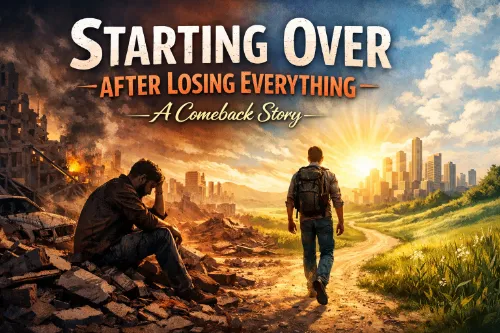
Starting over after losing everything is one of the most terrifying, disorienting experiences a person can go through—and yet, countless people have rebuilt from rock bottom into lives that are more grounded, meaningful, and free than what they had before. This article walks through that “comeback arc,” blending practical steps with real stories and psychology research, and includes external resources you can link naturally throughout your blog post.
When Life Collapses: Naming The Loss
Losing everything can mean different things: a financial collapse, a divorce, a failed business, illness, or a combination of crises that strip away your identity, security, and plans.
- In a personal story on Vocal Media, one writer describes how financial ruin, personal loss, and isolation left them feeling like everything that once gave them comfort and security had vanished—and that they no longer knew who they were.
- KeepThrifty shares how losing a home, money, and stability led to depression, anxiety, and even suicidal thoughts before any kind of rebuilding felt possible.
You can link to “How I Rebuilt My Life After Losing Everything” and KeepThrifty’s “How Losing Everything I Had Became A Blessing In My Life” as relatable, story‑driven anchors for readers who feel like they’re at rock bottom.
Step 1: Allow Yourself To Grieve (Before You “Get Over It”)
Every strong comeback starts with grief, not grind. If you skip mourning your losses, they leak out later as burnout, anger, or paralysis.
- In the Vocal Media story, the author’s first step wasn’t a new job or side hustle—it was allowing themselves to feel the weight of their loss: crying, acknowledging anger, and finally admitting, “I’ve lost so much.”
- Psychology Times notes that after trauma or loss, many people go through an adjustment process that can include disruption and pain, but research shows humans are often more resilient than they think.
When you talk about this stage, you can naturally reference “The Adjustment Process After Trauma And Loss: We Are More Resilient Than We Think” to reassure readers that intense emotions are normal—and not the end of their story.
Step 2: Understand Resilience (You Are More Capable Than You Think)
Resilience isn’t pretending you’re fine; it’s the capacity to adapt, bend, and slowly rebuild after something shatters your life.
- Psychology Today explains that resilience can be nurtured through cognitive‑behavioural tools that teach you to reframe negative thoughts, regulate emotions, and solve problems more effectively.
- An NCBI chapter on trauma notes that many people respond to severe stress with increased bonding, a redefined sense of purpose, revised priorities, and even post‑traumatic growth—positive change that emerges from struggle.
You can point readers to Psychology Today’s piece “When Everything Is Lost: The Role of Resilience in Recovery” and NCBI’s “Understanding the Impact of Trauma” chapter to underline that resilience is real, learnable, and more common than people assume.
Step 3: Start With Tiny Steps (When You Have No Energy)
When you’ve lost everything, “reinvent your life” feels impossible; “take one small step today” is manageable.
- The Vocal story emphasises that rebuilding didn’t happen overnight; it started with “small, sometimes barely noticeable steps” like allowing grief, practising gratitude for one tiny thing each day, and taking simple actions like updating a résumé or reaching out to contacts.
- Possibility Change’s article “5 Lessons I Learned After Losing Everything” highlights acceptance, questioning motives, pivoting when something isn’t working, and remembering that rebuilding “takes time.”
You can use these two pieces to show that meaningful comebacks are built on micro‑actions—short walks, one honest conversation, a single call to a potential employer—rather than dramatic overnight transformations.
Step 4: Stabilise Your Finances (Even If It’s Humbling)
If your “losing everything” includes money and debt, stabilising your finances becomes a core part of your comeback story.
Practical steps you can outline:
- Assess the damage honestly. List debts, expenses, and remaining assets; Coca‑Cola Credit Union notes that seeing everything laid out can actually reduce uncertainty and give you a foundation to move forward.
- Prioritise essentials. Focus on housing, food, utilities, and minimum debt obligations first; cut or pause non‑essential spending like dining out and subscriptions.
- Create a realistic budget and repayment plan. Both Coca‑Cola Credit Union and Advantage One Credit Union suggest prioritising high‑interest debts and looking for ways to temporarily increase income.
- Rebuild with a clean slate. An Economic Times wealth guide recommends selling assets you can’t sustain, avoiding new unpayable loans, and being willing to take “any job that will keep your mind off your situation and remind you that you have the task of rebuilding.”
You can link to:
- Economic Times – “How to recover after suffering irretrievable financial losses and rebuild your wealth”
- Coca‑Cola Credit Union – “How to Recover From a Financial Setback”
- Advantage One – “How to Recover From a Financial Setback”
- Banner Bank – “5 steps to help you recover from a financial setback”
These make excellent external anchors around “recovering from financial loss” and “rebuilding your wealth from scratch.”
Step 5: Rebuild Your Identity (Beyond Job Titles And Status)
Losing your job, business, or home can feel like losing yourself because so much of your identity was wrapped up in what you did or owned.
- The Vocal Media author shares that the hardest part of losing everything wasn’t the money; it was feeling like they no longer knew who they were.
- Psychology Times argues that post‑trauma adjustment isn’t only about “recovery” to an old normal; sometimes people redefine their values, priorities, and sense of self in a way that leaves them stronger and more grounded.
- The NCBI chapter notes that many trauma survivors report increased meaning, a clearer sense of purpose, and revised priorities, such as focusing more on relationships or mission‑driven work.
In your post, you can encourage readers to explore questions like “Who am I without my job or possessions?” and reference the NCBI chapter and Psychology Times article as evidence that identity can be rebuilt on deeper foundations.
Step 6: Ask For Help (And Let People Show Up)
Starting over after losing everything is incredibly hard to do alone. Accepting help can feel humbling, but it’s often a turning point in a comeback story.
- Economic Times suggests taking support, help, references, or subsidies from friends and family, joining support groups, and staying connected with people who want you to turn around—without obsessing over appearances or social approval.
- Banner Bank recommends seeking help from a financial counsellor or local banker who can help you build a realistic recovery plan and identify resources you might not know about.
- NCBI’s trauma chapter reports that resilient responses often include increased bonding with family and community, and greater charitable giving and volunteerism, as people find strength in connection.
You can naturally link to Banner Bank’s and Economic Times’ guides when you emphasise the importance of support and advice in rebuilding from financial and life setbacks.
Step 7: Harness Mindset Shifts (Without Toxic Positivity)
The people who rebuild don’t deny their pain, but they gradually shift from “This is the end” to “This might be the beginning of something different.”
- In his story on The Secret’s site, one writer describes how “losing everything gave me everything I wanted,” explaining that the collapse forced him to transform his life completely and align it with his real values.
- The Vocal Media author explains how daily gratitude—finding one small thing to appreciate each day—slowly shifted their outlook from scarcity to possibility as they rebuilt.
- Psychology Today notes that CBT‑style reframing (challenging catastrophic thoughts and focusing on what you can control) enhances resilience and helps people cope more effectively with adversity.
You can link to:
- The Secret – “Losing Everything Gave Me Everything”
- Psychology Today – “When Everything Is Lost: The Role of Resilience in Recovery”
These show how mindset work complements practical action in a comeback.
Step 8: Take Imperfect Action (And Expect Setbacks)
No comeback story is linear. You’ll make progress, get knocked back, doubt yourself, and keep going anyway.
- The Vocal story shares that the author updated their résumé, reached out to contacts, read personal development books, took freelance work, and kept moving—even on days they weren’t sure they’d make it.
- Possibility Change emphasises pivoting when something isn’t working and accepting that rebuilding takes time: “If it’s not working, pivot. You have to accept. It takes time.”
- An Inc. feature on “11 Inspiring People Who Lost It All and Came Back Stronger” showcases figures like Steve Jobs and others who were fired, bankrupt, or publicly humiliated—and then used those experiences as fuel for their eventual success.
Inc.’s article is a solid external link when you talk about real examples of starting over and coming back stronger.
Step 9: Write Your Own Comeback Story
Ultimately, “Starting Over After Losing Everything: A Comeback Story” is an invitation for your reader to see themselves as the protagonist in a narrative that’s still being written.
You can encourage them to:
- Name the low point honestly. Describe what they’ve lost and how it feels, like the authors on Vocal, KeepThrifty, and Possibility Change did.
- Identify the first tiny step. A phone call, a budget, a support group, an updated résumé.
- Ask who’s on their side. Friends, family, mentors, professionals, support communities.
- Define a new “why.” A sense of purpose that goes beyond what they used to own or do.
You could even reference the YouTube video “Starting Life Over After Losing Everything” as an extra resource for people who prefer listening/watching to reading.